Anker SOLIX C1000 Gen 2 Review: What the Specs Tell You
As an Amazon Associate I earn from qualifying purchases. Read our affiliate disclosure.
At a glance
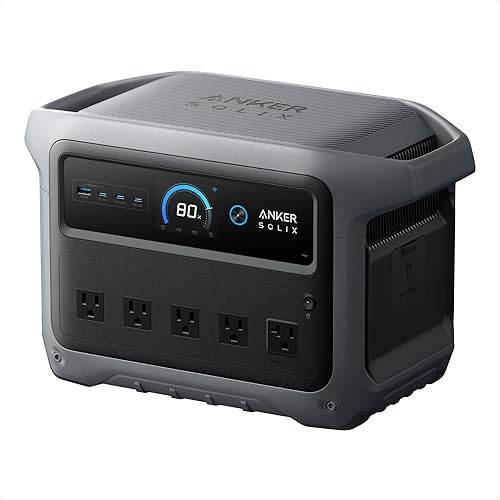 Best all-round 1 kWh optionAnker SOLIX C1000 Gen 2View on Amazon
The Anker SOLIX C1000 Gen 2 packs a lot of output into a portable box, with 2,000 W from a 24.9 lb station. Its main limit is that you can’t add batteries, so 1 kWh is all you’ll ever have.
We based this review on Anker’s published specs as of November 2026. We haven’t used the C1000 Gen 2 ourselves.
Anker SOLIX C1000 Gen 2 key specs
| Spec | Anker SOLIX C1000 Gen 2 |
|---|---|
| Capacity | 1,024 Wh |
| Battery rating | 80% capacity after 4,000 cycles |
| AC output | 2,000 W, 3,000 W peak |
| Solar input | 600 W, 60 V max |
| AC charge | 49 minutes with UltraFast charging |
| UPS switchover | Under 10 ms |
| Noise | 20 dB listed |
| Use and charge range | -4°F to 104°F, 32°F to 104°F |
| Size | 15.12 × 8.19 × 9.61 in |
| Weight | 24.9 lb |
Who is the Anker SOLIX C1000 Gen 2 for?
- Campers and apartment dwellers who want a station that’s easy to carry
- People running higher-power appliances for short periods
- Anyone using it in very cold weather
Skip it if you may need more than 1 kWh later, or want the most solar input for its size.
Anker SOLIX C1000 Gen 2 strengths
High output for its size: 2,000 W is the highest standard output of the 1 kWh models we compare.
Fast charging: Anker lists a full AC charge in 49 minutes, which helps if power only returns for a short time.
Cold rating: it’s rated for use down to -4°F, the lowest limit we could confirm.
Anker SOLIX C1000 Gen 2 weaknesses
No expansion: Anker says it has no expansion feature.
Solar input: 600 W is decent, but the EcoFlow DELTA 3 Plus takes 1,000 W into the same size of battery.
Capacity: heavy loads drain it quickly. A 1,500 W appliance would empty it in about 35 minutes.
Anker SOLIX C1000 Gen 2
- Capacity
- 1,024 Wh
- AC output
- 2,000 W
- Solar input
- 600 W
- Weight
- 24.9 lb
Who it's for: People who want about 1 kWh and 2,000 W in a portable box, and don't need to add batteries.
Strengths
- 49-minute full AC charge
- 2,000 W output, 3,000 W peak
- Rated to keep 80% capacity after 4,000 cycles
Weaknesses
- Not expandable
- Lower solar input than the DELTA 3 Plus
How long will the Anker SOLIX C1000 Gen 2 run?
We estimate usable energy at 85% efficiency, which turns 1,024 Wh into about 870 Wh.
| Load | Estimated runtime |
|---|---|
| 100 W | About 8.7 hours |
| 500 W | About 1.7 hours |
| 1,000 W | About 52 minutes |
How does the Anker SOLIX C1000 Gen 2 compare?
The table puts the C1000 Gen 2 beside the EcoFlow DELTA 3 Plus and Jackery Explorer 1000 v2, the nearest capacities we cover. It has the most AC output of the three. Capacity, output, and weight are published figures, and the last column is our own math: capacity divided by weight.
| Model | Capacity | AC output | Weight | Capacity per pound |
|---|---|---|---|---|
| Anker SOLIX C1000 Gen 2 | 1,024 Wh | 2,000 W | 24.9 lb | 41.1 Wh/lb |
| EcoFlow DELTA 3 Plus | 1,024 Wh | 1,800 W | 27.6 lb | 37.1 Wh/lb |
| Jackery Explorer 1000 v2 | 1,070 Wh | 1,500 W | 23.8 lb | 45.0 Wh/lb |
Live in an apartment? See our picks for the best battery generator for apartment living.
How to choose
Choose the C1000 Gen 2 if you want strong output in a compact box. If you want solar or expansion, compare it with the EcoFlow DELTA 3 Plus. If you need more capacity and don’t mind the weight, compare it with the Goal Zero Yeti 1500. You can also browse our C1000 Gen 2 alternatives.
FAQ
Can I add a battery to the C1000 Gen 2?
No. Anker says it doesn’t include an expansion feature.
Can I use it as a UPS?
Anker lists a switchover of under 10 ms. Test your own devices before you rely on it.
Can I charge it below freezing?
No. Anker lists a charging range of 32°F to 104°F, so bring it somewhere warmer first.