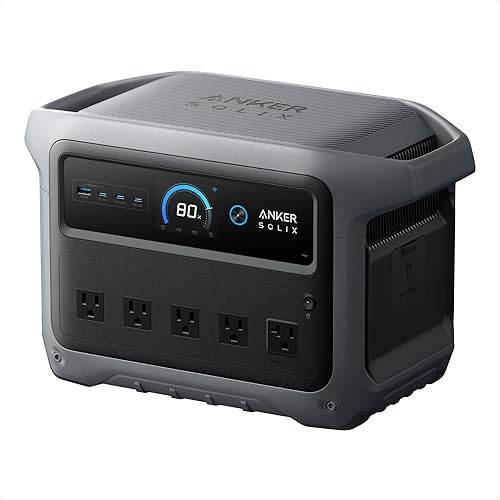
Best Lightweight Portable Power Station
As an Amazon Associate I earn from qualifying purchases. Read our affiliate disclosure.
Top picks at a glance
 Best balance of weight and capacityJackery Explorer 1000 v2View on Amazon
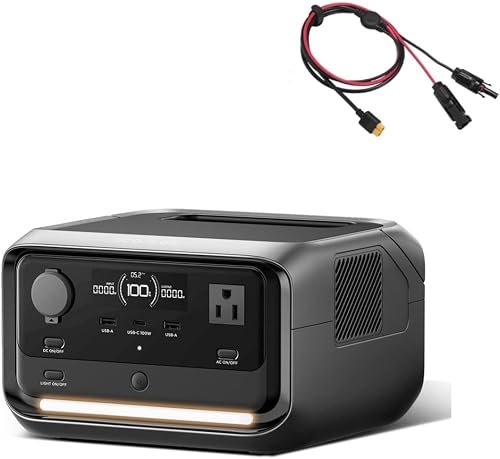 Lightest overallEcoFlow RIVER 3 PlusView on Amazon
 Best step up from a small stationGoal Zero Yeti 700View on Amazon
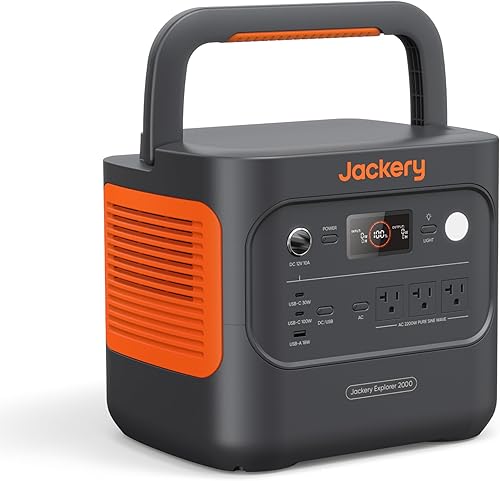 Most capacity per poundJackery Explorer 2000 v2View on Amazon
For most people, we’d pick the Jackery Explorer 1000 v2. It’s the lightest 1 kWh model we compare, at 23.8 lb. If you only need to charge small devices, the EcoFlow RIVER 3 Plus weighs less than half as much.
Weights here come from published specs we checked in November 2026. We haven’t tested these models or weighed them.
Quick comparison
A station’s total weight only tells you part of the story. Dividing capacity by weight shows how much energy you get for each pound you carry.
| Model | Weight | Capacity | Wh per lb |
|---|---|---|---|
| EcoFlow RIVER 3 Plus | 10.4 lb | 286 Wh | 27.5 |
| Goal Zero Yeti 700 | 20.3 lb | 677 Wh | 33.3 |
| Jackery Explorer 1000 v2 | 23.8 lb | 1,070 Wh | 45.0 |
| Anker SOLIX C1000 Gen 2 | 24.9 lb | 1,024 Wh | 41.1 |
| EcoFlow DELTA 3 Plus | 27.6 lb | 1,024 Wh | 37.1 |
| Jackery Explorer 2000 v2 | 39.5 lb | 2,042 Wh | 51.7 |
| BLUETTI Elite 200 V2 | 53.4 lb | 2,073.6 Wh | 38.8 |
How light do you really need?
Start with how you’ll move it:
- Carried by hand over a distance: stay near 10 lb, and accept a smaller battery.
- Carried from car to campsite: 20 to 30 lb is manageable for most adults, and gets you about 1 kWh.
- Moved around the house: around 40 lb is fine if you only lift it now and then.
Jackery Explorer 1000 v2: best balance of weight and capacity
It has the highest capacity of the 1 kWh group and the lowest weight. The trade-offs are a 1,500 W output, which is lower than the Anker’s 2,000 W, and a cycle rating listed as 4,000 cycles to 70% or more.
Jackery Explorer 1000 v2
- Capacity
- 1,070 Wh
- AC output
- 1,500 W
- Solar input
- 400 W
- Weight
- 23.8 lb
Who it's for: Campers who want about 1 kWh at a low weight and don't run appliances over 1,500 W.
Strengths
- Lightest 1 kWh model we compare
- LiFePO4 battery
- 3,000 W surge rating
Weaknesses
- Lower AC output than the Anker C1000 Gen 2
- Cycle rating is listed to 70% or more, not 80%
EcoFlow RIVER 3 Plus: lightest overall
At 10.4 lb, it’s the easiest model here to take anywhere. It has the lowest energy per pound, though, and 600 W limits what you can run. It suits phones, laptops, lights, and a Wi-Fi router. At a 50 W load, expect about 4.9 hours at 85% efficiency.
EcoFlow RIVER 3 Plus
- Capacity
- 286 Wh
- AC output
- 600 W
- AC charge
- 1 hour
- Weight
- 10.4 lb
Who it's for: People who mainly charge phones and laptops or keep Wi-Fi on, and want a station that's easy to carry.
Strengths
- Easy to carry at 10.4 lb
- Expandable to 858 Wh
- Listed at under 30 dB
Weaknesses
- Small capacity for high-power devices
- 600 W limits what you can run
Goal Zero Yeti 700: best step up from a small station
It holds more than twice as much as the RIVER 3 Plus and weighs 3.5 lb less than the Jackery Explorer 1000 v2. The trade-off is energy per pound, as the Jackery gives you much more capacity for a small weight increase. Output is 600 W, the same as the RIVER.
Goal Zero Yeti 700
- Capacity
- 677 Wh
- AC output
- 600 W
- Solar input
- 200 W
- Weight
- 20.3 lb
Who it's for: People who need more energy than a small station holds, but mostly run low-power devices.
Strengths
- Rated for use down to -4°F
- Fills the gap between small and 1 kWh stations
- Rated to keep 80% capacity after 4,000+ cycles
Weaknesses
- 600 W limits what you can run
- 200 W of solar input is low
Jackery Explorer 2000 v2: most capacity per pound
This is the best ratio of any station we compare. At 39.5 lb it’s still a two-handed lift, but it’s 13.9 lb lighter than the BLUETTI with nearly the same capacity. It isn’t expandable, so make sure 2 kWh is enough.
Jackery Explorer 2000 v2
- Capacity
- 2,042 Wh
- AC output
- 2,200 W
- Surge
- 4,400 W
- Weight
- 39.5 lb
Who it's for: Households that want about 2 kWh one person can move, with no plans to expand.
Strengths
- About 2 kWh at 39.5 lb
- 4,400 W surge rating
- LFP battery
Weaknesses
- Heavier to move than 1 kWh models
- Not expandable
Other things that affect portability
- Size: a compact shape can matter as much as weight in a packed car.
- Handles: check that you can carry it comfortably with one or two hands.
- Accessories: panels and cables add weight. A 200 W panel can add about 15 lb, based on the models in our solar panel comparison.
Not sure how much capacity you need? Follow our sizing guide.
How to choose
- Set a weight limit. Base it on how far you’ll carry the station.
- Compare energy per pound. The table shows which models give you more for the weight.
- Check the AC output. Lighter models can limit what you run, and the RIVER 3 Plus stops at 600 W.
- Add your accessories. Count the weight of panels and cables too.
FAQ
What’s the lightest model you compare?
The EcoFlow RIVER 3 Plus is the lightest station we compare, at 10.4 lb.
What’s the lightest 2 kWh model?
The Jackery Explorer 2000 v2, at 39.5 lb. The BLUETTI Elite 200 V2 has a similar capacity at 53.4 lb.
Is the lightest 1 kWh model the best one?
Not always. The Jackery Explorer 1000 v2 is lightest at 23.8 lb, but the Anker SOLIX C1000 Gen 2 has more output at 2,000 W for only 1.1 lb more.