Best Portable Power Station for Camping
As an Amazon Associate I earn from qualifying purchases. Read our affiliate disclosure.
Top picks at a glance
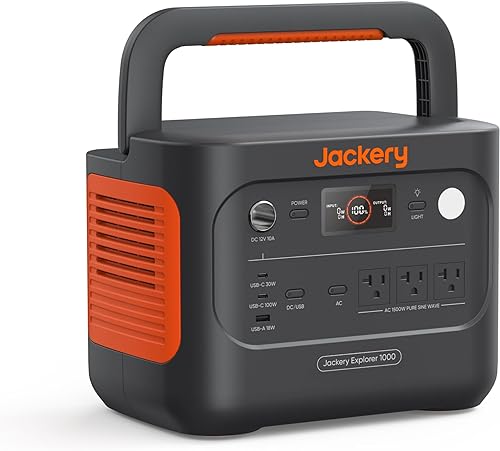 Best for most campersJackery Explorer 1000 v2View on Amazon
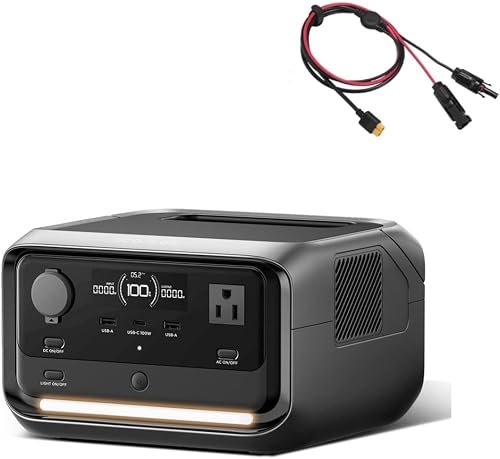 Best for light packingEcoFlow RIVER 3 PlusView on Amazon
 Best for camping with a fridgeBLUETTI Elite 200 V2View on Amazon
For most campers, we’d choose the Jackery Explorer 1000 v2. It’s among the lightest 1 kWh models we’ve compared, and it holds enough for a few days of laptops, phones, and lights.
We based these camping picks on published specs from November 2026. We haven’t taken them camping.
Quick comparison
| Model | Capacity | AC output | Usable energy (est.) | Weight |
|---|---|---|---|---|
| EcoFlow RIVER 3 Plus | 286 Wh | 600 W | About 240 Wh | 10.4 lb |
| Jackery Explorer 1000 v2 | 1,070 Wh | 1,500 W | About 910 Wh | 23.8 lb |
| BLUETTI Elite 200 V2 | 2,073.6 Wh | 2,600 W | About 1,760 Wh | 53.4 lb |
Usable energy assumes 85% efficiency.
Match the station to your trip
In our sizing guide, a sample camping day uses:
- 310 Wh for a laptop, phone, and lights
- 1,510 Wh with a mini fridge added
The fridge is what changes your choice, so decide on that first.
Jackery Explorer 1000 v2: best for most campers
Without a fridge, the sample day uses about a third of this station’s estimated usable energy. That’s close to three days between charges. It takes up to 400 W of solar through its two DC8020 ports. Note that its cycle rating is listed as 4,000 cycles to 70% or more of capacity.
Jackery Explorer 1000 v2
- Capacity
- 1,070 Wh
- AC output
- 1,500 W
- Solar input
- 400 W
- Weight
- 23.8 lb
Who it's for: Campers who want about 1 kWh at a low weight and don't run appliances over 1,500 W.
Strengths
- Lightest 1 kWh model we compare
- LiFePO4 battery
- 3,000 W surge rating
Weaknesses
- Lower AC output than the Anker C1000 Gen 2
- Cycle rating is listed to 70% or more, not 80%
EcoFlow RIVER 3 Plus: best for light packing
At 10.4 lb, this is the easiest to carry. It won’t cover the full sample day, but it’s plenty for phones, lights, and a speaker on a short trip. EcoFlow lists a 1-hour AC charge and says you can add an extra battery for up to 858 Wh.
EcoFlow RIVER 3 Plus
- Capacity
- 286 Wh
- AC output
- 600 W
- AC charge
- 1 hour
- Weight
- 10.4 lb
Who it's for: People who mainly charge phones and laptops or keep Wi-Fi on, and want a station that's easy to carry.
Strengths
- Easy to carry at 10.4 lb
- Expandable to 858 Wh
- Listed at under 30 dB
Weaknesses
- Small capacity for high-power devices
- 600 W limits what you can run
BLUETTI Elite 200 V2: best for camping with a fridge
This one covers the 1,510 Wh day with a little to spare, so it’s the only one of the three that can handle that load by itself. At 53.4 lb, it’s better for car camping than for carrying far from the vehicle.
BLUETTI Elite 200 V2
- Capacity
- 2,073.6 Wh
- AC output
- 2,600 W
- Solar input
- 1,000 W
- Weight
- 53.4 lb
Who it's for: People who stay parked, run on solar, and don't need to carry their station far.
Strengths
- About 2 kWh in one unit
- 1,000 W of solar input
- LiFePO4 battery
Weaknesses
- Heavy to carry at 53.4 lb
- Car input is only 96 W on 12V or 192 W on 24V
Bring solar on longer trips
A 200 W panel gives roughly 700 Wh on a day with 5 peak sun hours, based on our rule of thumb. That can cover the no-fridge day. See our solar panel comparison to find one that fits your station.
Campsite tips
- Check the temperature range: batteries are sensitive to cold and heat, so read the manual for charging limits.
- Keep it dry: most power stations aren’t waterproof, so keep yours covered and off wet ground.
- Respect quiet hours: stations are quiet, but their fans can spin up under heavy loads or fast charging.
How to choose
- Decide on a fridge first. In our sample day, a mini fridge takes the load from 310 Wh to 1,510 Wh, which moves you up to a 2 kWh station.
- Think about how far you’ll carry it. The weights here run from 10.4 lb to 53.4 lb.
- Count your nights. The longer the trip, the more solar input matters. Jackery lists up to 400 W, and BLUETTI lists up to 1,000 W.
FAQ
Can a 1 kWh station run a mini fridge all day?
Not in our sample day. The fridge day needs 1,510 Wh, and the Jackery has about 910 Wh of estimated usable energy, so you’d need to recharge.
How quiet are these stations?
Jackery lists 30 dB, EcoFlow lists under 30 dB, and BLUETTI lists 16 dB under low loads. Makers may not measure in the same way, so don’t compare them too closely.
Can I recharge the RIVER 3 Plus with solar?
Yes. EcoFlow lists a full solar charge in as little as 1.5 hours, but we didn’t find a maximum solar wattage on its page.