Portable Power Station vs. Gas Generator
As an Amazon Associate I earn from qualifying purchases. Read our affiliate disclosure.
Top picks at a glance
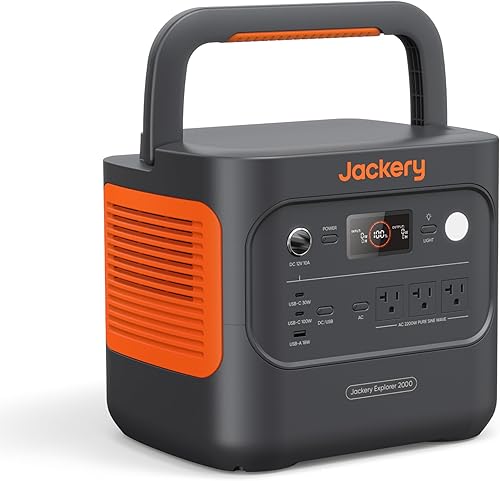 Best battery option for most homesJackery Explorer 2000 v2View on Amazon
 Best for replacing a generatorEcoFlow DELTA Pro 3View on Amazon
Choose a portable power station if you want quiet power you can use indoors. Choose a gas generator if you need high power for days and can run it safely outdoors. Some households keep both.
If you go with a battery, we’d start with the Jackery Explorer 2000 v2, or the EcoFlow DELTA Pro 3 for bigger loads. We haven’t tested these models. Our picks come from published specs, which we checked in November 2026.
Side-by-side comparison
| Power station | Gas generator | |
|---|---|---|
| Indoor use | Yes | Never |
| Exhaust | None | Carbon monoxide |
| Noise | Low | Usually much louder |
| Runtime | Limited by battery and recharging | As long as you have fuel |
| Refueling | Wall, car, or solar | Gasoline, which needs safe storage |
| Upkeep | Very little | Oil, filters, and fuel care |
| High-power loads | Depends on the model | Often a strong point |
Safety
This is the biggest difference. Gas generators produce carbon monoxide (CO), which you can’t see or smell. The US Consumer Product Safety Commission (CPSC) reports an average of about 100 deaths a year in the US from generator CO poisoning.
CPSC advises you to:
- Run generators outside only, at least 20 feet from the home.
- Never run one in a home, garage, basement, crawlspace, or shed.
- Not use one on a porch or in a carport.
- Point the exhaust away from the home and other buildings.
- Install working CO alarms on each level of your home and outside sleeping areas.
Opening doors or windows won’t provide enough ventilation. Power stations don’t burn fuel, so they don’t create this risk, though you should still follow the safety instructions in the manual.
Runtime and recharging
A generator can keep running as long as you can refill it safely. In a long outage, though, gas stations may be closed or have no fuel.
A power station stops when its battery is empty. To go further, you need solar panels or another power source. Our solar guide shows how to estimate what panels can give you.
Cost
Gas generators generally cost less for the same amount of output. A power station costs more upfront, but it doesn’t need fuel or regular engine maintenance. Compare current prices for the power you really need.
How to choose
A power station is likely the better fit if:
- You live in an apartment or have no safe outdoor spot.
- Your loads are small, such as a fridge, Wi-Fi, and lights.
- You want something for camping and for outages.
- Noise matters to you or your neighbors.
A gas generator is likely the better fit if:
- You need to run high-power equipment for days.
- You have a safe place at least 20 feet from the home.
- You’re happy to store fuel and maintain an engine.
Jackery Explorer 2000 v2: best battery option for most homes
It can keep a fridge, Wi-Fi, and lights going with no exhaust, and it’s light enough for one person to move. Read our full Explorer 2000 v2 review.
Jackery Explorer 2000 v2
- Capacity
- 2,042 Wh
- AC output
- 2,200 W
- Surge
- 4,400 W
- Weight
- 39.5 lb
Who it's for: Households that want about 2 kWh one person can move, with no plans to expand.
Strengths
- About 2 kWh at 39.5 lb
- 4,400 W surge rating
- LFP battery
Weaknesses
- Heavier to move than 1 kWh models
- Not expandable
EcoFlow DELTA Pro 3: best for replacing a generator
If you want a generator’s strengths without the fuel, this has 4,000 W of output and 120V and 240V ports. EcoFlow says it can also work with its Smart Generator 4000 for recharging. Read our full DELTA Pro 3 review.
EcoFlow DELTA Pro 3
- Capacity
- 4 kWh
- AC output
- 4,000 W
- Voltage
- 120V and 240V
- Expansion
- Up to 12 kWh per unit
Who it's for: Homeowners who want 120V and 240V backup and may add batteries over time.
Strengths
- Expands to 12 kWh on one unit, more as a multi-unit system
- 120V and 240V output
- Rated to keep 80% capacity after 4,000 cycles
Weaknesses
- Lower continuous output than the F3800 Plus
- More capacity than small essential loads need
FAQ
Can I run a gas generator indoors?
No. CPSC says to run generators outside only, at least 20 feet from the home.
Can I use a power station indoors?
Yes. Power stations don’t burn fuel, so they don’t produce exhaust. Follow the safety instructions in the manual.
Can a power station replace a generator?
For small loads, often yes. For high-power equipment over several days, a generator is usually the stronger option, unless you have a large battery and solar.
If you’ve decided on a battery, see what size you need and our picks for power outages.