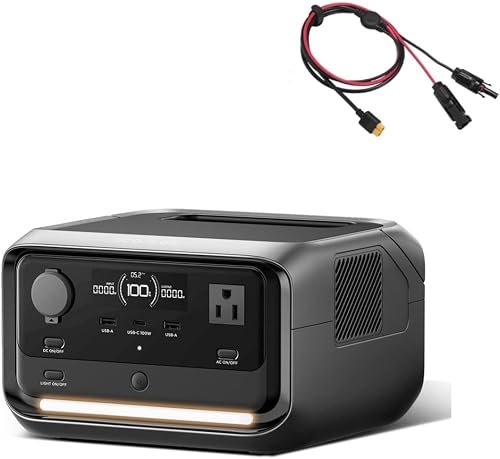
Best Jackery Explorer 2000 v2 Alternatives
As an Amazon Associate I earn from qualifying purchases. Read our affiliate disclosure.
Top picks at a glance
 Best for adding batteriesDJI Power 2000View on Amazon
 Best for built-in solar inputBLUETTI Elite 200 V2View on Amazon
 Best for RV hookupsRenogy PowerStation 2000View on Amazon
 Best lighter alternativeEcoFlow DELTA 3 PlusView on Amazon
The DJI Power 2000 is the alternative we’d look at first. It holds about the same energy as the Jackery Explorer 2000 v2, adds 800 W of AC output, and can take expansion batteries. If solar comes first, choose the BLUETTI Elite 200 V2. For an RV, the Renogy PowerStation 2000 has a built-in TT-30 outlet.
We sorted these alternatives using maker spec sheets from November 2026, and we haven’t used any of these stations.
Why look past the Explorer 2000 v2?
The Jackery is still a good buy, as our full review explains. No other 2 kWh station here weighs less, so if easy carrying is your priority, you may not need an alternative.
Three limits send buyers elsewhere:
- Fixed capacity: Jackery says you can’t add batteries to this model.
- Modest solar input: it accepts 400 W, which is low for a battery this size.
- Less AC headroom: 2,200 W is the lowest output among the 2 kWh stations below.
Jackery Explorer 2000 v2 alternatives compared
| Model | Capacity | AC output | Solar or DC input | Weight | Add batteries? |
|---|---|---|---|---|---|
| Jackery Explorer 2000 v2 | 2,042 Wh | 2,200 W | 400 W solar | 39.5 lb | No |
| DJI Power 2000 | 2,048 Wh | 3,000 W | Up to 1,800 W with a separate charger | About 48.5 lb | Yes, up to 22,528 Wh |
| BLUETTI Elite 200 V2 | 2,073.6 Wh | 2,600 W | 1,000 W solar | 53.4 lb | Not confirmed |
| Renogy PowerStation 2000 | 2,048 Wh | 2,400 W | 1,200 W DC | 51.81 lb | Not found |
| EcoFlow DELTA 3 Plus | 1,024 Wh | 1,800 W | 1,000 W solar | 27.6 lb | Yes, up to 5 kWh |
DJI Power 2000: best for adding batteries
This is the natural step if you like the Jackery’s size but want room to grow. DJI lists up to 10 expansion batteries, and its 3,000 W output is the highest in this group.
You’d carry about 9 lb more. Solar also takes extra hardware: DJI lists up to 400 W through a separate module, or up to 1,800 W through its 1.8 kW charger. Read our DJI and Jackery comparison for the details.
DJI Power 2000
- Capacity
- 2,048 Wh
- AC output
- 3,000 W
- Expansion
- Up to 22,528 Wh
- Weight
- About 48.5 lb
Who it's for: People who want high output from a 2 kWh station and may add batteries later.
Strengths
- 3,000 W output
- Takes up to 10 expansion batteries
- Rated to keep over 80% capacity after 4,000 cycles
Weaknesses
- Solar charging needs a separate DJI module or charger
- Heavy to carry at about 48.5 lb
BLUETTI Elite 200 V2: best for built-in solar input
BLUETTI accepts 1,000 W of solar with no add-on, which is two and a half times the Jackery’s limit. That could cut a best-case solar refill from about 5 hours to about 2, if you have enough panels and strong sun. It also adds 400 W of AC output.
The cost is weight, since it’s 13.9 lb heavier. Road-trippers should also note the low car input, at 96 W on 12V or 192 W on 24V. We couldn’t find a cycle rating on BLUETTI’s page.
BLUETTI Elite 200 V2
- Capacity
- 2,073.6 Wh
- AC output
- 2,600 W
- Solar input
- 1,000 W
- Weight
- 53.4 lb
Who it's for: People who stay parked, run on solar, and don't need to carry their station far.
Strengths
- About 2 kWh in one unit
- 1,000 W of solar input
- LiFePO4 battery
Weaknesses
- Heavy to carry at 53.4 lb
- Car input is only 96 W on 12V or 192 W on 24V
Renogy PowerStation 2000: best for RV hookups
Renogy builds in a TT-30 outlet, rated up to 2,400 W, and says it matches the plug used by most RVs and trailers. That makes this the simplest swap for anyone who wants to feed a compatible RV directly.
It’s 12.3 lb heavier than the Jackery, and its 3,600 W surge rating is lower. Renogy lists 3,000 cycles, while Jackery lists 4,000 cycles to 70% or more. We didn’t find a full AC charge time on Renogy’s page.
Renogy PowerStation 2000
- Capacity
- 2,048 Wh
- AC output
- 2,400 W
- DC input
- 1,200 W
- Weight
- 51.81 lb
Who it's for: RV owners who want about 2 kWh with a direct TT-30 connection.
Strengths
- Built-in TT-30 RV outlet
- 3,600 W surge rating
- Listed at 25 dB under a 500 W load
Weaknesses
- Heavy to carry at 51.81 lb
- Rated for 3,000 cycles, fewer than many models we compare
EcoFlow DELTA 3 Plus: best lighter alternative
Maybe 2 kWh is more than you need to carry. The DELTA 3 Plus is 11.9 lb lighter and starts at half the capacity, and you can add batteries later if your needs grow, up to 5 kWh.
Half the battery means much less runtime. At 85% efficiency, a 200 W load would last about 4.4 hours here, compared with about 8.7 hours on the Jackery. Its 1,800 W output is lower too.
EcoFlow DELTA 3 Plus
- Capacity
- 1,024 Wh
- AC output
- 1,800 W
- Solar input
- 1,000 W
- Weight
- 27.6 lb
Who it's for: Campers and van owners who want fast recharging, strong solar input, and the option to add batteries later.
Strengths
- Expandable to 5 kWh
- 1,000 W of solar input
- Full charge in about 1.3 hours from an 800 W car source
Weaknesses
- Fast car charging needs a separate Alternator Charger
- 1 kWh base capacity is modest for full-time use
How to choose
Start with the limit that bothers you most about the Jackery:
- You want more capacity later: DJI Power 2000
- You’ll rely on several solar panels: BLUETTI Elite 200 V2
- You want a direct RV connection: Renogy PowerStation 2000
- It’s too heavy to move often: EcoFlow DELTA 3 Plus
- None of these limits matter to you: stay with the Jackery
For more on growing a system, see our expandable power station picks.
FAQ
What is the best alternative to the Jackery Explorer 2000 v2?
We’d start with the DJI Power 2000. It holds 2,048 Wh, outputs 3,000 W, and takes up to 10 expansion batteries, though it’s about 9 lb heavier than the Jackery.
Is any 2 kWh alternative lighter than the Jackery?
Not among the stations we compare. The Explorer 2000 v2 weighs 39.5 lb, and the next lightest 2 kWh model here is the DJI Power 2000 at about 48.5 lb.
Which Jackery alternative suits a large solar array?
The BLUETTI Elite 200 V2 is the simplest fit, with 1,000 W of built-in solar input. The DJI Power 2000 can take more, up to 1,800 W, but only through a separate 1.8 kW charger.
Which alternative plugs straight into an RV?
The Renogy PowerStation 2000 has a built-in TT-30 outlet rated up to 2,400 W. Check that your RV uses that plug before you buy.