Best Expandable Power Station
As an Amazon Associate I earn from qualifying purchases. Read our affiliate disclosure.
Top picks at a glance
 Best for most peopleEcoFlow DELTA 3 PlusView on Amazon
 Best 2 kWh starting pointDJI Power 2000View on Amazon
 Best for home backupEcoFlow DELTA Pro 3View on Amazon
 Most capacity on one unitAnker SOLIX F3800 PlusView on Amazon
 Best small starterEcoFlow RIVER 3 PlusView on Amazon
For most people, we’d pick the EcoFlow DELTA 3 Plus. It starts at a portable 1 kWh and can grow to 5 kWh. For serious home backup, the EcoFlow DELTA Pro 3 and Anker SOLIX F3800 Plus start near 4 kWh and offer 240V output.
Expansion limits here are the makers’ published figures from November 2026, and we haven’t tested these systems.
Quick comparison
| Model | Starting capacity | Maximum on one unit | AC output |
|---|---|---|---|
| EcoFlow RIVER 3 Plus | 286 Wh | 858 Wh | 600 W |
| EcoFlow DELTA 3 Plus | 1,024 Wh | 5 kWh | 1,800 W |
| DJI Power 2000 | 2,048 Wh | 22,528 Wh | 3,000 W |
| EcoFlow DELTA Pro 3 | 4 kWh | 12 kWh | 4,000 W |
| Anker SOLIX F3800 Plus | 3,840 Wh | About 26.9 kWh | 6,000 W |
The F3800 Plus figure is our sum of the main unit plus six 3.84 kWh batteries.
Some popular models don’t expand at all. Anker says the C1000 Gen 2 has no expansion feature, and Jackery says the same of the Explorer 2000 v2. We couldn’t confirm expansion for the BLUETTI Elite 200 V2.
When expansion makes sense
Adding batteries later is useful if you want to spread out the cost or aren’t sure how much you need yet. It’s also useful for a home setup that may grow.
If you already know you need 2 kWh and don’t expect that to change, a single fixed unit can be simpler, with fewer parts to store and connect.
EcoFlow DELTA 3 Plus: best for most people
At 27.6 lb, it’s still easy to take camping, and it can grow to 5 kWh for outages. EcoFlow lists several compatible extra batteries, including models from the DELTA 2 and DELTA Pro 3 lines. Check which cable your battery needs before you buy.
EcoFlow DELTA 3 Plus
- Capacity
- 1,024 Wh
- AC output
- 1,800 W
- Solar input
- 1,000 W
- Weight
- 27.6 lb
Who it's for: Campers and van owners who want fast recharging, strong solar input, and the option to add batteries later.
Strengths
- Expandable to 5 kWh
- 1,000 W of solar input
- Full charge in about 1.3 hours from an 800 W car source
Weaknesses
- Fast car charging needs a separate Alternator Charger
- 1 kWh base capacity is modest for full-time use
DJI Power 2000: best 2 kWh starting point
DJI says up to 10 expansion batteries can take it to 22,528 Wh, and it has a 3,000 W output. It starts at twice the size of the DELTA 3 Plus. For solar, you’ll need a separate DJI module or charger, with up to 400 W through the module or up to 1,800 W through the 1.8 kW charger.
DJI Power 2000
- Capacity
- 2,048 Wh
- AC output
- 3,000 W
- Expansion
- Up to 22,528 Wh
- Weight
- About 48.5 lb
Who it's for: People who want high output from a 2 kWh station and may add batteries later.
Strengths
- 3,000 W output
- Takes up to 10 expansion batteries
- Rated to keep over 80% capacity after 4,000 cycles
Weaknesses
- Solar charging needs a separate DJI module or charger
- Heavy to carry at about 48.5 lb
EcoFlow DELTA Pro 3: best for home backup
One unit expands to 12 kWh with two extra batteries. EcoFlow’s 48 kWh headline figure is for a larger system with three DELTA Pro 3 units, extra batteries, generators, and a Smart Home Panel 2, so don’t expect to reach it with a single station.
EcoFlow DELTA Pro 3
- Capacity
- 4 kWh
- AC output
- 4,000 W
- Voltage
- 120V and 240V
- Expansion
- Up to 12 kWh per unit
Who it's for: Homeowners who want 120V and 240V backup and may add batteries over time.
Strengths
- Expands to 12 kWh on one unit, more as a multi-unit system
- 120V and 240V output
- Rated to keep 80% capacity after 4,000 cycles
Weaknesses
- Lower continuous output than the F3800 Plus
- More capacity than small essential loads need
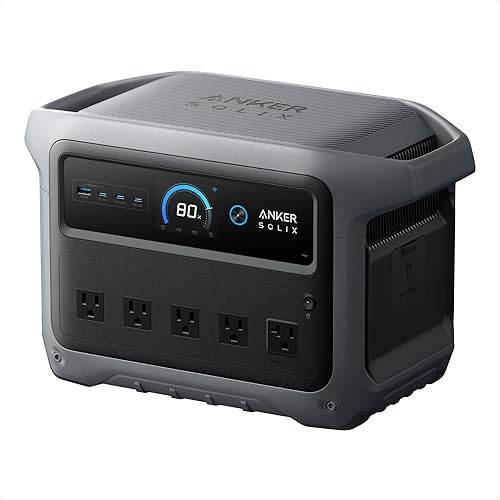
Anker SOLIX F3800 Plus: most capacity on one unit
Anker lists support for up to six expansion batteries, so one station can reach far more capacity than the others here. Size up the weight before you commit, as the main unit is 136.7 lb and each BP3800 battery adds 72.8 lb.
Anker SOLIX F3800 Plus
- Capacity
- 3,840 Wh
- AC output
- 6,000 W
- Solar input
- 3,200 W
- Weight
- 136.7 lb
Who it's for: RV owners and homeowners with heavy or 240V loads who can keep a large unit in one place.
The photo also shows the Home Power Panel, which Amazon sells with this model in some listings. Check what's included before you buy.
Strengths
- 120V and 240V output
- TT-30 RV port
- Supports up to six 3.84 kWh expansion batteries
Weaknesses
- Very heavy at 136.7 lb, though it has wheels
- AC charging input is 1,800 W
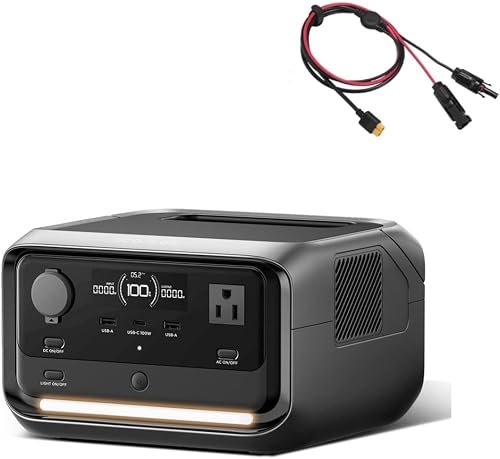
EcoFlow RIVER 3 Plus: best small starter
This is a low-commitment way to get started. An Extra Battery takes it from 286 Wh to 858 Wh, which is useful for small backup loads. Its 600 W output doesn’t change, though, so more capacity won’t let you run bigger devices.
EcoFlow RIVER 3 Plus
- Capacity
- 286 Wh
- AC output
- 600 W
- AC charge
- 1 hour
- Weight
- 10.4 lb
Who it's for: People who mainly charge phones and laptops or keep Wi-Fi on, and want a station that's easy to carry.
Strengths
- Easy to carry at 10.4 lb
- Expandable to 858 Wh
- Listed at under 30 dB
Weaknesses
- Small capacity for high-power devices
- 600 W limits what you can run
What to check before you expand
- Compatibility: extra batteries usually work only with specific models, so check the list on the maker’s site.
- Output: extra batteries add runtime, not watts.
- Recharging: a larger battery takes longer to fill, especially from solar.
- Home wiring: connecting a station to home circuits needs a proper transfer switch or compatible system, installed by a licensed electrician.
For more, see our guide to how much capacity you need.
How to choose
- Start with today’s needs. Choose a base unit that handles your current loads.
- Check the AC output. It stays the same on a single station, so make sure it’s high enough from the start.
- Look at the maximum. See how far each model can grow on one unit.
- Confirm compatibility. Check the exact battery model on the maker’s page.
FAQ
Do extra batteries increase output?
Not on a single station. They add capacity, so your devices run for longer.
Can I mix extra batteries between product lines?
Only where the maker allows it. For example, EcoFlow says the DELTA Pro 3 Extra Battery isn’t compatible with the original DELTA Pro.
Is the Jackery Explorer 2000 v2 expandable?
No. Jackery says it isn’t, and points buyers who want expansion to its Solar Generator 2000 Plus.