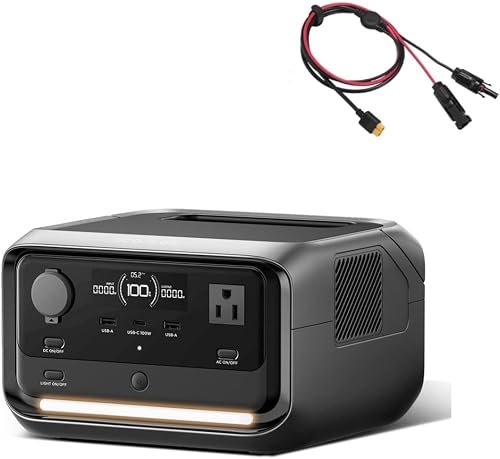
Best Power Station for Power Outages
As an Amazon Associate I earn from qualifying purchases. Read our affiliate disclosure.
Top picks at a glance
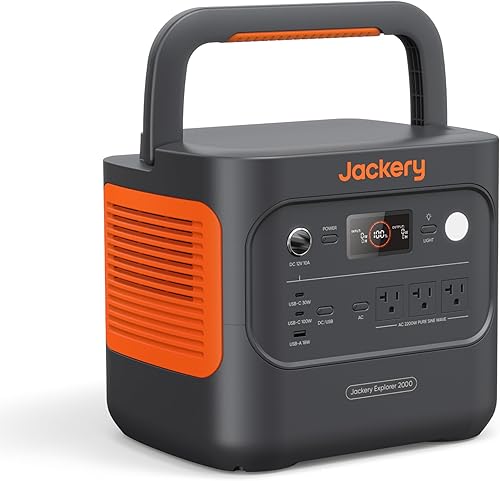 Best for most homesJackery Explorer 2000 v2View on Amazon
 Best for long outagesEcoFlow DELTA Pro 3View on Amazon
 Best for high-power loadsAnker SOLIX F3800 PlusView on Amazon
 Best for shorter outagesAnker SOLIX C1000 Gen 2View on Amazon
For most homes, we’d pick the Jackery Explorer 2000 v2, as it can keep the essentials running for most of a day and is still fairly easy to move. If you need to back up 240V circuits or get through longer outages, step up to the EcoFlow DELTA Pro 3 or Anker SOLIX F3800 Plus.
We picked these backup stations from published specs in November 2026. We haven’t tested them in an outage.
Quick comparison
| Model | Capacity | AC output | Expandable | Weight |
|---|---|---|---|---|
| Anker SOLIX C1000 Gen 2 | 1,024 Wh | 2,000 W | No | 24.9 lb |
| Jackery Explorer 2000 v2 | 2,042 Wh | 2,200 W | No | 39.5 lb |
| EcoFlow DELTA Pro 3 | 4 kWh | 4,000 W | Up to 12 kWh per unit | 113.5 lb |
| Anker SOLIX F3800 Plus | 3,840 Wh | 6,000 W | Yes | 136.7 lb |
How long will the essentials run?
Here is a sample essentials load:
| Device | Average watts |
|---|---|
| Efficient fridge | 41 |
| Router and modem | 15 |
| LED lights | 20 |
| Phone charging | 10 |
| Total | 86 |
At 85% efficiency, that gives:
| Model | Estimated runtime |
|---|---|
| Anker SOLIX C1000 Gen 2 | About 10 hours |
| Jackery Explorer 2000 v2 | About 20 hours |
| Anker SOLIX F3800 Plus | About 38 hours |
| EcoFlow DELTA Pro 3 | About 40 hours |
Your numbers will change with your fridge and how you use it. Heating and cooling use far more power, and most stations here can’t run them for long. See how to estimate a fridge’s power use.
Jackery Explorer 2000 v2: best for most homes
With about 2 kWh and 2,200 W of output (4,400 W surge), it suits fridges, lights, and small appliances. At 39.5 lb, one person can usually move it. Jackery says its LFP cells are built for 4,000+ charge cycles.
Jackery Explorer 2000 v2
- Capacity
- 2,042 Wh
- AC output
- 2,200 W
- Surge
- 4,400 W
- Weight
- 39.5 lb
Who it's for: Households that want about 2 kWh one person can move, with no plans to expand.
Strengths
- About 2 kWh at 39.5 lb
- 4,400 W surge rating
- LFP battery
Weaknesses
- Heavier to move than 1 kWh models
- Not expandable
EcoFlow DELTA Pro 3: best for long outages
It delivers 120V and 240V, with capacity that can expand from 4 kWh to 12 kWh on one unit, or further as a multi-unit system. EcoFlow rates the battery to keep 80% of its capacity after 4,000 cycles.
EcoFlow DELTA Pro 3
- Capacity
- 4 kWh
- AC output
- 4,000 W
- Voltage
- 120V and 240V
- Expansion
- Up to 12 kWh per unit
Who it's for: Homeowners who want 120V and 240V backup and may add batteries over time.
Strengths
- Expands to 12 kWh on one unit, more as a multi-unit system
- 120V and 240V output
- Rated to keep 80% capacity after 4,000 cycles
Weaknesses
- Lower continuous output than the F3800 Plus
- More capacity than small essential loads need
Anker SOLIX F3800 Plus: best for high-power loads
With a 6,000 W total output and 120V/240V ports, this has the most output in this group. AC input is listed at 1,800 W. It’s a large unit, at 136.7 lb including wheels.
Anker SOLIX F3800 Plus
- Capacity
- 3,840 Wh
- AC output
- 6,000 W
- Solar input
- 3,200 W
- Weight
- 136.7 lb
Who it's for: RV owners and homeowners with heavy or 240V loads who can keep a large unit in one place.
The photo also shows the Home Power Panel, which Amazon sells with this model in some listings. Check what's included before you buy.
Strengths
- 120V and 240V output
- TT-30 RV port
- Supports up to six 3.84 kWh expansion batteries
Weaknesses
- Very heavy at 136.7 lb, though it has wheels
- AC charging input is 1,800 W
Anker SOLIX C1000 Gen 2: best for shorter outages
If your outages are usually short, this is a smaller, lighter option. Anker lists a full recharge in 49 minutes, and a UPS switchover of under 10 ms.
Anker SOLIX C1000 Gen 2
- Capacity
- 1,024 Wh
- AC output
- 2,000 W
- Solar input
- 600 W
- Weight
- 24.9 lb
Who it's for: People who want about 1 kWh and 2,000 W in a portable box, and don't need to add batteries.
Strengths
- 49-minute full AC charge
- 2,000 W output, 3,000 W peak
- Rated to keep 80% capacity after 4,000 cycles
Weaknesses
- Not expandable
- Lower solar input than the DELTA 3 Plus
Backup safety
- Never connect a station to home wiring by yourself. Connecting to a home’s circuits needs a proper transfer switch or a compatible system, installed by a licensed electrician.
- Keep the station charged. Top it up every few months, or as the manual advises.
- Test it before storm season. Run your essentials once so you know what works.
Also weighing up gasoline? Read power station vs. gas generator.
Thinking bigger than a few essentials? See what large systems can realistically do in our guide to the best solar generator for whole-home backup.
How to choose
- List your essentials. Add up their watts, as in the sample load above.
- Check for 240V loads. If you need them, choose the DELTA Pro 3 or F3800 Plus.
- Decide how long you need to last. Use the runtime table as a starting point.
- Think about moving it. The range here runs from 24.9 lb to 136.7 lb.
- Check whether you can expand. The C1000 Gen 2 and Explorer 2000 v2 can’t take extra batteries.
FAQ
Can these power stations run a refrigerator?
Yes. Our fridge guide shows how to check the startup power and estimate runtime.
Can I use a station while it’s charging?
Jackery says the Explorer 2000 v2 supports this. Anker lists bypass charging for the C1000 Gen 2 and F3800 Plus, and EcoFlow lists pass-through charging for the DELTA Pro 3.
How quickly can I recharge between outages?
Anker lists 49 minutes for the C1000 Gen 2, and Jackery lists about 1.75 hours for the Explorer 2000 v2. EcoFlow lists 80% in 50 minutes for the DELTA Pro 3.