Best Solar Generator for Whole-Home Backup
As an Amazon Associate I earn from qualifying purchases. Read our affiliate disclosure.
Top picks at a glance
 Best overallAnker SOLIX F3800 PlusView on Amazon
 Best for long outagesEcoFlow DELTA Pro 3View on Amazon
 Best to build up over timeDJI Power 2000View on Amazon
If you want the closest thing to whole-home backup from a portable system, we’d pick the Anker SOLIX F3800 Plus. To be clear, though, none of these will run a typical home for long. A typical US home uses about 28 kWh a day, while these systems start between 2 and 4 kWh. They’re much better at keeping your essentials on.
System limits here come from specs published as of November 2026. We haven’t tested these systems in a home.
Quick comparison
| System | Base capacity | Maximum on one unit | AC output | Solar input |
|---|---|---|---|---|
| Anker SOLIX F3800 Plus | 3,840 Wh | About 26.9 kWh | 6,000 W | 3,200 W |
| EcoFlow DELTA Pro 3 | 4 kWh | 12 kWh | 4,000 W | 2,600 W |
| DJI Power 2000 | 2,048 Wh | 22,528 Wh | 3,000 W | Up to 1,800 W with a separate charger |
The F3800 Plus figure is our sum of the main unit plus six 3.84 kWh batteries.
Can a solar generator power a house?
Not all of it, at least for long. The US Energy Information Administration says the average residential customer used 865 kWh a month in 2024, or about 28 kWh a day. Check your electric bill for your own number.
| System | Capacity | Share of an average day |
|---|---|---|
| EcoFlow DELTA Pro 3 | 4 kWh | About 14% |
| EcoFlow DELTA Pro 3 with two extra batteries | 12 kWh | About 42% |
| DJI Power 2000 with 10 expansion batteries | 22.5 kWh | About 79% |
| Anker SOLIX F3800 Plus with six batteries | About 26.9 kWh | About 95% |
Those shares are before losses. Recharging is the other limit. Using our 0.7 rule of thumb and 5 peak sun hours, replacing 28 kWh a day would take about 8,000 W of panels. The F3800 Plus accepts 3,200 W, which would give about 11 kWh a day.
What it can realistically run
Our power outage guide uses a sample essentials load of 86 W, for a fridge, router, LED lights, and phone charging. That’s about 2 kWh a day, or less than a tenth of what the average home uses.
| Capacity | Runtime at 86 W, 85% efficiency |
|---|---|
| 2,048 Wh | About 20 hours |
| 3,840 Wh | About 38 hours |
| 12 kWh | About 5 days |
Anker SOLIX F3800 Plus: best overall
It has the highest output and solar input we compare, with 120V and 240V available. It can also take up to six expansion batteries. Read how it compares with the DELTA Pro 3.
Anker SOLIX F3800 Plus
- Capacity
- 3,840 Wh
- AC output
- 6,000 W
- Solar input
- 3,200 W
- Weight
- 136.7 lb
Who it's for: RV owners and homeowners with heavy or 240V loads who can keep a large unit in one place.
The photo also shows the Home Power Panel, which Amazon sells with this model in some listings. Check what's included before you buy.
Strengths
- 120V and 240V output
- TT-30 RV port
- Supports up to six 3.84 kWh expansion batteries
Weaknesses
- Very heavy at 136.7 lb, though it has wheels
- AC charging input is 1,800 W
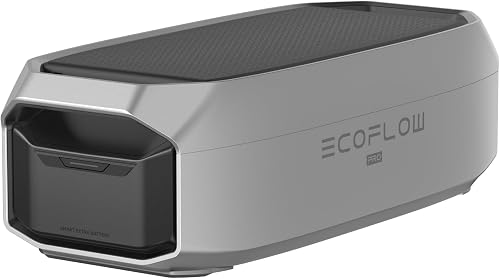
EcoFlow DELTA Pro 3: best for long outages
It has 120V and 240V output and a 4,000-cycle rating to 80%. EcoFlow says it can power a 3-ton central AC. Read our full DELTA Pro 3 review.
EcoFlow DELTA Pro 3
- Capacity
- 4 kWh
- AC output
- 4,000 W
- Voltage
- 120V and 240V
- Expansion
- Up to 12 kWh per unit
Who it's for: Homeowners who want 120V and 240V backup and may add batteries over time.
Strengths
- Expands to 12 kWh on one unit, more as a multi-unit system
- 120V and 240V output
- Rated to keep 80% capacity after 4,000 cycles
Weaknesses
- Lower continuous output than the F3800 Plus
- More capacity than small essential loads need
DJI Power 2000: best to build up over time
It starts at about 2 kWh and can take up to 10 expansion batteries. It’s the only one here that’s 120V only in the US, so it suits homes without 240V backup needs.
DJI Power 2000
- Capacity
- 2,048 Wh
- AC output
- 3,000 W
- Expansion
- Up to 22,528 Wh
- Weight
- About 48.5 lb
Who it's for: People who want high output from a 2 kWh station and may add batteries later.
Strengths
- 3,000 W output
- Takes up to 10 expansion batteries
- Rated to keep over 80% capacity after 4,000 cycles
Weaknesses
- Solar charging needs a separate DJI module or charger
- Heavy to carry at about 48.5 lb
How to choose
- Start with your essentials. Don’t size for the whole house unless you have to.
- Check for 240V loads. Central air and other large appliances may need it.
- Add up what runs at once. The AC output has to cover it, and motors need extra at startup.
- Plan your connection. To power home circuits, you need a proper transfer switch or compatible system, installed by a licensed electrician.
FAQ
Can a solar generator run central air?
Whether a solar generator can run central air depends on the unit and the system. EcoFlow says the DELTA Pro 3 can power a 3-ton central AC, but runtime will be short compared with lighter loads, so check your unit’s label first.
Can a solar generator take my home off the grid?
Not for a typical home. A portable system would mean cutting your energy use a lot. See our off-grid cabin guide for a smaller-scale example.
How big a system do I need for outages?
Start with your essentials. Our beginner’s guide walks you through the numbers.