Best Power Station for Large Solar Arrays
As an Amazon Associate I earn from qualifying purchases. Read our affiliate disclosure.
Top picks at a glance
 Best overallAnker SOLIX F3800 PlusView on Amazon
 Best for mixed voltagesEcoFlow DELTA Pro 3View on Amazon
 Best smaller setupBLUETTI Elite 200 V2View on Amazon
For a large array, we’d pick the Anker SOLIX F3800 Plus, with 3,200 W of solar input and a voltage range up to 165 V on each port. The EcoFlow DELTA Pro 3 is close behind, and it has separate high- and low-voltage inputs.
Solar limits here come from published specs, checked in November 2026. We haven’t wired arrays to these models.
Quick comparison
| Model | Max solar input | Listed input range |
|---|---|---|
| Anker SOLIX F3800 Plus | 3,200 W | 11 V to 165 V, 17 A per port |
| EcoFlow DELTA Pro 3 | 2,600 W | 11 V to 60 V at 20 A, 30 V to 150 V at 15 A |
| BLUETTI Elite 200 V2 | 1,000 W | 12 V to 60 V, 20 A |
Series vs. parallel
Wiring panels in series adds their voltage, and wiring them in parallel adds their current.
| Series | Parallel | |
|---|---|---|
| Voltage | Adds up | Stays the same |
| Current | Stays the same | Adds up |
| Main limit | Station’s maximum voltage | Station’s maximum current |
| With shade | One shaded panel can hold back the whole string | The other panels are less affected |
| Hardware | Panels usually connect to each other | Usually needs a parallel adapter |
The total wattage is about the same either way. For most portable setups, series is the first thing to try, as long as the total stays under the station’s voltage limit.
A worked example
The EcoFlow 220W Bifacial has an open-circuit voltage of 21.5 V.
| Panels in series | Total voltage | With a 60 V limit |
|---|---|---|
| 1 | 21.5 V | Fine |
| 2 | 43 V | Fine |
| 3 | 64.5 V | Over the limit |
For current, the Jackery SolarSaga 200W lists a short-circuit current of 12.5 A. Two in parallel come to about 25 A, which is more than the 20 A maximum BLUETTI lists for the Elite 200 V2.
Some stations also accept more current at higher voltages. The Anker C1000 Gen 2 lists 8.2 A up to 28 V and 14.5 A from 29 V, so a series string can suit it better.
Allow for cold weather
A panel’s voltage rises as it gets colder. Jackery lists a voltage temperature coefficient of about -0.27% per °C for the SolarSaga 200W. On a 14°F day, that takes a 22 V panel to roughly 24 V, so don’t plan right up to the limit.
Anker SOLIX F3800 Plus: best overall
Anker lists up to 1,600 W per port at 11 V to 165 V. That wide range gives you much more room for long series strings. Anker says it can recharge in under two hours in optimal sunlight.
Anker SOLIX F3800 Plus
- Capacity
- 3,840 Wh
- AC output
- 6,000 W
- Solar input
- 3,200 W
- Weight
- 136.7 lb
Who it's for: RV owners and homeowners with heavy or 240V loads who can keep a large unit in one place.
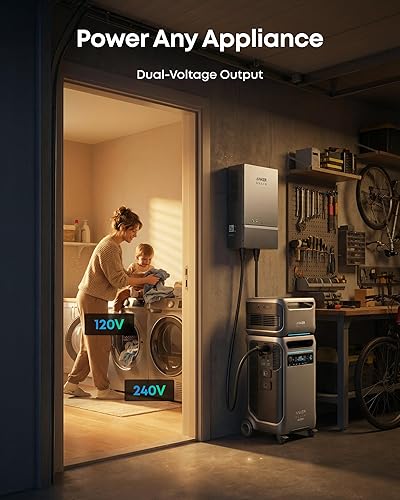
The photo also shows the Home Power Panel, which Amazon sells with this model in some listings. Check what's included before you buy.
Strengths
- 120V and 240V output
- TT-30 RV port
- Supports up to six 3.84 kWh expansion batteries
Weaknesses
- Very heavy at 136.7 lb, though it has wheels
- AC charging input is 1,800 W
EcoFlow DELTA Pro 3: best for mixed voltages
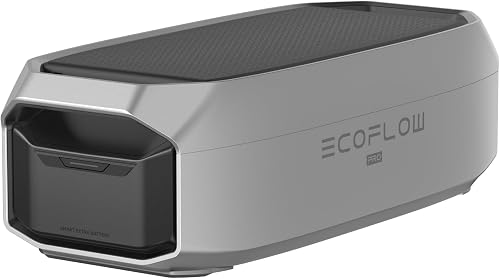
EcoFlow lists a 1,600 W high-voltage input and a 1,000 W low-voltage input, for 2,600 W in total. That’s handy if you have different panel strings. Read our full DELTA Pro 3 review.
EcoFlow DELTA Pro 3
- Capacity
- 4 kWh
- AC output
- 4,000 W
- Voltage
- 120V and 240V
- Expansion
- Up to 12 kWh per unit
Who it's for: Homeowners who want 120V and 240V backup and may add batteries over time.
Strengths
- Expands to 12 kWh on one unit, more as a multi-unit system
- 120V and 240V output
- Rated to keep 80% capacity after 4,000 cycles
Weaknesses
- Lower continuous output than the F3800 Plus
- More capacity than small essential loads need
BLUETTI Elite 200 V2: best smaller setup
It takes 1,000 W at up to 60 V, which suits a smaller array. Watch both limits, as a few panels in series can reach 60 V, and panels in parallel can reach 20 A.
BLUETTI Elite 200 V2
- Capacity
- 2,073.6 Wh
- AC output
- 2,600 W
- Solar input
- 1,000 W
- Weight
- 53.4 lb
Who it's for: People who stay parked, run on solar, and don't need to carry their station far.
Strengths
- About 2 kWh in one unit
- 1,000 W of solar input
- LiFePO4 battery
Weaknesses
- Heavy to carry at 53.4 lb
- Car input is only 96 W on 12V or 192 W on 24V
How to choose
- Add up the open-circuit voltage of the panels you want in series.
- Allow for cold if you’ll use them in winter.
- Compare the total with your station’s maximum voltage. If it’s under, series is usually the simplest option.
- If it’s over, or you expect shade, use parallel, and check the total current against the station’s limit.
- Use matching panels. Jackery says it doesn’t recommend mixing different models, and mismatched panels can reduce output.
FAQ
What happens if I go over the voltage limit?
You can damage the station. Stay under the listed maximum, and remember that voltage rises in the cold.
Is series or parallel better in partial shade?
Parallel usually copes better. PV Education explains that in a series string, a shaded cell or module can hold back the power of the rest.
Can I mix different panels?
It’s best to avoid mixing different solar panels. Series strings need matching current and parallel sets need matching voltage.
Do I need a special cable?
Often, yes. Check whether your panels connect directly in series, and whether you need a parallel adapter for your plugs.
Want to know how many panels you need? Read our solar panel setup guide.