EcoFlow DELTA 3 Plus vs. Jackery Explorer 1000 v2
As an Amazon Associate I earn from qualifying purchases. Read our affiliate disclosure.
Top picks at a glance
 Best for solar and growthEcoFlow DELTA 3 PlusView on Amazon
 Best for carrying lightJackery Explorer 1000 v2View on Amazon
Go with the EcoFlow DELTA 3 Plus if you recharge from solar panels or might add batteries later. Go with the Jackery Explorer 1000 v2 if you carry your station a lot and your gear stays under 1,500 W. Both store about 1 kWh, so the choice comes down to output, solar input, weight, and room to grow.
Everything here comes from the spec pages EcoFlow and Jackery published as of November 2026. Neither station has been through our hands, so treat this as a paper comparison.
How do the DELTA 3 Plus and Explorer 1000 v2 compare on paper?
| Spec | EcoFlow DELTA 3 Plus | Jackery Explorer 1000 v2 |
|---|---|---|
| Capacity | 1,024 Wh | 1,070 Wh |
| AC output | 1,800 W, or 2,200 W with X-Boost | 1,500 W |
| Listed surge | 3,600 W | 3,000 W |
| Solar input | 1,000 W | 400 W |
| AC charge | 56 minutes at 1,500 W | About 1.6 hours |
| UPS switchover | Under 10 ms | Under 20 ms |
| Cycle rating | 4,000 cycles to 80% | 4,000 cycles to 70%+ |
| Weight | 27.6 lb | 23.8 lb |
| Add batteries? | Yes, to 5 kWh | Not listed |
| Wh per lb | 37.1 | 45.0 |
We worked out the Wh per lb row by dividing capacity by weight. The rest are published figures.
A quick guide to the terms: watt-hours (Wh) measure how much energy the battery stores. AC output is how many watts the wall-style outlets can supply at once. Surge is a brief peak a station can handle while a motor starts, not something it can hold.
The capacity gap is small: the Jackery holds 46 Wh more. The other gaps are bigger. The EcoFlow takes 2.5 times the solar input and has 300 W more standard output, while the Jackery weighs 3.8 lb less.
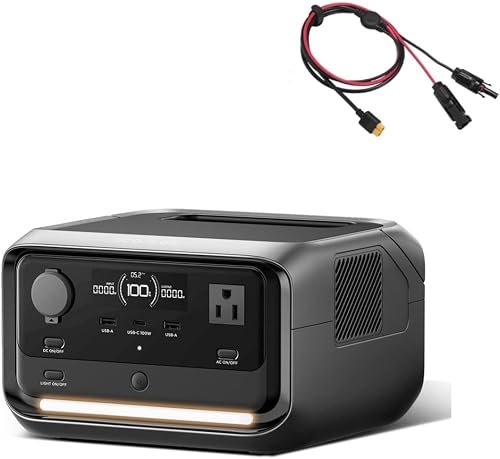
EcoFlow DELTA 3 Plus: best for solar and growth
EcoFlow DELTA 3 Plus
- Capacity
- 1,024 Wh
- AC output
- 1,800 W
- Solar input
- 1,000 W
- Weight
- 27.6 lb
Who it's for: Campers and van owners who want fast recharging, strong solar input, and the option to add batteries later.
Strengths
- Expandable to 5 kWh
- 1,000 W of solar input
- Full charge in about 1.3 hours from an 800 W car source
Weaknesses
- Fast car charging needs a separate Alternator Charger
- 1 kWh base capacity is modest for full-time use
This is the station to choose if panels are part of your plan. With 1,000 W of solar input, a sunny afternoon can refill it in far less time than the Jackery’s 400 W limit allows. EcoFlow lists a full solar charge in 70 minutes at that input. At the wall, it lists 56 minutes.
It also leaves room to grow. You can start at 1,024 Wh and add extra batteries up to 5 kWh, which helps if a weekend setup later becomes a van build or home backup. Its 1,800 W output gives you 300 W more headroom than the Jackery for appliances that draw a lot at once.
The downsides: it’s the heavier of the two at 27.6 lb, and the quick car charging in its specs, about 1.3 hours from an 800 W source, depends on EcoFlow’s Alternator Charger, which is sold separately. On its own, 1 kWh is also modest for living off-grid every day.
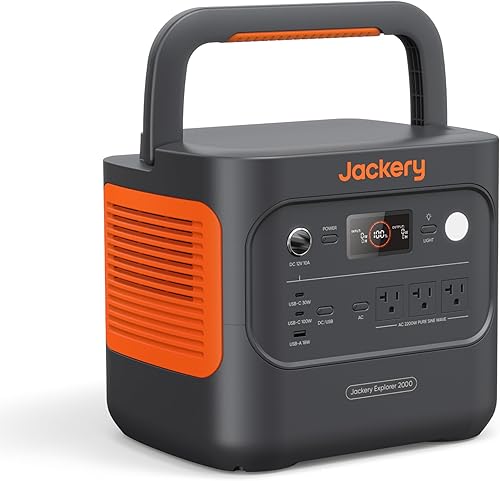
Jackery Explorer 1000 v2: best for carrying light
Jackery Explorer 1000 v2
- Capacity
- 1,070 Wh
- AC output
- 1,500 W
- Solar input
- 400 W
- Weight
- 23.8 lb
Who it's for: Campers who want about 1 kWh at a low weight and don't run appliances over 1,500 W.
Strengths
- Lightest 1 kWh model we compare
- LiFePO4 battery
- 3,000 W surge rating
Weaknesses
- Lower AC output than the Anker C1000 Gen 2
- Cycle rating is listed to 70% or more, not 80%
If you carry the station from the car to a campsite, the Jackery’s lower weight counts. At 23.8 lb, it stores about 45 Wh for each pound, the highest of the 1 kWh models we cover. It also holds slightly more energy than the EcoFlow, and its LiFePO4 battery (lithium iron phosphate, a chemistry known for long life) is listed at 4,000 cycles.
The limits show up with bigger loads and solar. Its 1,500 W output rules out devices that need more, even though the 3,000 W surge helps motors start. Solar input tops out at 400 W, so refilling from panels takes longer; Jackery lists 7.5 hours with one SolarSaga 200W panel. Its cycle rating counts down to 70% capacity, a lower bar than the 80% EcoFlow uses.
How long would each one run a camp setup?
Suppose your campsite gear draws a steady 100 W, such as a 12V fridge, lights, and phone charging. We assume 85% of each battery’s rated capacity reaches that gear.
| Model | Usable energy | Hours at 100 W |
|---|---|---|
| Jackery Explorer 1000 v2 | About 910 Wh | About 9.1 |
| EcoFlow DELTA 3 Plus | About 870 Wh | About 8.7 |
On one charge, the two are close. Over several days, solar input matters more than this small gap, which favors the EcoFlow if you bring panels.
How to choose
- List your biggest device. If anything needs more than 1,500 W, the Jackery won’t run it. The DELTA 3 Plus handles up to 1,800 W.
- Decide whether you’ll use solar. If you recharge from panels each day, the EcoFlow’s 1,000 W input is the stronger choice.
- Think about carrying. If you lift it often, the Jackery’s 3.8 lb saving adds up.
- Plan for later. If you might want more than 1 kWh, the DELTA 3 Plus takes extra batteries.
For each station in more depth, read our DELTA 3 Plus review and Explorer 1000 v2 review. We also compare the Jackery with the Anker C1000 Gen 2, and our camping picks cover more options.
FAQ
Is the EcoFlow DELTA 3 Plus or Jackery Explorer 1000 v2 better for solar charging?
The EcoFlow DELTA 3 Plus. It accepts up to 1,000 W of solar input, while the Jackery Explorer 1000 v2 accepts 400 W. EcoFlow lists a full solar charge in 70 minutes at 1,000 W.
Which is lighter, the DELTA 3 Plus or the Explorer 1000 v2?
The Jackery Explorer 1000 v2 weighs 23.8 lb, 3.8 lb less than the 27.6 lb EcoFlow DELTA 3 Plus. It also stores slightly more energy, 1,070 Wh against 1,024 Wh.
Can the Jackery Explorer 1000 v2 run a 1,600 W appliance?
Not based on its published specs. Its continuous AC output is 1,500 W, and its 3,000 W surge rating only covers brief start-up peaks. The EcoFlow DELTA 3 Plus lists 1,800 W of continuous output.
Can I add batteries to either station?
The EcoFlow DELTA 3 Plus expands to 5 kWh with extra batteries. We didn’t find an expansion option in the Jackery Explorer 1000 v2 specs we checked, so plan on its 1,070 Wh being the total.