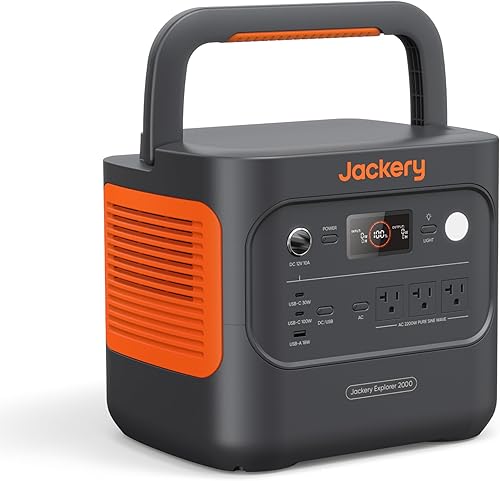
Jackery Explorer 1000 v2 vs. Anker SOLIX C1000 Gen 2
As an Amazon Associate I earn from qualifying purchases. Read our affiliate disclosure.
Top picks at a glance
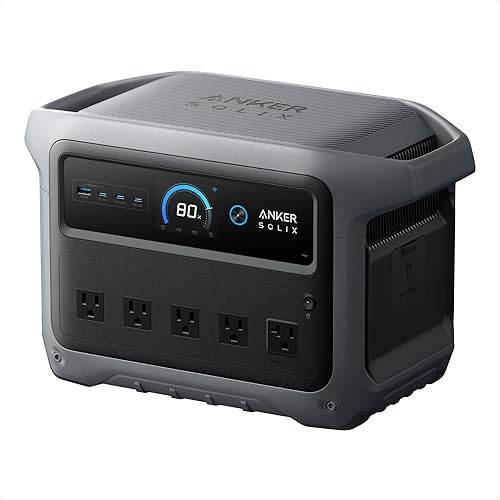 Best for higher-watt devicesAnker SOLIX C1000 Gen 2View on Amazon
 Best for carrying lightJackery Explorer 1000 v2View on Amazon
Pick the Anker SOLIX C1000 Gen 2 if you’ll plug in anything that pulls more than 1,500 W, or you want the battery refilled in under an hour. Pick the Jackery Explorer 1000 v2 if you carry your station a lot. It’s 1.1 lb lighter and stores 46 Wh more.
Everything below comes from the Jackery and Anker spec pages as they read in November 2026. We haven’t used either station, so treat this as a side-by-side reading of their published numbers.
Explorer 1000 v2 vs. C1000 Gen 2 at a glance
| Spec | Jackery Explorer 1000 v2 | Anker SOLIX C1000 Gen 2 |
|---|---|---|
| Capacity | 1,070 Wh | 1,024 Wh |
| AC output | 1,500 W | 2,000 W |
| Surge or peak | 3,000 W | 3,000 W |
| Solar input | 400 W | 600 W |
| AC charge | About 1.6 hours | 49 minutes |
| UPS switchover | Under 20 ms | Under 10 ms |
| Listed noise | 30 dB | 20 dB |
| Use range | 14°F to 113°F | -4°F to 104°F |
| Battery rating | 4,000 cycles to 70%+ | 4,000 cycles to 80% |
| Weight | 23.8 lb | 24.9 lb |
Where the Anker C1000 Gen 2 wins
Output: 2,000 W gives a third more headroom than the Jackery’s 1,500 W. Kettles, hair dryers, and small space heaters are often labeled close to 1,500 W, so this is the gap most likely to matter.
Recharge speed: Anker lists a full wall charge in 49 minutes. Jackery’s figure is about 1.6 hours, nearly twice as long.
Solar input: the Anker takes 600 W against the Jackery’s 400 W. With enough panels and strong sun, that’s a faster refill.
Battery rating: both list 4,000 cycles, but Anker says 80% capacity remains at that point, while Jackery says 70% or more.
Cold use: Anker rates it for use down to -4°F. The Jackery stops at 14°F.
Where the Jackery Explorer 1000 v2 wins
Weight and energy per pound: 23.8 lb and 1,070 Wh work out to 45.0 Wh per lb. The Anker comes to 41.1 Wh per lb.
Heat: Jackery lists use up to 113°F, and Anker’s limit is 104°F. That helps in a hot car or a summer campsite.
Capacity: 46 Wh more is a small edge, about 40 extra minutes at a 60 W load after losses.
Runtime with a light campsite load
Suppose you run 75 W for a whole evening, such as a laptop plus a string of lights. We assume 85% of each battery reaches your devices.
| Model | Usable energy | Hours at 75 W |
|---|---|---|
| Jackery Explorer 1000 v2 | About 910 Wh | About 12.1 hours |
| Anker SOLIX C1000 Gen 2 | About 870 Wh | About 11.6 hours |
At light loads the two are close, so output and charging speed should drive the decision more than capacity.
The two stations in detail
Anker SOLIX C1000 Gen 2
- Capacity
- 1,024 Wh
- AC output
- 2,000 W
- Solar input
- 600 W
- Weight
- 24.9 lb
Who it's for: People who want about 1 kWh and 2,000 W in a portable box, and don't need to add batteries.
Strengths
- 49-minute full AC charge
- 2,000 W output, 3,000 W peak
- Rated to keep 80% capacity after 4,000 cycles
Weaknesses
- Not expandable
- Lower solar input than the DELTA 3 Plus
Jackery Explorer 1000 v2
- Capacity
- 1,070 Wh
- AC output
- 1,500 W
- Solar input
- 400 W
- Weight
- 23.8 lb
Who it's for: Campers who want about 1 kWh at a low weight and don't run appliances over 1,500 W.
Strengths
- Lightest 1 kWh model we compare
- LiFePO4 battery
- 3,000 W surge rating
Weaknesses
- Lower AC output than the Anker C1000 Gen 2
- Cycle rating is listed to 70% or more, not 80%
How to choose
- List your highest-watt device. If its label is above 1,500 W, the Jackery can’t run it. The Anker can, up to 2,000 W.
- Think about recharging. If you’ll top up during short windows of grid power, the Anker’s 49-minute charge is a real advantage.
- Think about where you’ll use it. Below 14°F, only the Anker is rated for use. Above 104°F, only the Jackery is.
- Weigh the carry. If the station goes in and out of a car often, the Jackery’s lighter build adds up.
For full details, read our Jackery Explorer 1000 v2 review and Anker C1000 Gen 2 review. If neither fits, see our C1000 Gen 2 alternatives.
FAQ
Which is better for camping, the Jackery Explorer 1000 v2 or the Anker C1000 Gen 2?
For light camping loads, the Jackery Explorer 1000 v2 is the easier carry, at 23.8 lb with 1,070 Wh. Choose the Anker C1000 Gen 2 instead if you’ll run a device above 1,500 W or camp below 14°F.
Which one charges faster from the wall?
The Anker SOLIX C1000 Gen 2. Anker lists a full AC charge in 49 minutes, while Jackery lists about 1.6 hours for the Explorer 1000 v2.
Which one is quieter?
On paper, the Anker C1000 Gen 2. Anker lists 20 dB and Jackery lists 30 dB, but neither page says what load or distance those figures were measured at.
Can either one work as a backup for a router?
Both list a UPS-style switchover: under 10 ms for the Anker C1000 Gen 2 and under 20 ms for the Jackery Explorer 1000 v2. Test your own router before relying on either during an outage.