Best Portable Power Station for Van Life
As an Amazon Associate I earn from qualifying purchases. Read our affiliate disclosure.
Top picks at a glance
 Best for most vansEcoFlow DELTA 3 PlusView on Amazon
 Best for parked daysBLUETTI Elite 200 V2View on Amazon
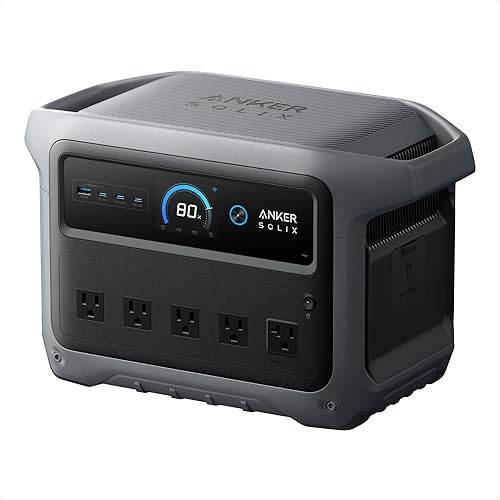 Best for weekend vansAnker SOLIX C1000 Gen 2View on Amazon
For most van builds, we’d start with the EcoFlow DELTA 3 Plus. It can recharge quickly while you drive, take a lot of solar, and grow with extra batteries.
These van life picks come from November 2026 published specs. We haven’t tested them in a van.
Quick comparison
| Model | Capacity | AC output | Max solar input | Weight |
|---|---|---|---|---|
| EcoFlow DELTA 3 Plus | 1,024 Wh, expandable to 5 kWh | 1,800 W | 1,000 W | 27.6 lb |
| BLUETTI Elite 200 V2 | 2,073.6 Wh | 2,600 W | 1,000 W | 53.4 lb |
| Anker SOLIX C1000 Gen 2 | 1,024 Wh, not expandable | 2,000 W | 600 W | 24.9 lb |
How much capacity a van needs
Here is a sample day. Your numbers will differ, so replace them with your own.
| Device | Average watts | Hours | Watt-hours |
|---|---|---|---|
| 12V fridge | 40 | 24 | 960 |
| Laptop | 60 | 4 | 240 |
| Lights | 10 | 4 | 40 |
| Total | 1,240 |
After allowing for 85% efficiency, that’s about 1,460 Wh a day. A 1 kWh station won’t cover this without daily recharging, so how you recharge matters as much as capacity.
EcoFlow DELTA 3 Plus: best for most vans
EcoFlow lists a full charge in about 1.3 hours from an 800 W car charging source. That requires its Alternator Charger, which is a separate purchase and needs installing. Solar input is 1,000 W across two inputs, and you can add batteries later to reach 5 kWh.
The base capacity is the main drawback, as our sample day would use it all. Plan on driving or solar each day, or add a battery.
EcoFlow DELTA 3 Plus
- Capacity
- 1,024 Wh
- AC output
- 1,800 W
- Solar input
- 1,000 W
- Weight
- 27.6 lb
Who it's for: Campers and van owners who want fast recharging, strong solar input, and the option to add batteries later.
Strengths
- Expandable to 5 kWh
- 1,000 W of solar input
- Full charge in about 1.3 hours from an 800 W car source
Weaknesses
- Fast car charging needs a separate Alternator Charger
- 1 kWh base capacity is modest for full-time use
BLUETTI Elite 200 V2: best for parked days
With about twice the capacity, this station can run the sample day with some energy left over. It suits people who stay parked and rely on solar, with up to 1,000 W of input.
The trade-offs are weight and car charging. BLUETTI lists car input at just 96 W on 12V or 192 W on 24V, which is slow for a battery this large.
BLUETTI Elite 200 V2
- Capacity
- 2,073.6 Wh
- AC output
- 2,600 W
- Solar input
- 1,000 W
- Weight
- 53.4 lb
Who it's for: People who stay parked, run on solar, and don't need to carry their station far.
Strengths
- About 2 kWh in one unit
- 1,000 W of solar input
- LiFePO4 battery
Weaknesses
- Heavy to carry at 53.4 lb
- Car input is only 96 W on 12V or 192 W on 24V
Anker SOLIX C1000 Gen 2: best for weekend vans
This is the lightest of the three, with the highest AC output for its size. Anker says it can’t be expanded, so it fits a van you use for short trips better than one you live in.
Anker SOLIX C1000 Gen 2
- Capacity
- 1,024 Wh
- AC output
- 2,000 W
- Solar input
- 600 W
- Weight
- 24.9 lb
Who it's for: People who want about 1 kWh and 2,000 W in a portable box, and don't need to add batteries.
Strengths
- 49-minute full AC charge
- 2,000 W output, 3,000 W peak
- Rated to keep 80% capacity after 4,000 cycles
Weaknesses
- Not expandable
- Lower solar input than the DELTA 3 Plus
What to check next
Before you buy, size your own setup and estimate your solar input. If you plan to wire any charger into your vehicle and aren’t sure how, ask a qualified installer.
How to choose
- Add up a typical day. Use the sample table as a template, and swap in your own devices.
- Pick your main way of recharging. The DELTA 3 Plus suits people who drive most days, while the Elite 200 V2 suits people who stay parked with solar.
- Think about the future. If you may need more capacity later, note that the C1000 Gen 2 can’t be expanded.
- Measure your space. Anker lists the C1000 Gen 2 at 15.12 × 8.19 × 9.61 inches, and it’s worth checking any model against your build.
FAQ
Is a 1 kWh station enough for van life?
Not for our sample day, which needs about 1,460 Wh. It can work if you recharge every day or use less power.
Does the DELTA 3 Plus include the Alternator Charger?
Not on its own. The 800 W Alternator Charger is a separate item, and it needs installing.
How much solar can each one take?
EcoFlow lists 1,000 W for the DELTA 3 Plus. BLUETTI lists 1,000 W for the Elite 200 V2, and Anker lists 600 W for the C1000 Gen 2.