Best Portable Power Station for RV Trips
As an Amazon Associate I earn from qualifying purchases. Read our affiliate disclosure.
Top picks at a glance
 Best for whole-RV powerAnker SOLIX F3800 PlusView on Amazon
 Best 2 kWh option with a TT-30 outletRenogy PowerStation 2000View on Amazon
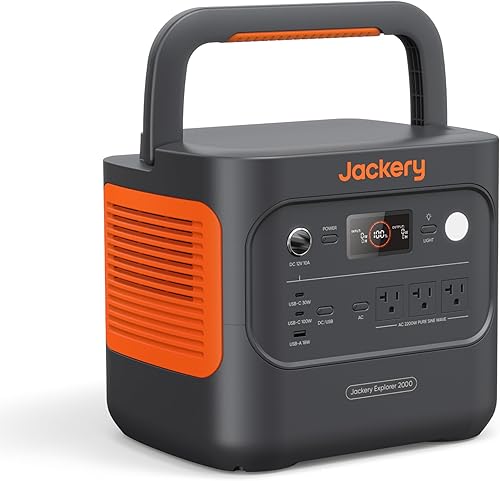
 Best middle optionBLUETTI Elite 200 V2View on Amazon
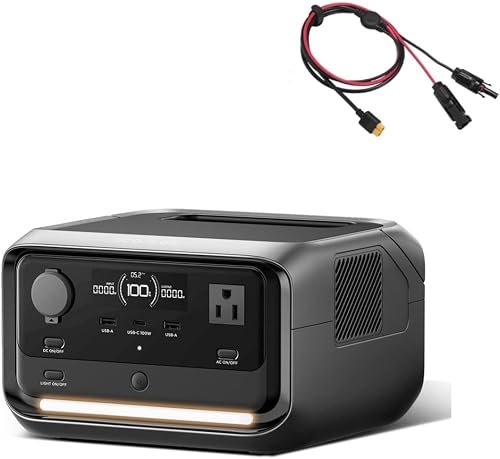
 Best for flexibilityEcoFlow DELTA 3 PlusView on Amazon
If you want to plug in your whole RV, the Anker SOLIX F3800 Plus is the one to look at, as it has a built-in RV outlet. For most other trips, the EcoFlow DELTA 3 Plus is easier to carry and can grow with you.
These RV picks rest on specs published as of November 2026. We haven’t tested them on the road.
Quick comparison
| Model | Capacity | AC output | Max solar input | Weight |
|---|---|---|---|---|
| Anker SOLIX F3800 Plus | 3,840 Wh | 6,000 W | 3,200 W | 136.7 lb |
| Renogy PowerStation 2000 | 2,048 Wh | 2,400 W | 1,200 W DC input | 51.81 lb |
| BLUETTI Elite 200 V2 | 2,073.6 Wh | 2,600 W | 1,000 W | 53.4 lb |
| EcoFlow DELTA 3 Plus | 1,024 Wh, expandable to 5 kWh | 1,800 W | 1,000 W | 27.6 lb |
Can it run the RV air conditioner?
Air conditioning is usually the biggest load in an RV. Check your unit’s label, but as an example, here is what a 1,500 W running load would mean at 85% efficiency:
| Capacity | Estimated runtime at 1,500 W |
|---|---|
| 1,024 Wh | About 35 minutes |
| 2,073.6 Wh | About 1.2 hours |
| 3,840 Wh | About 2.2 hours |
An AC unit cycles on and off, so real runtime may be longer. Its compressor also needs extra power to start, so check the surge rating. Some RV owners fit a soft starter to reduce this. Unless you have a large battery bank, plan on shore power or a generator for all-day cooling.
Anker SOLIX F3800 Plus: best for whole-RV power
Anker lists a NEMA TT-30 port, which is the common 30-amp RV plug, rated at 120V and 3,000 W. There’s also a 120V/240V NEMA L14-30 port and support for up to six expansion batteries. At 136.7 lb, it’s more of a semi-permanent fixture than something you’d lift in and out. It does have wheels.
Anker SOLIX F3800 Plus
- Capacity
- 3,840 Wh
- AC output
- 6,000 W
- Solar input
- 3,200 W
- Weight
- 136.7 lb
Who it's for: RV owners and homeowners with heavy or 240V loads who can keep a large unit in one place.
The photo also shows the Home Power Panel, which Amazon sells with this model in some listings. Check what's included before you buy.
Strengths
- 120V and 240V output
- TT-30 RV port
- Supports up to six 3.84 kWh expansion batteries
Weaknesses
- Very heavy at 136.7 lb, though it has wheels
- AC charging input is 1,800 W
Renogy PowerStation 2000: best 2 kWh option with a TT-30 outlet
Renogy lists a built-in TT-30 outlet with up to 2,400 W of output, so you can connect it directly to a compatible RV without such a large unit. It also lists 3,600 W of surge power, a UPS switchover of up to 20 ms, and a DC input of up to 1,200 W. Its 3,000-cycle rating is lower than some models here.
Renogy PowerStation 2000
- Capacity
- 2,048 Wh
- AC output
- 2,400 W
- DC input
- 1,200 W
- Weight
- 51.81 lb
Who it's for: RV owners who want about 2 kWh with a direct TT-30 connection.
Strengths
- Built-in TT-30 RV outlet
- 3,600 W surge rating
- Listed at 25 dB under a 500 W load
Weaknesses
- Heavy to carry at 51.81 lb
- Rated for 3,000 cycles, fewer than many models we compare
BLUETTI Elite 200 V2: best middle option
This model doubles the capacity of a typical 1 kWh station, with 2,600 W of output for appliances like a microwave. It’s a good fit if you boondock with solar, though its car input is low, at 96 W on 12V or 192 W on 24V.
BLUETTI Elite 200 V2
- Capacity
- 2,073.6 Wh
- AC output
- 2,600 W
- Solar input
- 1,000 W
- Weight
- 53.4 lb
Who it's for: People who stay parked, run on solar, and don't need to carry their station far.
Strengths
- About 2 kWh in one unit
- 1,000 W of solar input
- LiFePO4 battery
Weaknesses
- Heavy to carry at 53.4 lb
- Car input is only 96 W on 12V or 192 W on 24V
EcoFlow DELTA 3 Plus: best for flexibility
If your RV already has basic power, this works well for laptops, fans, and small appliances. It can take up to 1,000 W of solar, and a full charge takes around 1.3 hours from an 800 W car source, which requires EcoFlow’s Alternator Charger.
EcoFlow DELTA 3 Plus
- Capacity
- 1,024 Wh
- AC output
- 1,800 W
- Solar input
- 1,000 W
- Weight
- 27.6 lb
Who it's for: Campers and van owners who want fast recharging, strong solar input, and the option to add batteries later.
Strengths
- Expandable to 5 kWh
- 1,000 W of solar input
- Full charge in about 1.3 hours from an 800 W car source
Weaknesses
- Fast car charging needs a separate Alternator Charger
- 1 kWh base capacity is modest for full-time use
Before you plug in
Check that your RV’s plug matches the port, and find out whether you need an adapter. Any permanent connection to your RV’s electrical system should be done by a qualified technician.
Then work out your daily use. You may also want to look at solar panels or read our van life comparison.
How to choose
- Check your plug. Anker and Renogy list a TT-30 outlet on these models. We didn’t confirm one for the other two, so check before you buy.
- Find your biggest load. The AC output has to cover it, and air conditioning is usually the one that decides this.
- Plan how you’ll recharge. Choose the DELTA 3 Plus if you’ll charge while driving, or look at solar input if you’ll stay parked.
- Be realistic about weight. At 136.7 lb, the F3800 Plus stays where you put it.
FAQ
Can a power station run an RV air conditioner?
For a while. Our example 1,500 W load would run for about 2.2 hours on 3,840 Wh, so plan on shore power or a generator for all-day cooling.
Can I recharge while I drive?
EcoFlow lists about 1.3 hours for a full charge of the DELTA 3 Plus from an 800 W car source, which needs its Alternator Charger. BLUETTI lists 96 W on 12V or 192 W on 24V for the Elite 200 V2, which is much slower.
How much power does a TT-30 port deliver?
Anker lists the F3800 Plus port at 120V and 3,000 W. Renogy says the PowerStation 2000 connects with up to 2,400 W of output.