Best Fast-Charging Power Station
As an Amazon Associate I earn from qualifying purchases. Read our affiliate disclosure.
Top picks at a glance
 Fastest AC chargeAnker SOLIX C1000 Gen 2View on Amazon
 Best for solar and car chargingEcoFlow DELTA 3 PlusView on Amazon
 Fastest 2 kWh optionBLUETTI Elite 200 V2View on Amazon
For the fastest wall charge, we’d pick the Anker SOLIX C1000 Gen 2, with a listed 49 minutes. If you charge away from home, the EcoFlow DELTA 3 Plus is nearly as quick from a wall and much stronger on solar and car charging.
Charge times here are what makers published as of November 2026. We haven’t tested these models or timed them.
Quick comparison
| Model | Capacity | Listed full AC charge | Max solar input |
|---|---|---|---|
| Anker SOLIX C1000 Gen 2 | 1,024 Wh | 49 minutes | 600 W |
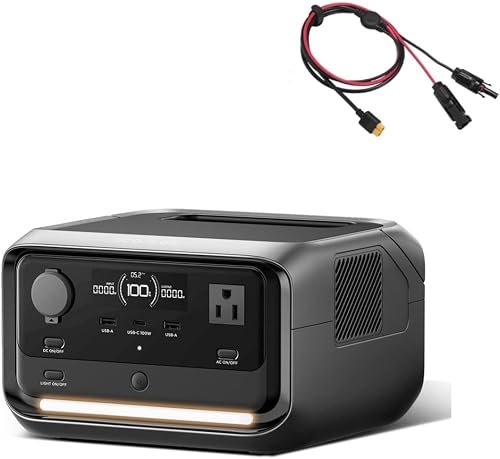
| EcoFlow DELTA 3 Plus | 1,024 Wh | 56 minutes | 1,000 W |
| EcoFlow RIVER 3 Plus | 286 Wh | 1 hour | Not found |
| Goal Zero Yeti 1500 | 1,505 Wh | About 1.1 hours | 900 W |
| BLUETTI Elite 200 V2 | 2,073.6 Wh | 1.4 hours | 1,000 W |
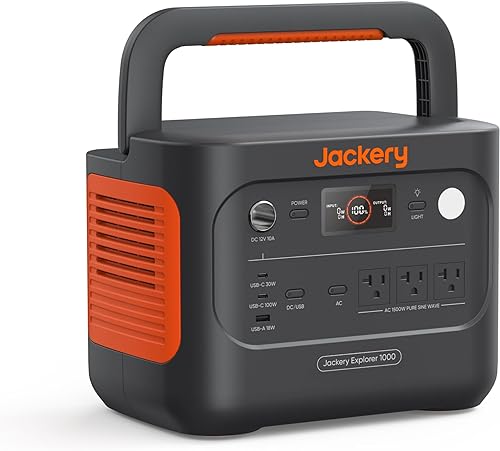
| Jackery Explorer 1000 v2 | 1,070 Wh | About 1.6 hours | 400 W |
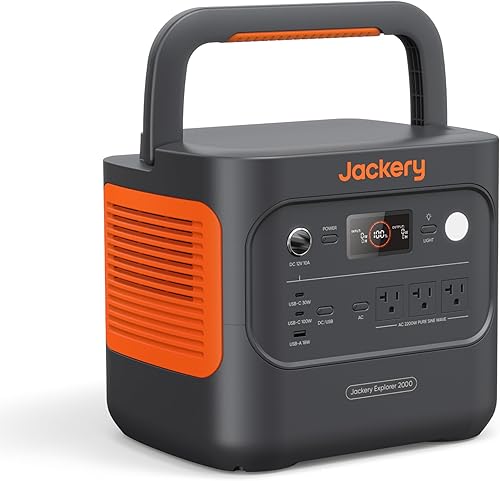
| Jackery Explorer 2000 v2 | 2,042 Wh | About 1.75 hours | 400 W |
Some figures use a maker’s fast-charge mode, such as Anker’s UltraFast and BLUETTI’s TurboBoost.
How long does solar charging take?
We use the same 0.7 rule of thumb as our other solar guides, to allow for heat, panel angle, and losses:
Peak sun hours needed = battery watt-hours ÷ (panel watts × 0.7)
This table shows the peak sun hours needed to charge from empty.
| Battery size | 200 W of panels | 400 W of panels | 800 W of panels |
|---|---|---|---|
| 286 Wh | About 2 | About 1 | About 0.5 |
| 1,024 Wh | About 7.3 | About 3.7 | About 1.8 |
| 2,048 Wh | About 14.6 | About 7.3 | About 3.7 |
| 3,840 Wh | About 27.4 | About 13.7 | About 6.9 |
Peak sun hours aren’t the same as daylight hours. With 5 peak sun hours a day, 7.3 takes about a day and a half. Anything you run during the day comes out of what’s going into the battery.
Published times are usually best-case figures. Jackery lists 7.5 hours for the Explorer 1000 v2 with a SolarSaga 200W, which lines up well with our estimate. EcoFlow lists 70 minutes for the DELTA 3 Plus, but that needs a full 1,000 W reaching the station.
Anker SOLIX C1000 Gen 2: fastest AC charge
Anker lists 49 minutes with UltraFast charging, which helps if power returns only briefly. Read our full C1000 Gen 2 review.
Anker SOLIX C1000 Gen 2
- Capacity
- 1,024 Wh
- AC output
- 2,000 W
- Solar input
- 600 W
- Weight
- 24.9 lb
Who it's for: People who want about 1 kWh and 2,000 W in a portable box, and don't need to add batteries.
Strengths
- 49-minute full AC charge
- 2,000 W output, 3,000 W peak
- Rated to keep 80% capacity after 4,000 cycles
Weaknesses
- Not expandable
- Lower solar input than the DELTA 3 Plus
EcoFlow DELTA 3 Plus: best for solar and car charging
EcoFlow lists 56 minutes from AC, 1,000 W of solar input, and about 1.3 hours from an 800 W car source, which needs its separate Alternator Charger. Read our full DELTA 3 Plus review.
EcoFlow DELTA 3 Plus
- Capacity
- 1,024 Wh
- AC output
- 1,800 W
- Solar input
- 1,000 W
- Weight
- 27.6 lb
Who it's for: Campers and van owners who want fast recharging, strong solar input, and the option to add batteries later.
Strengths
- Expandable to 5 kWh
- 1,000 W of solar input
- Full charge in about 1.3 hours from an 800 W car source
Weaknesses
- Fast car charging needs a separate Alternator Charger
- 1 kWh base capacity is modest for full-time use
BLUETTI Elite 200 V2: fastest 2 kWh option
BLUETTI lists 1.4 hours with TurboBoost, the quickest published time we found among the 2 kWh models. Car charging is slow, though, at 96 W on 12V or 192 W on 24V.
BLUETTI Elite 200 V2
- Capacity
- 2,073.6 Wh
- AC output
- 2,600 W
- Solar input
- 1,000 W
- Weight
- 53.4 lb
Who it's for: People who stay parked, run on solar, and don't need to carry their station far.
Strengths
- About 2 kWh in one unit
- 1,000 W of solar input
- LiFePO4 battery
Weaknesses
- Heavy to carry at 53.4 lb
- Car input is only 96 W on 12V or 192 W on 24V
How to choose
- Decide how you’ll charge most often. Wall, solar, and car speeds vary widely.
- Compare speed with capacity. A larger battery takes more to fill, so compare like with like.
- Check the mode. Find out if the listed speed needs a special charging mode.
- Check for extra parts. Fast car charging may need a separate accessory.
FAQ
How long does it take to charge a power station with solar?
With a 200 W panel, a 1 kWh station needs about 7 peak sun hours. That usually means about two days.
Does fast charging harm the battery?
We didn’t find a clear answer on these product pages. Check the maker’s manual, as some offer a slower, quieter mode.
Why don’t I get the full wattage from my panel?
A panel’s rating comes from test conditions. In real use, the sun’s angle, heat, and clouds all reduce the output.
Want more solar? See our solar charging picks.