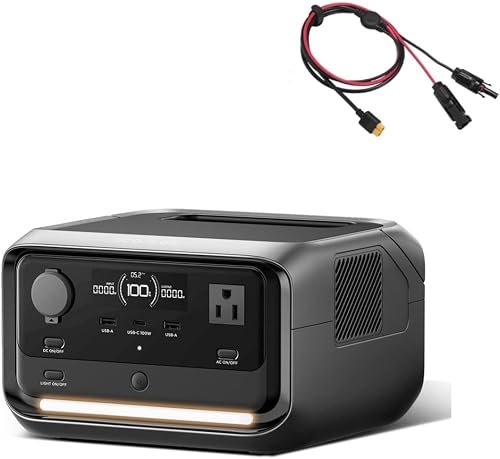
Renogy PowerStation 2000 vs. BLUETTI Elite 200 V2
As an Amazon Associate I earn from qualifying purchases. Read our affiliate disclosure.
Top picks at a glance
 Best for RV hookupsRenogy PowerStation 2000View on Amazon
 Best for more AC outputBLUETTI Elite 200 V2View on Amazon
These two are close in size and weight, so look at how you’ll connect them. Choose the Renogy PowerStation 2000 if you want to plug straight into an RV through its TT-30 outlet. Choose the BLUETTI Elite 200 V2 if you want a little more continuous output and a faster listed AC charge.
Everything below comes from specs published as of November 2026, and we haven’t tested the Renogy or the BLUETTI.
Side by side
| Spec | Renogy PowerStation 2000 | BLUETTI Elite 200 V2 |
|---|---|---|
| Capacity | 2,048 Wh | 2,073.6 Wh |
| AC output | 2,400 W | 2,600 W |
| Listed peak | 3,600 W surge | 3,900 W for resistive loads |
| Charging input | 1,200 W DC input | 1,000 W solar input |
| TT-30 RV outlet | Yes | Not confirmed |
| Weight | 51.81 lb | 53.4 lb |
| Battery | LiFePO4, 3,000 cycles | LiFePO4, cycles not found |
| Listed noise | 25 dB at a 500 W load | 16 dB at low loads |
| UPS switchover | Up to 20 ms | Not found |
Where the Renogy wins
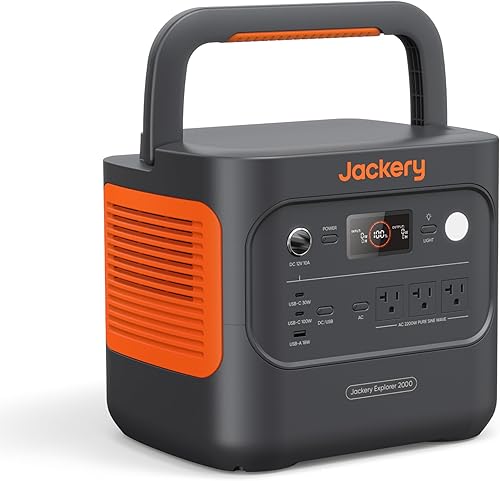
RV connection: Renogy lists a built-in TT-30 outlet, which it says matches the plug used by most RVs and trailers, with up to 2,400 W of output.
Startup power: its 3,600 W surge rating covers motor starts. BLUETTI’s 3,900 W mode is only for pure resistive loads, and we didn’t find a separate surge rating on its page.
Published details: Renogy lists a cycle rating, operating temperatures, and UPS time. It gives a charging range of 32°F to 104°F and a discharge range of 14°F to 104°F. We couldn’t find these details on BLUETTI’s page.
Renogy PowerStation 2000
- Capacity
- 2,048 Wh
- AC output
- 2,400 W
- DC input
- 1,200 W
- Weight
- 51.81 lb
Who it's for: RV owners who want about 2 kWh with a direct TT-30 connection.
Strengths
- Built-in TT-30 RV outlet
- 3,600 W surge rating
- Listed at 25 dB under a 500 W load
Weaknesses
- Heavy to carry at 51.81 lb
- Rated for 3,000 cycles, fewer than many models we compare
Where the BLUETTI wins
Continuous output: at 2,600 W, it has 200 W more than the Renogy.
AC charging: BLUETTI lists a full charge in 1.4 hours with TurboBoost. We didn’t find a full AC charge time on Renogy’s page.
Warranty: BLUETTI lists 5 years. Renogy’s page links to a warranty download, but we didn’t find the length in its specs.
One weak spot is car charging. BLUETTI lists 96 W on 12V or 192 W on 24V, so it’s slow to recharge while you drive.
BLUETTI Elite 200 V2
- Capacity
- 2,073.6 Wh
- AC output
- 2,600 W
- Solar input
- 1,000 W
- Weight
- 53.4 lb
Who it's for: People who stay parked, run on solar, and don't need to carry their station far.
Strengths
- About 2 kWh in one unit
- 1,000 W of solar input
- LiFePO4 battery
Weaknesses
- Heavy to carry at 53.4 lb
- Car input is only 96 W on 12V or 192 W on 24V
Where they’re close
Weight differs by only 1.6 lb, and capacity is within about 26 Wh. Their charging inputs are close too, and both accept up to 60 V. Renogy’s 1,200 W figure is for its DC input, so check how it applies to your panels.
Don’t read too much into the noise figures. The two makers measure at different loads, so they aren’t a direct comparison.
How to choose
- Connecting directly to an RV: Renogy PowerStation 2000
- Running a motor or compressor: Renogy PowerStation 2000, thanks to its published surge rating
- Running more at once from AC outlets: BLUETTI Elite 200 V2
- Recharging quickly from a wall outlet: BLUETTI Elite 200 V2, based on its published charge time
FAQ
Can the Renogy connect to my RV’s shore power inlet?
Renogy says the TT-30 outlet allows a direct connection to compatible RVs with up to 2,400 W of output. Check your RV’s plug, and ask a qualified technician about anything beyond plugging in.
Which one is lighter?
The Renogy, at 51.81 lb compared with 53.4 lb. Neither is easy to carry far.
Can I use the Renogy while it’s charging?
Yes. Renogy says it supports pass-through charging.
See all our picks in the RV guide, or check how much solar you need.