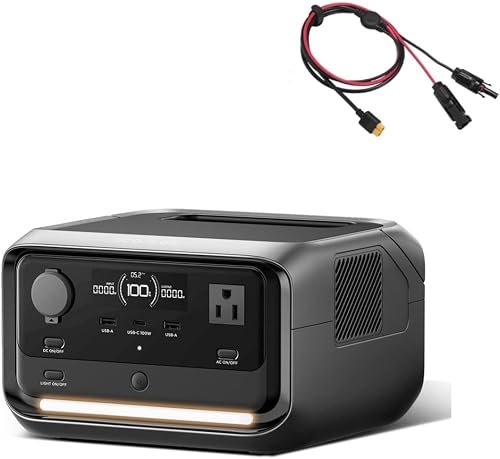
DJI Power 2000 Review: What the Specs Tell You
As an Amazon Associate I earn from qualifying purchases. Read our affiliate disclosure.
At a glance
 Best 2 kWh starting pointDJI Power 2000View on Amazon
The DJI Power 2000 gives you 3,000 W from a 2 kWh station, and it can grow to 22,528 Wh. The main catch is solar, which needs a separate DJI module or charger.
This DJI Power 2000 review draws on specs DJI has published, last checked in November 2026. We haven’t tested the unit.
DJI Power 2000 key specs
| Spec | DJI Power 2000 |
|---|---|
| Capacity | 2,048 Wh |
| Expansion | Up to 10 batteries, 22,528 Wh |
| Battery | LFP, over 80% after 4,000 cycles |
| AC output | 3,000 W |
| Solar input | 400 W with the adapter module, or up to 1,800 W with the 1.8 kW charger |
| Switchover | 0.01 seconds |
| Use and charge range | 14°F to 113°F, 32°F to 113°F |
| Size | 448 × 225 × 324 mm |
| Weight | About 48.5 lb |
| Warranty | 5 years |
Who is the DJI Power 2000 for?
- People who run several appliances at once
- Homeowners who want to add batteries over time
- Anyone who wants a strong battery rating
Skip it if you want to plug panels straight in without an accessory, or you need 240V.
DJI Power 2000 strengths
Output: 3,000 W is the highest of the 2 kWh models we compare.
Expansion: DJI says up to 10 batteries can take it to 22,528 Wh.
Battery rating: DJI lists over 80% capacity after 4,000 cycles.
DJI Power 2000 weaknesses
Solar needs extra parts: you’ll need DJI’s adapter module or its 1.8 kW charger.
Weight: about 48.5 lb is 9 lb heavier than the Jackery Explorer 2000 v2.
Published details: we didn’t find a surge rating, and DJI’s pages give different times for reaching 80%, at 45 and 55 minutes.
DJI Power 2000
- Capacity
- 2,048 Wh
- AC output
- 3,000 W
- Expansion
- Up to 22,528 Wh
- Weight
- About 48.5 lb
Who it's for: People who want high output from a 2 kWh station and may add batteries later.
Strengths
- 3,000 W output
- Takes up to 10 expansion batteries
- Rated to keep over 80% capacity after 4,000 cycles
Weaknesses
- Solar charging needs a separate DJI module or charger
- Heavy to carry at about 48.5 lb
How long will the DJI Power 2000 run?
Allowing for 15% conversion loss, roughly 1,741 Wh of the 2,048 Wh reaches your devices.
| Load | Estimated runtime |
|---|---|
| 100 W | About 17 hours |
| 500 W | About 3.5 hours |
| 1,000 W | About 1.7 hours |
How does the DJI Power 2000 compare?
Here it sits between the Jackery Explorer 2000 v2 and Renogy PowerStation 2000, the closest stations in capacity. Its 3,000 W tops this group. Published specs fill the first columns, and we derived the final one by dividing Wh by pounds.
| Model | Capacity | AC output | Weight | Capacity per pound |
|---|---|---|---|---|
| Jackery Explorer 2000 v2 | 2,042 Wh | 2,200 W | 39.5 lb | 51.7 Wh/lb |
| DJI Power 2000 | 2,048 Wh | 3,000 W | About 48.5 lb | 42.2 Wh/lb |
| Renogy PowerStation 2000 | 2,048 Wh | 2,400 W | 51.81 lb | 39.5 Wh/lb |
How to choose
The Power 2000 suits you if you want high output and room to grow. If you’d rather carry less, read DJI Power 2000 vs. Jackery Explorer 2000 v2. For other expandable systems, see our expandable picks.
FAQ
How many batteries can I add?
DJI says up to 10 expansion batteries, for a total of 22,528 Wh.
Can I connect solar panels directly?
DJI lists two accessories for solar: the Solar Panel Adapter Module, up to 400 W, and the 1.8 kW Solar/Car Super Fast Charger, up to 1,800 W.
How fast does it switch over in an outage?
DJI says it can start powering connected devices within 0.01 seconds. Test your own setup before you rely on it.