Best Power Station for High-Wattage Appliances
As an Amazon Associate I earn from qualifying purchases. Read our affiliate disclosure.
Top picks at a glance
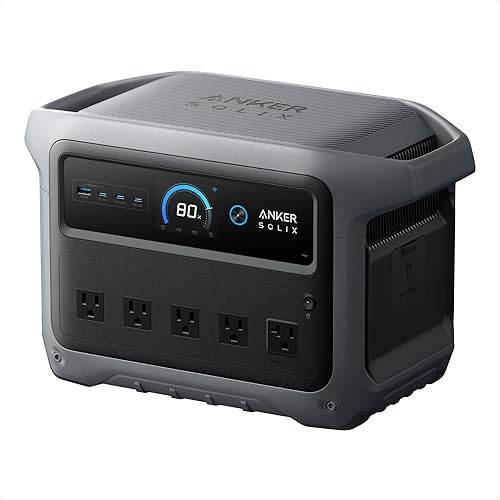 Best portable optionAnker SOLIX C1000 Gen 2View on Amazon
 Best 2 kWh optionDJI Power 2000View on Amazon
 Most outputAnker SOLIX F3800 PlusView on Amazon
If you want to run a microwave or coffee maker from something you can carry, we’d pick the Anker SOLIX C1000 Gen 2, with 2,000 W from a 24.9 lb station. For longer runtime, the DJI Power 2000 has 3,000 W and twice the capacity.
We compared published output ratings in November 2026. We haven’t tested these stations with real appliances.
Quick comparison
| Model | AC output | Capacity | Runtime at 1,500 W | Weight |
|---|---|---|---|---|
| Anker SOLIX C1000 Gen 2 | 2,000 W | 1,024 Wh | About 35 minutes | 24.9 lb |
| DJI Power 2000 | 3,000 W | 2,048 Wh | About 70 minutes | About 48.5 lb |
| Anker SOLIX F3800 Plus | 6,000 W | 3,840 Wh | About 2.2 hours | 136.7 lb |
Runtime estimates assume 85% efficiency.
Watts vs. watt-hours
Watt-hours tell you how much energy a power station stores. Watts tell you how much power it can deliver at any moment.
Think of a water tank. Watt-hours are the size of the tank, and watts are how fast water can flow from the tap.
| Situation | Check first |
|---|---|
| Running small devices for a long time | Watt-hours |
| Running a high-power appliance | Continuous watts |
| Starting a fridge or power tool | Surge watts |
Continuous output is what the station can hold. If a station has a 600 W output, it can’t power a 1,500 W device, even with a full battery. It will usually shut off or refuse to start the load.
Surge output is the higher level a station can supply briefly. It matters for devices with motors or compressors, which draw extra power as they start.
A large battery with a low output can’t run a heavy appliance. A high output with a small battery can run it, but not for long.
Anker SOLIX C1000 Gen 2: best portable option
Its 2,000 W output leaves room above a 1,500 W appliance. It uses energy quickly at that level, so it suits short jobs like making coffee. Read our full C1000 Gen 2 review.
Anker SOLIX C1000 Gen 2
- Capacity
- 1,024 Wh
- AC output
- 2,000 W
- Solar input
- 600 W
- Weight
- 24.9 lb
Who it's for: People who want about 1 kWh and 2,000 W in a portable box, and don't need to add batteries.
Strengths
- 49-minute full AC charge
- 2,000 W output, 3,000 W peak
- Rated to keep 80% capacity after 4,000 cycles
Weaknesses
- Not expandable
- Lower solar input than the DELTA 3 Plus
DJI Power 2000: best 2 kWh option
At 3,000 W, you can run more than one large appliance at a time, and it has twice the energy of the Anker. We didn’t find a surge rating on DJI’s pages, so leave headroom for motors.
DJI Power 2000
- Capacity
- 2,048 Wh
- AC output
- 3,000 W
- Expansion
- Up to 22,528 Wh
- Weight
- About 48.5 lb
Who it's for: People who want high output from a 2 kWh station and may add batteries later.
Strengths
- 3,000 W output
- Takes up to 10 expansion batteries
- Rated to keep over 80% capacity after 4,000 cycles
Weaknesses
- Solar charging needs a separate DJI module or charger
- Heavy to carry at about 48.5 lb
Anker SOLIX F3800 Plus: most output
With 6,000 W and 120V and 240V output, this is the most powerful station we compare. It suits heavy home and RV loads, and it’s a large unit at 136.7 lb.
Anker SOLIX F3800 Plus
- Capacity
- 3,840 Wh
- AC output
- 6,000 W
- Solar input
- 3,200 W
- Weight
- 136.7 lb
Who it's for: RV owners and homeowners with heavy or 240V loads who can keep a large unit in one place.
The photo also shows the Home Power Panel, which Amazon sells with this model in some listings. Check what's included before you buy.
Strengths
- 120V and 240V output
- TT-30 RV port
- Supports up to six 3.84 kWh expansion batteries
Weaknesses
- Very heavy at 136.7 lb, though it has wheels
- AC charging input is 1,800 W
If your high-wattage load is a saw or compressor, read our guide to the best power station for power tools.
How to choose
- Find your highest-wattage appliance. Check its label.
- Add anything you’ll run at the same time. The station’s continuous output should be above the total.
- Decide how long you need it. Divide usable watt-hours by your load.
- Check for 240V. Most stations are 120V only, so look at larger models for 240V loads.
FAQ
Can a power station run a microwave?
Yes, if its continuous output is above the microwave’s rated input. Check the label, as this can be higher than the cooking power shown on the front.
What happens if I go over the output limit?
The station will usually shut off or refuse to start the load.
Are watts or watt-hours more important?
You need both. Watts decide what you can run, and watt-hours decide how long you can run it.
To work out your own numbers, try the runtime calculator.