Best Power Station with 240V Output
As an Amazon Associate I earn from qualifying purchases. Read our affiliate disclosure.
Top picks at a glance
 Best for strongest 240V outputAnker SOLIX F3800 PlusView on Amazon
 Best for capacity and expansionEcoFlow DELTA Pro 3View on Amazon
Choose the Anker SOLIX F3800 Plus if you need the strongest 240V output. Choose the EcoFlow DELTA Pro 3 if you need more capacity and room to expand. Both stations give 120V and 240V output, so the choice comes down to output, capacity, solar input, and weight.
The makers’ published specs, current in November 2026, are the source for this guide. Neither station was held or run by PowerPicked Editorial. Only those published specs are used below.
At a glance: which station gives 240V output?
| Spec | Anker SOLIX F3800 Plus | EcoFlow DELTA Pro 3 |
|---|---|---|
| Capacity | 3,840 Wh | 4 kWh |
| AC output | 6,000 W | 4,000 W |
| Solar input | 3,200 W | Not listed |
| Weight | 136.7 lb | Not listed |
| Voltage | 120V and 240V | 120V and 240V |
| Expansion | Up to six 3.84 kWh batteries | Up to 12 kWh per unit |
A watt-hour, written Wh, measures stored energy, and a kilowatt-hour, or kWh, is 1,000 Wh. AC output, in watts, or W, is the power a station sends to a plug-in device. Solar input, in watts, is the largest amount of power a station can accept from panels.
The F3800 Plus has 2,000 W more AC output than the DELTA Pro 3. The DELTA Pro 3 holds more energy, at 4 kWh against 3,840 Wh. The F3800 Plus has a listed solar input of 3,200 W. A solar input figure for the DELTA Pro 3 is not listed in the reference files. A weight figure for the DELTA Pro 3 is not listed either.
For more detail on each station on its own, see the Anker SOLIX F3800 Plus review and the EcoFlow DELTA Pro 3 review.
Is the Anker SOLIX F3800 Plus the right pick for you?
The F3800 Plus suits a home or RV that stays in one place and runs heavy or 240V loads.
Anker SOLIX F3800 Plus
- Capacity
- 3,840 Wh
- AC output
- 6,000 W
- Solar input
- 3,200 W
- Weight
- 136.7 lb
Who it's for: RV owners and homeowners with heavy or 240V loads who can keep a large unit in one place.
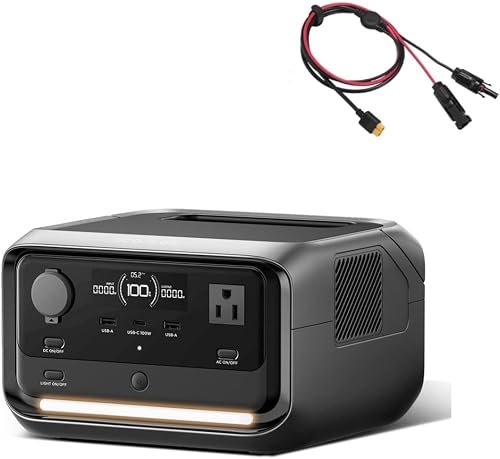
The photo also shows the Home Power Panel, which Amazon sells with this model in some listings. Check what's included before you buy.
Strengths
- 120V and 240V output
- TT-30 RV port
- Supports up to six 3.84 kWh expansion batteries
Weaknesses
- Very heavy at 136.7 lb, though it has wheels
- AC charging input is 1,800 W
Its strengths start with output. At 6,000 W, its AC output is 2,000 W higher than the DELTA Pro 3. It gives both 120V and 240V output. It has a TT-30 RV port, a port made for RV power cords. It can take up to six expansion batteries, each 3.84 kWh. Its solar input is 3,200 W.
Its weaknesses are clear too. At 136.7 lb, it is very heavy, although it has wheels. Its AC charging input is 1,800 W.
For usable energy, this guide counts 85% of the listed capacity as reaching your devices. On that basis, the F3800 Plus gives about 3,264 Wh, from 3,840 Wh times 0.85. A 100 W load would run for about 32.6 hours on that amount. The F3800 Plus holds about 28.1 Wh per pound, from 3,840 Wh divided by 136.7 lb.
Is the EcoFlow DELTA Pro 3 the right pick for you?
The DELTA Pro 3 suits a home that needs 120V and 240V backup, with room to add batteries later.
EcoFlow DELTA Pro 3
- Capacity
- 4 kWh
- AC output
- 4,000 W
- Voltage
- 120V and 240V
- Expansion
- Up to 12 kWh per unit
Who it's for: Homeowners who want 120V and 240V backup and may add batteries over time.
Strengths
- Expands to 12 kWh on one unit, more as a multi-unit system
- 120V and 240V output
- Rated to keep 80% capacity after 4,000 cycles
Weaknesses
- Lower continuous output than the F3800 Plus
- More capacity than small essential loads need
Its strengths start with capacity. At 4 kWh, it holds more energy than the F3800 Plus. It gives both 120V and 240V output. It can expand to 12 kWh on one unit, and more as a multi-unit system. The published specs list a rating to keep 80% capacity after 4,000 cycles.
Its weaknesses are clear too. Its AC output is 4,000 W, lower than the 6,000 W of the F3800 Plus. Its stored energy is more than a light backup plan needs. A weight figure and a solar input figure for the DELTA Pro 3 are not listed in the reference files, so this guide does not give them.
Using that same 85% basis, the DELTA Pro 3 gives about 3.4 kWh of usable energy, from 4 kWh times 0.85. A 100 W load would run for about 34.0 hours on that amount.
How to choose
Begin with the loads you plan to run. If any load needs more than 4,000 W, the DELTA Pro 3 will not run it. The F3800 Plus, with 6,000 W of AC output, gives more room here.
For capacity and growth, the DELTA Pro 3 holds 4 kWh and can expand to 12 kWh on one unit. The F3800 Plus holds 3,840 Wh and can take up to six expansion batteries, each 3.84 kWh.
For solar and weight, the F3800 Plus lists 3,200 W of input. A solar input figure for the DELTA Pro 3 is not listed. The F3800 Plus weighs 136.7 lb, although it has wheels.
FAQ
Which station has the higher AC output?
The Anker SOLIX F3800 Plus has the higher AC output. Its AC output is 6,000 W, while the EcoFlow DELTA Pro 3 has an AC output of 4,000 W. The gap is 2,000 W.
Which one gives you more usable energy?
The EcoFlow DELTA Pro 3 holds slightly more. On an 85% usable-energy basis, the DELTA Pro 3 gives about 3.4 kWh, and the Anker SOLIX F3800 Plus gives about 3,264 Wh.
Which one lists a solar input figure?
The Anker SOLIX F3800 Plus has a listed solar input of 3,200 W. A solar input figure for the EcoFlow DELTA Pro 3 is not listed in the reference files, so this guide does not give one.
Do both stations give 240V output?
Yes. Both stations give 120V and 240V output, based on the published specs.