Best Portable Power Station for Travel
As an Amazon Associate I earn from qualifying purchases. Read our affiliate disclosure.
Top picks at a glance
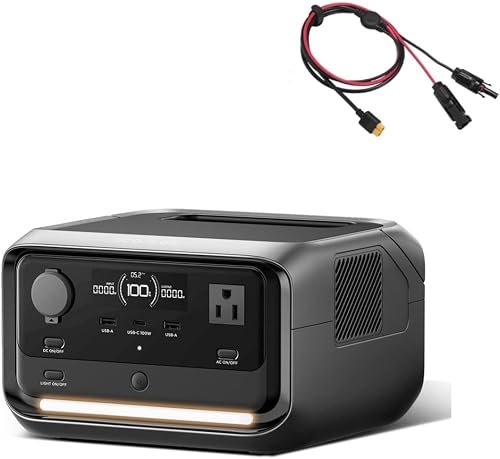 Easiest to travel withEcoFlow RIVER 3 PlusView on Amazon
 Best mid-size optionGoal Zero Yeti 700View on Amazon
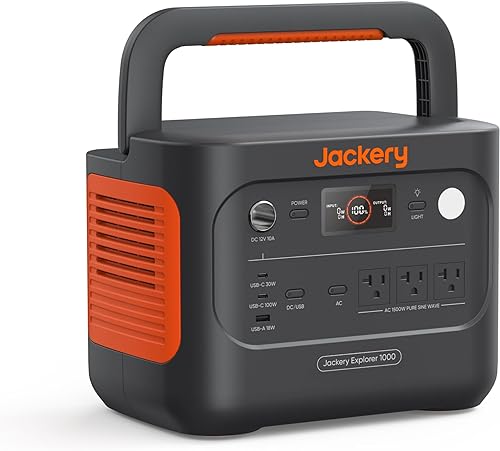 Best for longer road tripsJackery Explorer 1000 v2View on Amazon
For road trips, we’d pick the EcoFlow RIVER 3 Plus if you mainly charge small devices, or the Jackery Explorer 1000 v2 if you need more power. One thing to know first: none of these can go on a passenger plane. The FAA says power stations above 160 watt-hours aren’t allowed in carry-on or checked bags, and the smallest one we compare holds 286 Wh.
We made these travel picks from published specs in November 2026. We haven’t tested them on a trip.
Quick comparison
| Model | Capacity | AC output | Weight | Allowed on a passenger plane? |
|---|---|---|---|---|
| EcoFlow RIVER 3 Plus | 286 Wh | 600 W | 10.4 lb | No |
| Goal Zero Yeti 700 | 677 Wh | 600 W | 20.3 lb | No |
| Jackery Explorer 1000 v2 | 1,070 Wh | 1,500 W | 23.8 lb | No |
Flying: the limits at a glance
These are the FAA’s limits for spare lithium-ion batteries, which include power banks.
| Battery size | Carry-on | Checked bag |
|---|---|---|
| Up to 100 Wh | Allowed | Not allowed |
| 101 to 160 Wh | Airline approval needed, up to two spares | Not allowed |
| Over 160 Wh | Not allowed | Not allowed |
Many airlines set stricter limits, so check with yours before you fly. TSA’s security rules also apply on top of the FAA’s safety rules.
If a battery only lists milliamp-hours, use mAh ÷ 1,000 × volts = Wh. A 20,000 mAh power bank rated at 3.7 V holds 74 Wh, which falls within the 100 Wh limit for carry-on bags.
EcoFlow RIVER 3 Plus: easiest to travel with
At 10.4 lb, it fits easily in a packed car. It suits phones, laptops, lights, and a speaker, and EcoFlow lists operation under 30 dB.
EcoFlow RIVER 3 Plus
- Capacity
- 286 Wh
- AC output
- 600 W
- AC charge
- 1 hour
- Weight
- 10.4 lb
Who it's for: People who mainly charge phones and laptops or keep Wi-Fi on, and want a station that's easy to carry.
Strengths
- Easy to carry at 10.4 lb
- Expandable to 858 Wh
- Listed at under 30 dB
Weaknesses
- Small capacity for high-power devices
- 600 W limits what you can run
Goal Zero Yeti 700: best mid-size option
It holds more than twice as much as the RIVER at 20.3 lb. Goal Zero rates it for use from -4°F to 140°F, which helps with hot parked cars and cold mornings, if you stay within those limits.
Goal Zero Yeti 700
- Capacity
- 677 Wh
- AC output
- 600 W
- Solar input
- 200 W
- Weight
- 20.3 lb
Who it's for: People who need more energy than a small station holds, but mostly run low-power devices.
Strengths
- Rated for use down to -4°F
- Fills the gap between small and 1 kWh stations
- Rated to keep 80% capacity after 4,000+ cycles
Weaknesses
- 600 W limits what you can run
- 200 W of solar input is low
Jackery Explorer 1000 v2: best for longer road trips
It has the most capacity here and 1,500 W of output, with only 3.5 lb more weight than the Yeti 700. Jackery lists about 12 hours for a full charge from a 12V car adapter, so charge it at home if you can.
Jackery Explorer 1000 v2
- Capacity
- 1,070 Wh
- AC output
- 1,500 W
- Solar input
- 400 W
- Weight
- 23.8 lb
Who it's for: Campers who want about 1 kWh at a low weight and don't run appliances over 1,500 W.
Strengths
- Lightest 1 kWh model we compare
- LiFePO4 battery
- 3,000 W surge rating
Weaknesses
- Lower AC output than the Anker C1000 Gen 2
- Cycle rating is listed to 70% or more, not 80%
How to choose
- Decide how you’re traveling. For flights, you’ll need a small power bank, or a station at your destination.
- List your devices. Use our beginner’s guide to add up your watt-hours.
- Measure your space. A packed car often limits what you can bring.
- Plan your recharging. Car charging is slow, so charge before you leave.
FAQ
Can I take a portable power station on a plane?
Almost certainly not. The FAA says power stations over 160 Wh aren’t allowed on passenger aircraft.
Can I remove the battery to fly with it?
Don’t try this. Power stations aren’t designed to be taken apart, and opening one can be dangerous.
Can I ship a power station?
Lithium batteries have their own shipping rules, so ask the carrier what it allows before you pack one.
What can I bring on a plane instead?
A small power bank in your carry-on. Check that it’s under the limit, and check your airline’s rules.