Jackery Explorer 1500 Ultra vs. EcoFlow DELTA 3 Max
As an Amazon Associate I earn from qualifying purchases. Read our affiliate disclosure.
Top picks at a glance
 Best for rain, dust, and the trailJackery Explorer 1500 UltraCheck price on Amazon
 Best for quiet home backupEcoFlow DELTA 3 MaxCheck price on Amazon
Pick the Jackery Explorer 1500 Ultra if your station will live outdoors: it carries an IP65 dust and water rating and takes 800 W of solar. Pick the EcoFlow DELTA 3 Max if it will mostly sit in your home: it holds 512 Wh more, puts out 2,400 W, and switches to battery in under 10 ms.
This head-to-head uses Jackery’s and EcoFlow’s US spec sheets, read in November 2026. We haven’t run either station, so every comparison below is between the numbers each maker publishes.
Jackery Explorer 1500 Ultra: built for the outdoors
Jackery Explorer 1500 Ultra
- Capacity
- 1,536 Wh
- AC output
- 1,800 W
- Solar input
- 800 W
- Weight
- 38.6 lb
Who it's for: Campers, overlanders, and outdoor workers who want about 1.5 kWh in a sealed, weather-ready box.
Strengths
- IP65 dust and water rating with the port covers closed
- Full AC charge in about 1.5 hours
- 3,600 W surge peak
Weaknesses
- Jackery says it can't take an extra battery pack
- Cycle rating is 4,000 to 70%+, not 80%
The 1500 Ultra’s defining trait is its shell. Jackery rates it IP65 dustproof and waterproof when all port covers are secured, and calls it one-meter drop-resistant. That makes it a natural fit for overlanding, job sites, and wet campsites.
It holds 1,536 Wh of LiFePO4 and runs 1,800 W through 3 AC outlets, with a 3,600 W surge peak. Solar input reaches 800 W across two inputs, and a wall outlet fills it in about 1.5 hours. It switches to battery within 20 ms, and the warranty runs 3+2 years.
Its drawbacks are about growth and cold. Jackery says it can’t take an external battery pack, so 1,536 Wh is its limit. Its cycle rating is 4,000 cycles to 70%+, a looser standard than an 80% rating. It can discharge down to 5°F, but output drops to 1,000 W between 5°F and 14°F.
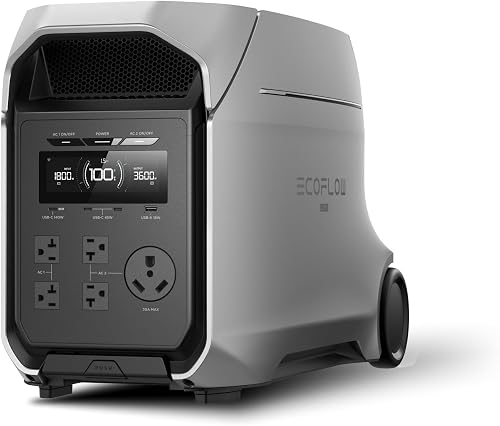
EcoFlow DELTA 3 Max: built for the house
EcoFlow DELTA 3 Max
- Capacity
- 2,048 Wh
- AC output
- 2,400 W
- Solar input
- 500 W
- Weight
- 44.7 lb
Who it's for: Home backup buyers who want 2 kWh with 20 A outlets in a quiet box.
Strengths
- 2,048 Wh with 2,400 W output
- 25 dB at 600 W (maker's test)
- Under 10 ms UPS switchover
Weaknesses
- Solar input only 500 W for a 2 kWh battery
- 0-80% takes 68 minutes on AC
- Heavy at 44.7 lb
The DELTA 3 Max is the better home station. Its 2,048 Wh LFP battery feeds four 120 V outlets rated at 20 A each, for 2,400 W in total, and X-Boost runs suitable appliances at up to 3,400 W. EcoFlow lists a UPS switchover under 10 ms and 25 dB or less at 600 W, measured at 1 m, so it can sit near a desk or a bed.
Wall charging is quick: 1,800 W of AC input takes it from 0 to 80% in 68 minutes. A generator or an alternator charger can refill it too. The warranty reaches 5 years once you register the station in the EcoFlow app.
Solar is its weak spot. It takes only 500 W, and EcoFlow lists 3.43 hours from 0 to 80% at that rate, a slow refill for a 2 kWh battery. An expansion battery isn’t listed, and it weighs 44.7 lb.
How do the specs line up?
| Explorer 1500 Ultra | DELTA 3 Max | |
|---|---|---|
| Capacity | 1,536 Wh | 2,048 Wh |
| AC output | 1,800 W, 3 outlets | 2,400 W, 4 outlets |
| Peak output | 3,600 W surge | 3,400 W X-Boost |
| Solar input | 800 W | 500 W |
| AC charging | about 1.5 hours to full | 68 minutes to 80% |
| UPS switchover | within 20 ms | under 10 ms |
| Water and dust rating | IP65 | Not listed |
| Discharge temperature | 5°F to 113°F | 14-113°F |
| Expansion | Not supported | Not listed |
| Weight | 38.6 lb | 44.7 lb |
| Warranty | 3+2 years | 5 years with app registration |
Which one lasts longer per charge, and per pound?
To estimate runtime, we assume 85% of the listed capacity makes it to your devices.
| Explorer 1500 Ultra | DELTA 3 Max | |
|---|---|---|
| Usable energy at 85% | 1,305.6 Wh | 1,740.8 Wh |
| Hours at a steady 150 W | about 8.7 | about 11.6 |
| Wh per lb | about 39.8 | about 45.8 |
The DELTA 3 Max runs a 150 W load almost 3 hours longer and stores more energy per pound. The 1500 Ultra is 6.1 lb lighter, but you give up energy along with the weight.
How to choose
- Rain, dust, or rough handling: the Explorer 1500 Ultra is the only one with a listed IP65 rating.
- Solar is your main source: the 1500 Ultra’s 800 W input beats the DELTA 3 Max’s 500 W.
- Cold-weather camping: the 1500 Ultra discharges down to 5°F, though at reduced output below 14°F.
- Home backup for a computer or router: the DELTA 3 Max’s under 10 ms switchover and 25 dB rating suit indoor use.
- More appliances at once: the DELTA 3 Max has four 20 A outlets and 2,400 W.
Before buying, compare the nameplate wattage of your appliances with each station’s rated and peak output.
FAQ
Is the Jackery Explorer 1500 Ultra waterproof?
Jackery rates the Explorer 1500 Ultra IP65 dustproof and waterproof, but only when all port covers are secured. The EcoFlow DELTA 3 Max does not list a water or dust rating.
Can either station take an extra battery?
Jackery says the Explorer 1500 Ultra doesn’t support an external battery pack. An expansion battery isn’t listed for the EcoFlow DELTA 3 Max, so plan on 1,536 Wh or 2,048 Wh as the full capacity.
Which station is better for solar charging?
The Jackery Explorer 1500 Ultra accepts up to 800 W of solar across two inputs. The EcoFlow DELTA 3 Max accepts 500 W and lists 3.43 hours from 0 to 80% at that rate.
Which one works better as a UPS for a computer?
The EcoFlow DELTA 3 Max lists a switchover under 10 ms. The Jackery Explorer 1500 Ultra lists within 20 ms. Check your device’s needs, since a faster switchover is safer for sensitive electronics.