DJI Power 1000 Mini vs. Anker SOLIX C1000 Gen 2
As an Amazon Associate I earn from qualifying purchases. Read our affiliate disclosure.
Top picks at a glance
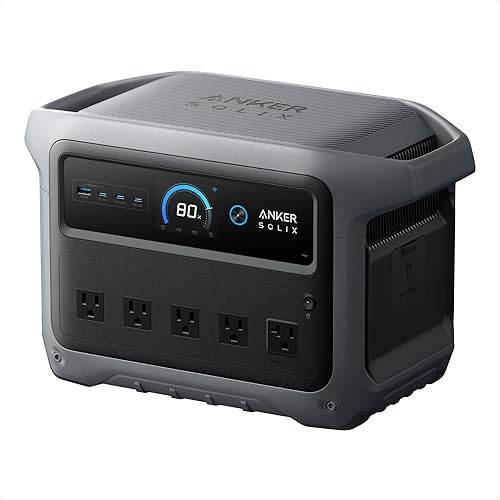 Best for high-watt appliancesAnker SOLIX C1000 Gen 2Check price on Amazon
 Best for laptops and dronesDJI Power 1000 MiniCheck price on Amazon
For most buyers the Anker SOLIX C1000 Gen 2 is the safer choice, because its 2,000 W output covers far more appliances than the DJI Power 1000 Mini’s 800 W continuous rating. The DJI makes sense when your loads are mostly USB-C gear, like laptops, cameras, and drone batteries, and you value its built-in retractable cable.
This comparison draws on DJI’s and Anker’s US specification pages, which we read in November 2026, plus one DJI listing photo for charge times. We have not run either station, so the verdicts reflect published numbers rather than use.
Anker SOLIX C1000 Gen 2: where does it win?
Anker SOLIX C1000 Gen 2
- Capacity
- 1,024 Wh
- AC output
- 2,000 W
- Solar input
- 600 W
- Weight
- 24.9 lb
Who it's for: People who want about 1 kWh and 2,000 W in a portable box, and don't need to add batteries.
Strengths
- 49-minute full AC charge
- 2,000 W output, 3,000 W peak
- Rated to keep 80% capacity after 4,000 cycles
Weaknesses
- Not expandable
- Lower solar input than the DELTA 3 Plus
Output is the big gap. The C1000 Gen 2 is rated for 2,000 W with a 3,000 W peak, so it can run appliances rated well above the DJI’s 800 W continuous limit. Anker lists a UPS switchover under 10 ms and a 20 dB noise figure.
It also refills fast. UltraFast charging fills it in 49 minutes from a wall outlet, and solar input reaches 600 W at up to 60 V. Its battery is rated to keep 80% of capacity after 4,000 cycles, and it weighs 24.9 lb.
Its limits: it can’t be expanded, so 1,024 Wh is all you get. It charges only from 32°F to 104°F, which matters on cold winter trips. A warranty term is not listed in the specs we checked.
DJI Power 1000 Mini: where does it win?
DJI Power 1000 Mini
- Capacity
- 1,008 Wh
- AC output
- 800 W continuous
- Solar input
- 400 W
- Weight
- 25.4 lb
Who it's for: Drone pilots, campers, and remote workers who want 1 kWh in a compact box with a built-in USB-C cable.
Strengths
- Retractable 100 W USB-C cable
- 4 AC outlets on the US model
- 4,000 cycles to 80%
Weaknesses
- 800 W continuous AC output
- Solar input tops out at 400 W
- Warranty isn't listed on the spec page
The Power 1000 Mini is built around USB-C. Besides one USB-C port, it has a retractable USB-C cable that extends 0.8 m, both rated at 100 W, with 150 W in total when both are in use. DJI’s listing says the cable sits in a replaceable module. If most of your devices charge over USB-C, that means fewer cables to pack.
Its LFP battery holds 1,008 Wh and keeps over 80% after 4,000 cycles. The US model has 4 AC outlets. It also has a 300 W SDC output, and a bypass mode that passes up to 1,440 W through while plugged in. DJI’s listing photo gives about 58 minutes to 80% and about 75 minutes to full in Fast Recharge Mode. It works and recharges from 14°F to 113°F, and DJI lists a maximum operating altitude of 5,000 m.
The trade-off is AC power. It delivers 800 W continuously, with a 1,000 W maximum. Solar input stops at 400 W, and DJI’s spec page doesn’t list a warranty.
How do the specs compare?
| SOLIX C1000 Gen 2 | Power 1000 Mini | |
|---|---|---|
| Capacity | 1,024 Wh | 1,008 Wh |
| Cycle rating | 80% after 4,000 cycles | Over 80% after 4,000 cycles |
| AC output | 2,000 W, 3,000 W peak | 800 W continuous, 1,000 W max |
| USB-C | Not listed | Port plus retractable cable, 100 W each |
| Solar input | 600 W | 400 W |
| AC charge | 49 minutes | About 75 minutes to full |
| UPS switchover | Under 10 ms | Not listed |
| Operating range | -4°F to 104°F | 14-113°F |
| Charging range | 32°F to 104°F | 14-113°F |
| Weight | 24.9 lb | 25.4 lb |
| Warranty | Not listed | Not listed |
How long does each one run a laptop setup?
Assume 85% of the battery reaches your devices. That gives about 870.4 Wh for the Anker and about 856.8 Wh for the DJI. On a steady 100 W load, such as a laptop, a monitor, and a router, that is roughly 8.7 hours against 8.6 hours.
By weight they are close: about 41.1 Wh per lb for the Anker and about 39.7 Wh per lb for the DJI. Neither has a real edge to carry, so pick on output and ports.
How to choose
- Appliances rated above 800 W: the Anker’s 2,000 W covers loads the DJI can’t run continuously.
- Cold-weather charging: the DJI recharges down to 14°F, while the Anker needs 32°F.
- Lots of USB-C devices: the DJI’s retractable cable saves packing a separate cord.
- Bigger solar panels: the Anker takes 600 W against the DJI’s 400 W.
- A computer that must stay on in an outage: the Anker lists a switchover time; the DJI does not.
Read the wattage label on anything you plan to plug into the AC outlets before you choose the DJI.
FAQ
Which has more AC output, the DJI Power 1000 Mini or the Anker SOLIX C1000 Gen 2?
The Anker SOLIX C1000 Gen 2 is rated for 2,000 W with a 3,000 W peak. The DJI Power 1000 Mini is rated for 800 W continuous and 1,000 W max, so it suits smaller loads.
Does the DJI Power 1000 Mini have a built-in cable?
Yes. The DJI Power 1000 Mini has a retractable USB-C cable that extends 0.8 m and charges at up to 100 W. It also has a separate USB-C port at 100 W.
Which station refills faster when plugged into the wall?
Anker lists 49 minutes for a full charge of the SOLIX C1000 Gen 2. DJI’s listing gives about 75 minutes to full for the Power 1000 Mini in Fast Recharge Mode.
Can either station be expanded with an extra battery?
The Anker SOLIX C1000 Gen 2 can’t be expanded. DJI’s spec page doesn’t list an expansion battery for the Power 1000 Mini, so plan on about 1 kWh with either one.