EcoFlow DELTA 3 Max Review: The Spec Sheet, Read
As an Amazon Associate I earn from qualifying purchases. Read our affiliate disclosure.
At a glance
 Best quiet 2 kWh boxEcoFlow DELTA 3 MaxCheck price on Amazon
The EcoFlow DELTA 3 Max suits a home backup buyer who wants 2 kWh with 20 A outlets in a quiet box. It puts out 2,400 W, with X-Boost to 3,400 W, and it is listed at 25 dB or less at 600 W.
This review rests on the makers’ published specs, current in November 2026. PowerPicked Editorial did not test the DELTA 3 Max.
Wh counts stored energy, written Wh. A watt is a unit of power. It is written W. AC output is what a station sends to plug-in gear. Solar input caps the power from panels.
EcoFlow DELTA 3 Max
- Capacity
- 2,048 Wh
- AC output
- 2,400 W
- Solar input
- 500 W
- Weight
- 44.7 lb
Who it's for: Home backup buyers who want 2 kWh with 20 A outlets in a quiet box.
Strengths
- 2,048 Wh with 2,400 W output
- 25 dB at 600 W (maker's test)
- Under 10 ms UPS switchover
Weaknesses
- Solar input only 500 W for a 2 kWh battery
- 0-80% takes 68 minutes on AC
- Heavy at 44.7 lb
What does the EcoFlow DELTA 3 Max hold?
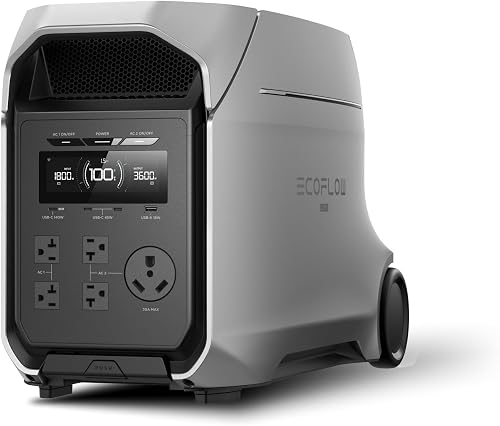
The DELTA 3 Max carries 2,048 Wh in a LiFePO4 battery. It puts out 2,400 W of AC from four 120V outlets, with 20 A at most per port. One 100 W USB-C port and two 30 W USB-C ports sit on it, plus one 18 W USB-A port. A 12.6 V car outlet gives 126 W at most.
The runtime math in this review works from an assumed 85% of the listed capacity. Eighty-five percent of the listed 2,048 Wh gives 1,740.8 Wh of usable energy. A 100 W load gets 17.4 hours from that energy. Dividing 2,048 Wh by 44.7 lb gives about 45.8 Wh per pound.
AC charging runs at 1,800 W at most, reaching 80% in 68 minutes. Panels can send it up to 500 W, and 80% takes 3.43 hours at that input. It also charges from a generator or an alternator charger. Car charging reaches 80% in 3.41 hours, by the listing photo. The UPS mode switches in less than 10 ms. Noise is listed at 25 dB or less at 600 W, measured at 1 m. It connects to the app over Wi-Fi and Bluetooth. It measures 494 by 239 by 305 mm and weighs about 44.7 lb. A 5-year warranty covers it, with 3 years standard and 2 more after app registration.
How does the EcoFlow DELTA 3 Max compare?
By capacity, the two closest stations are the EcoFlow DELTA 2 Max and the DJI Power 2000, both at 2,048 Wh. The usable energy and runtime rows below use an assumed 85% of the listed capacity.
| EcoFlow DELTA 3 Max | EcoFlow DELTA 2 Max | DJI Power 2000 | |
|---|---|---|---|
| Capacity | 2,048 Wh | 2,048 Wh | 2,048 Wh |
| AC output | 2,400 W | 2,400 W | 3,000 W |
| Solar input | 500 W | 1,000 W | not listed |
| Weight | 44.7 lb | 50 lb | about 48.5 lb |
| Usable energy at 85% | 1,740.8 Wh | 1,740.8 Wh | 1,740.8 Wh |
| Runtime at 100 W | about 17.4 hours | about 17.4 hours | about 17.4 hours |
| Wh per pound | about 45.8 | about 41.0 | about 42.2 |
All three hold 2,048 Wh, so the differences sit in output, solar input, and weight. The DJI Power 2000 puts out the most AC, at 3,000 W. The DELTA 2 Max takes the most solar input, at 1,000 W. The DELTA 3 Max is the lightest of the three, at 44.7 lb, and it holds the most energy per pound, at about 45.8 Wh.
Read the DELTA 2 Max review and the DJI Power 2000 review.
How to choose
Check the output your gear needs first. Capacity sets the hours a run lasts before a refill. A quieter box suits a bedroom. Solar input decides the refill speed from panels. Weight decides how easy the box is to move. A fast UPS switchover keeps gear online.
FAQ
How fast does it fill on AC?
It reaches 80% in 68 minutes on AC.
Is it quiet?
It is listed at 25 dB or less at 600 W.
What solar input does it take?
500 W at most, and 80% takes 3.43 hours with 500 W of solar.
Does it switch fast in a power cut?
It switches in under 10 ms.