EcoFlow DELTA 2 Max Review: A First Read of the Specs
As an Amazon Associate I earn from qualifying purchases. Read our affiliate disclosure.
At a glance
 Best for 2 kWh and expansionEcoFlow DELTA 2 MaxCheck price on Amazon
The EcoFlow DELTA 2 Max is a 2 kWh station with 2,400 W of output that grows to 6,144 Wh with two extra batteries. It suits a home backup or RV owner who wants room to grow.
This review follows the makers’ published specs, current in November 2026. PowerPicked Editorial did not test the DELTA 2 Max.
Wh is short for watt-hour. It counts stored energy in the battery. A watt is power, written in W. AC output is the power for plug-in home backup gear. Solar input caps the power a panel can send to a station.
Who is the EcoFlow DELTA 2 Max for?
EcoFlow DELTA 2 Max
- Capacity
- 2,048 Wh
- AC output
- 2,400 W
- Solar input
- 1,000 W
- Weight
- 50 lb
Who it's for: Home backup and RV owners who want about 2 kWh now and room to grow to 6 kWh with extra batteries.
Strengths
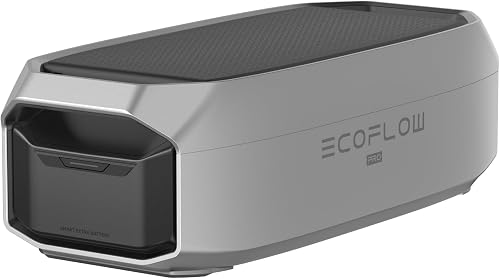
- Expands to 6,144 Wh with two extra batteries
- 1,000 W solar input across two ports
- 2,400 W output, 3,400 W with X-Boost
Weaknesses
- Heavy at 50 lb
- UPS switchover time isn't listed
The DELTA 2 Max fits a home backup or RV owner who wants about 2 kWh now, with room to grow to 6 kWh. It gives 2,400 W of AC output.
For this part, take an assumed 85% of the listed capacity for the runtime numbers. Times 0.85, the listed 2,048 Wh gives 1,740.8 Wh of usable energy. From that amount, a 100 W load runs for about 17.4 hours of runtime. Dividing 2,048 Wh by 50 lb gives about 41.0 Wh per pound.
What does the EcoFlow DELTA 2 Max do well?
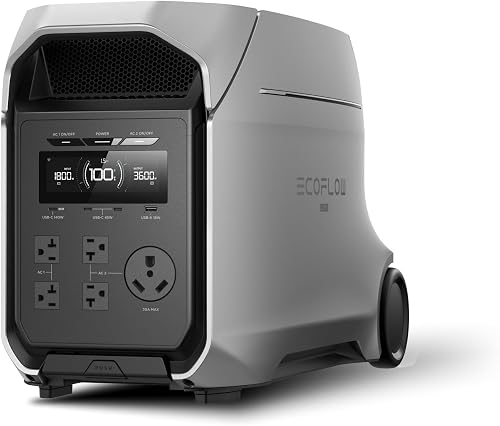
Two extra batteries take it to 6,144 Wh. Solar input is 1,000 W, split across two ports. Its output is 2,400 W, and X-Boost lifts it to 3,400 W for some devices. It has six AC outlets, with 2,400 W total and a 4,800 W surge.
Two 100 W USB-C ports sit on it, plus two 12 W USB-A ports, two 18 W fast-charge USB-A ports, a 126 W car outlet, and two DC5521 ports at 38 W each. AC charging runs at 1,800 W with X-Stream. Solar takes 500 W on one port or 1,000 W on two. The car input is 12V or 24V at 8 A.
Its battery is LFP. It keeps 80% or more of its capacity after 3,000 cycles. It works with the EcoFlow Smart Generator, WAVE, and GLACIER. The app runs on Wi-Fi and Bluetooth. The warranty runs 5 years. It measures 19.6 by 9.5 by 12 inches.
Where does the EcoFlow DELTA 2 Max fall short?
At 50 lb, it is heavy to carry. No UPS figure is listed in the spec table. Its 2,048 Wh is modest for a full home backup, though extra batteries can join.
How does the EcoFlow DELTA 2 Max compare?
| DELTA 2 Max | DJI Power 2000 | Renogy PowerStation 2000 | |
|---|---|---|---|
| Capacity | 2,048 Wh | 2,048 Wh | 2,048 Wh |
| AC output | 2,400 W | 3,000 W | 2,400 W |
| Weight | 50 lb | 48.5 lb | 51.81 lb |
All three hold the same capacity, at 2,048 Wh. The DJI Power 2000 gives the most AC output, at 3,000 W. The DJI Power 2000 is the lightest of the three, at 48.5 lb.
The DJI Power 2000 review link is /guides/dji-power-2000-review/. Find the Renogy 2000 review at /guides/renogy-powerstation-2000-review/.
How to choose
Begin with the output your loads need. Capacity sets how long a run lasts. Expansion lets a station add batteries later. Solar input sets how fast panels can charge the station. Weight decides how easy the station is to shift about.
FAQ
Does the DELTA 2 Max take extra batteries?
Yes. It takes two extra batteries, for 6,144 Wh in total.
How much solar input does it take?
It takes up to 1,000 W of solar input.
What is the warranty?
It comes with a 5-year warranty.
Does it have a UPS mode?
The UPS switchover time is not listed, so the spec table gives no UPS figure.