BLUETTI Elite 300 vs. EcoFlow DELTA Pro 3
As an Amazon Associate I earn from qualifying purchases. Read our affiliate disclosure.
Top picks at a glance
 Best for TT-30 at 3 kWhBLUETTI Elite 300Check price on Amazon
 Best for expandable 240VEcoFlow DELTA Pro 3Check price on Amazon
The BLUETTI Elite 300 is the better pick for buyers who want a lighter 3 kWh box with a TT-30 outlet. The EcoFlow DELTA Pro 3 holds more energy, at 4 kWh, and can grow to 12 kWh.
This head-to-head is judged on the makers’ published specs, current in November 2026. PowerPicked Editorial did not test any station in this head-to-head.
Wh counts the energy a battery holds. It is short for watt-hour. A watt is power, and it is written W. AC output is the power a station sends to plug-in gear. Solar input caps the power that panels send a station.
How do the two stations compare?
| Elite 300 | DELTA Pro 3 | |
|---|---|---|
| Capacity | 3,014 Wh | 4 kWh |
| AC output | 2,400 W | 4,000 W |
| Weight | 58 lb | Not listed |
The DELTA Pro 3 has the larger capacity of the two. The DELTA Pro 3 has the higher AC output of the two. The Elite 300 is the lighter one here.
Does the BLUETTI Elite 300 suit an RV or home backup?
BLUETTI Elite 300
- Capacity
- 3,014 Wh
- AC output
- 2,400 W
- Solar input
- 1,200 W
- Weight
- 58 lb
Who it's for: RV owners and home backup buyers who want about 3 kWh with a TT-30 outlet, without adding batteries.
Strengths
- Built-in TT-30 RV outlet and 12V/30 A DC port
- 1,200 W solar input
- Rated for 6,000+ cycles to 80%
Weaknesses
- Can't add expansion batteries
- Heavy to carry at about 58 lb
The Elite 300 fits an RV owner or home backup buyer who wants about 3 kWh and a TT-30 outlet, with no extra batteries. It gives 2,400 W of AC output.
The runtime numbers in this section are worked out from 85% of the listed capacity. 2,561.9 Wh is the usable energy, from 3,014 Wh times 0.85. From that amount, a 100 W load runs for about 25.6 hours. Per pound, it holds about 52.0 Wh. That is 3,014 Wh over 58 lb.
It has a TT-30 RV outlet and a 12V/30 A DC port. Its solar input is 1,200 W. The listing puts its cycle rating at 6,000 to 80%. It cannot link extra batteries. At 58 lb, carrying it is hard work.
Find the Elite 300 review at /guides/bluetti-elite-300-review/.
Does the EcoFlow DELTA Pro 3 suit a growing backup?
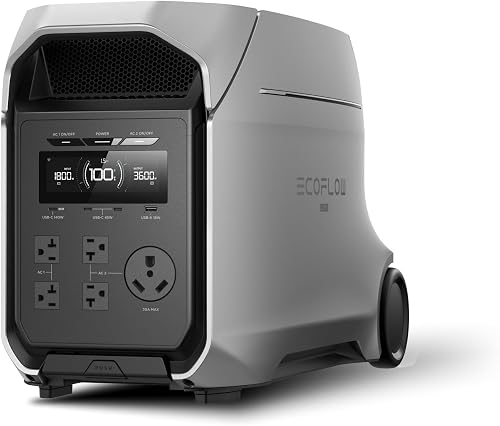
EcoFlow DELTA Pro 3
- Capacity
- 4 kWh
- AC output
- 4,000 W
- Voltage
- 120V and 240V
- Expansion
- Up to 12 kWh per unit
Who it's for: Homeowners who want 120V and 240V backup and may add batteries over time.
Strengths
- Expands to 12 kWh on one unit, more as a multi-unit system
- 120V and 240V output
- Rated to keep 80% capacity after 4,000 cycles
Weaknesses
- Lower continuous output than the F3800 Plus
- More capacity than small essential loads need
The DELTA Pro 3 is for a homeowner who wants 120V and 240V backup, with batteries that can join over time. It gives 4,000 W of AC output.
Work out the runtime numbers in this section from 85% of the listed capacity. 3,400 Wh of usable energy comes from 4 kWh times 0.85. A 100 W load runs about 34.0 hours on that energy.
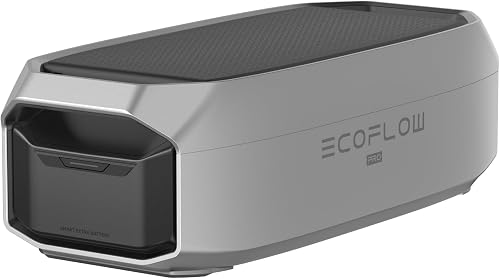
A single unit grows to 12 kWh, and more as a multi-unit system. Its cycle rating is listed at 4,000 to 80%. Its continuous output sits below the F3800 Plus.
Look up the DELTA Pro 3 review at /guides/ecoflow-delta-pro-3-review/.
How to choose
Start with the output your loads need. Capacity sets how many hours the station runs before it needs a recharge. Solar input sets the speed at which panels refill the station. Weight decides how easy it is to move the station. Expansion lets the station grow with extra batteries. A 240V outlet fits heavy loads.
FAQ
Which station here stores the most energy?
The DELTA Pro 3 holds more energy, at 4 kWh. The Elite 300 holds 3,014 Wh.
Which station here gives more AC output?
The DELTA Pro 3 gives more AC output, at 4,000 W. The Elite 300 gives 2,400 W.
Which station here weighs less?
The Elite 300 weighs less, at 58 lb. The DELTA Pro 3 lists no weight.
Can the DELTA Pro 3 add batteries?
Yes. It grows to 12 kWh on one unit, and more as a multi-unit system. The Elite 300 cannot link extra batteries.