Anker SOLIX C300 Review: What the Specs Tell You
As an Amazon Associate I earn from qualifying purchases. Read our affiliate disclosure.
At a glance
 Best for phones and laptops on the goAnker SOLIX C300Check price on Amazon
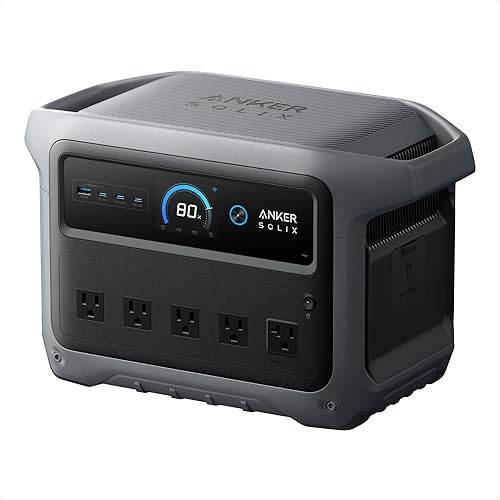
The Anker SOLIX C300 is a strong pick for campers and commuters who mainly charge phones, laptops, and cameras. Its main strengths are two 140 W USB-C ports, a 3,000+ cycle battery rating, and a weight of 9.1 lb. Its main weakness is that 300 W of AC output can run only low-power devices.
This review is based on the makers’ published specs, current in November 2026. PowerPicked Editorial did not test the C300.
Who is the C300 for?
This station fits a camper or a commuter who mainly charges phones, laptops, and cameras and wants a small 9 lb box. It holds 288 Wh, gives 300 W of AC output, lists 100 W of solar input, and weighs 9.1 lb.
Wh stands for watt-hour, a unit of stored energy. W stands for watt, a unit of power. AC output powers devices that plug in. Solar input is the highest power a station can take from panels.
What are its strengths?
Its two 140 W USB-C ports are the main strength. USB-C is a type of charging port. It also has one 15 W USB-C port, one 12 W USB-A port, and a 120 W car outlet. That is enough to charge a phone, a laptop, and a camera at the same time.
Anker SOLIX C300
- Capacity
- 288 Wh
- AC output
- 300 W
- Solar input
- 100 W
- Weight
- 9.1 lb
Who it's for: Campers and commuters who mainly charge phones, laptops, and cameras and want a small 9 lb box.
Strengths
- Two 140 W USB-C ports
- Rated 3,000+ cycles to 80%
- 10 ms UPS switchover
Weaknesses
- 300 W AC output limits what it can run
- Solar input tops out at 100 W
Its battery is LiFePO4, rated for more than 3,000 cycles to 80% of its capacity. A cycle means one full charge and discharge. Its UPS switchover is 10 ms. UPS stands for uninterruptible power supply. It keeps a plugged-in device running when wall power stops, switching in 10 ms.
Its warranty runs for 5 years. Wi-Fi and Bluetooth connect it to an app. It works from -4°F to 104°F. Its size is 6.46 by 6.34 by 9.45 inches.
What are its weaknesses?
With 300 W of AC output, it can run only low-power devices. It gives 300 W of AC output, with a 600 W surge, at 120 V, through three outlets. Surge is a brief peak of power at start-up. A device that needs more than 300 W would not run.
Its solar input stops at 100 W. Solar input runs from 11 to 28 V, at up to 8.2 A. AC input is 330 W, and it also takes a 12 V car input. An expansion figure for the C300 is not listed in the reference files, so this guide does not give one.
How much energy does it give?
The numbers in this section assume 85% of the listed capacity reaches your devices. On that basis, the C300 gives about 244.8 Wh, from 288 Wh times 0.85. That amount runs a 100 W load for about 2.4 hours. The C300 holds about 31.6 Wh for each pound, from 288 Wh over 9.1 lb.
How does the Anker SOLIX C300 compare?
The RIVER 3 Plus is the closest station by capacity, at 286 Wh, and the Yeti 700 is the next closest, at 677 Wh.
| Spec | Anker SOLIX C300 | EcoFlow RIVER 3 Plus | Goal Zero Yeti 700 |
|---|---|---|---|
| Capacity | 288 Wh | 286 Wh | 677 Wh |
| AC output | 300 W | 600 W | 600 W |
| Solar input | 100 W | Not listed | 200 W |
| Weight | 9.1 lb | 10.4 lb | 20.3 lb |
The C300 and the RIVER 3 Plus hold almost the same capacity, at 288 Wh and 286 Wh. The RIVER 3 Plus gives 600 W of AC output, twice the 300 W of the C300. The Yeti 700 holds 677 Wh and gives 600 W of AC output, but it weighs 20.3 lb, more than twice the 9.1 lb of the C300. The C300 is the lightest station in this table.
For a full review of the RIVER 3 Plus on its own, see the EcoFlow RIVER 3 Plus review. For the Yeti 700, see the Goal Zero Yeti 700 review.
How to choose
Start with the devices. Pick the C300 if you mainly charge phones, laptops, and cameras, which stay under 300 W.
Then check the weight. The C300 weighs 9.1 lb. Pick it if you will carry the station by hand.
Last, check solar. The C300 lists 100 W of solar input. Pick a different station if you want faster solar charging.
FAQ
What can the C300 run?
It can run low-power devices, such as phones, laptops, and cameras. It gives 300 W of AC output, with a 600 W surge. A device that needs over 300 W would not run.
How long does the C300 last on a 100 W load?
It lasts about 2.4 hours on a 100 W load. That comes from about 244.8 Wh of usable energy, from 288 Wh times 0.85.
Does the C300 have USB-C ports?
Yes, it has two 140 W USB-C ports and one 15 W USB-C port. It also has one 12 W USB-A port and a 120 W car outlet.
How much does the C300 weigh?
It weighs 9.1 lb. That makes it the lightest station in this guide, and lighter than the RIVER 3 Plus at 10.4 lb.