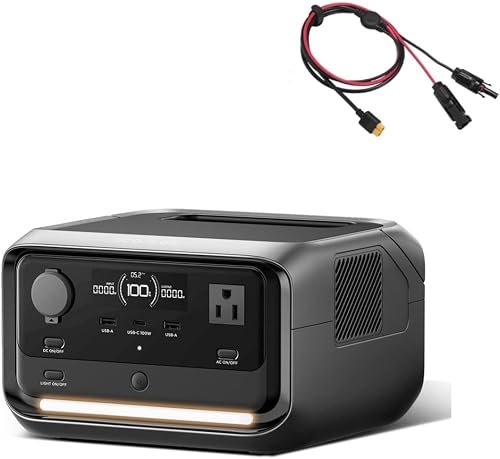
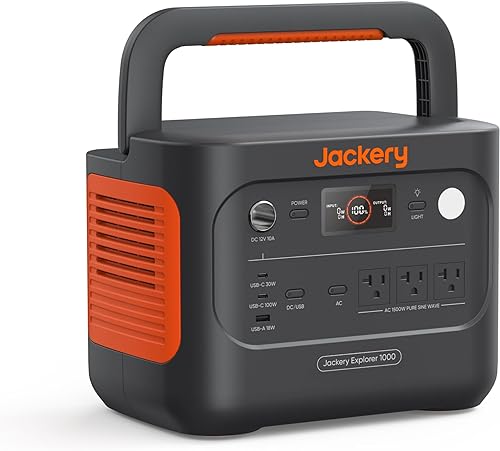
Jackery Explorer 1500 Ultra vs. Goal Zero Yeti 1500
As an Amazon Associate I earn from qualifying purchases. Read our affiliate disclosure.
Top picks at a glance
 Best for light carry and fast chargingJackery Explorer 1500 UltraCheck price on Amazon
 Best for more AC output and solar inputGoal Zero Yeti 1500Check price on Amazon
For most buyers choosing between the Jackery Explorer 1500 Ultra and the Goal Zero Yeti 1500, the Explorer 1500 Ultra is the better pick. The Yeti 1500 is the better pick only for a buyer who needs 2,000 W of AC output and 900 W of solar input. Both stations hold about 1.5 kWh, with a gap of only 31 Wh.
This comparison rests on the makers’ published specs, current in November 2026. PowerPicked Editorial did not test either station.
How do their specs compare?
| Spec | Jackery Explorer 1500 Ultra | Goal Zero Yeti 1500 |
|---|---|---|
| Capacity | 1,536 Wh | 1,505 Wh |
| AC output | 1,800 W | 2,000 W |
| Solar input | 800 W | 900 W |
| Weight | 38.6 lb | 52.75 lb |
A watt-hour, written Wh, is a measure of stored energy. A watt, written W, is a measure of power. AC output is the power that plug-in devices use. Solar input is the greatest power a station can take from panels.
The two stations hold almost the same energy, with a gap of only 31 Wh. The Yeti 1500 gives 200 W more AC output, at 2,000 W against 1,800 W. The Yeti 1500 also lists 100 W more solar input, at 900 W against 800 W. The Explorer 1500 Ultra is the lighter station, at 38.6 lb against 52.75 lb, a gap of 14.15 lb.
Which station suits you?
The Explorer 1500 Ultra fits a camper, an overlander, or an outdoor worker who wants about 1.5 kWh in a sealed, weather-ready box. The Yeti 1500 fits a buyer who wants a mid-size station for cold trips and can handle the weight.
What does the Explorer 1500 Ultra offer?
The Explorer 1500 Ultra is light enough to carry for its capacity. At 38.6 lb, it is easy to carry. AC charging fills it in about 1.5 hours. DC charging fills it in about 2.5 hours.
Jackery Explorer 1500 Ultra
- Capacity
- 1,536 Wh
- AC output
- 1,800 W
- Solar input
- 800 W
- Weight
- 38.6 lb
Who it's for: Campers, overlanders, and outdoor workers who want about 1.5 kWh in a sealed, weather-ready box.
Strengths
- IP65 dust and water rating with the port covers closed
- Full AC charge in about 1.5 hours
- 3,600 W surge peak
Weaknesses
- Jackery says it can't take an extra battery pack
- Cycle rating is 4,000 to 70%+, not 80%
Its shell is rated IP65 for dust and water, with the port covers closed. It is built to resist a 1-meter drop. The battery uses LiFePO4, with 4,000 cycles to more than 70% capacity. Its cycle rating runs to 70% or more, not 80%.
It has three AC outlets at 120 V, plus USB-C ports of 100 W and 30 W, a USB-A port of 18 W, and a 12 V car port of 10 A. Solar input runs at 16 to 60 V, up to 800 W across two inputs. Surge reaches 3,600 W. Surge is a short burst of power at start-up.
In UPS mode, it switches within 20 ms. UPS means uninterruptible power supply, which keeps a plugged-in device running when wall power stops. It charges from 32°F to 113°F and discharges from 5°F to 113°F, with output capped at 1,000 W from 5°F to 14°F. Its size is 13.2 by 10.4 by 11.6 inches. An app connects through Bluetooth and 2.4 GHz Wi-Fi. The warranty covers 3 plus 2 years. Jackery says an extra battery pack cannot be added.
The figures here assume 85% of the listed capacity reaches your devices. Usable energy comes to about 1,305.6 Wh, from 1,536 Wh times 0.85. That amount runs a 100 W load for about 13.1 hours. Per pound, the Explorer 1500 Ultra holds about 39.8 Wh, from 1,536 Wh over 38.6 lb.
For a full review of the Explorer 1500 Ultra on its own, see the Jackery Explorer 1500 Ultra review.
What does the Goal Zero Yeti 1500 offer?
The Yeti 1500 gives 2,000 W of AC output, 200 W more than the Explorer 1500 Ultra. It lists 900 W of solar input, 100 W more than the Explorer 1500 Ultra. It works down to -4°F.
Goal Zero Yeti 1500
- Capacity
- 1,505 Wh
- AC output
- 2,000 W
- Solar input
- 900 W
- Weight
- 52.75 lb
Who it's for: People who want a mid-size station for cold trips and can handle the weight.
Strengths
- Rated for use down to -4°F
- 900 W of solar input
- Rated to keep 80% capacity after 4,000 cycles
Weaknesses
- Heavy for its capacity at 52.75 lb
- Not compatible with expansion batteries
It keeps 80% of its capacity after 4,000 cycles. It weighs 52.75 lb, which is heavy for its capacity. It is not compatible with expansion batteries.
A battery type for the Yeti 1500 is not listed in the reference files, so this guide does not name one.
For this section, assume 85% of the listed capacity reaches your devices. Usable energy comes from 1,505 Wh times 0.85. On that amount, a 100 W load would run for about 12.8 hours. The Yeti 1500 holds about 28.5 Wh for each pound, from 1,505 Wh over 52.75 lb.
For a full review of the Yeti 1500 on its own, see the Goal Zero Yeti 1500 review.
How to choose
First, weigh carry weight. The Explorer 1500 Ultra weighs 38.6 lb and the Yeti 1500 weighs 52.75 lb. Pick the Explorer 1500 Ultra if you will carry the station by hand.
Second, weigh output. The Yeti 1500 gives 2,000 W and the Explorer 1500 Ultra gives 1,800 W. Pick the Yeti 1500 if a device needs more than 1,800 W.
Third, weigh solar. The Yeti 1500 lists 900 W of solar input and the Explorer 1500 Ultra lists 800 W. Pick the Yeti 1500 if faster solar charging matters most to you.
FAQ
Which one has more AC output?
The Goal Zero Yeti 1500 has more AC output. It gives 2,000 W, while the Jackery Explorer 1500 Ultra gives 1,800 W. The gap is 200 W.
Which station is lighter to carry?
The Jackery Explorer 1500 Ultra is lighter to carry. It weighs 38.6 lb, while the Goal Zero Yeti 1500 weighs 52.75 lb. The gap is 14.15 lb.
Which station lists the higher solar input?
The Goal Zero Yeti 1500 lists more solar input. It lists 900 W, while the Jackery Explorer 1500 Ultra lists 800 W. The gap is 100 W.
Which station can add an extra battery?
Neither station can add an extra battery. Jackery says an extra battery pack cannot be added to the Explorer 1500 Ultra. The Yeti 1500 is not compatible with expansion batteries.