Jackery Explorer 2000 v2 vs. Goal Zero Yeti 700
As an Amazon Associate I earn from qualifying purchases. Read our affiliate disclosure.
Top picks at a glance
 Best 2 kWh home boxJackery Explorer 2000 v2Check price on Amazon
 Best light low-power boxGoal Zero Yeti 700Check price on Amazon
About 2 kWh and 2,200 W make the Jackery Explorer 2000 v2 the bigger box here, while the Goal Zero Yeti 700 stays light at 677 Wh and 600 W. The Jackery suits a household that wants about 2 kWh in one box, while the Yeti 700 suits low-power devices on a lighter frame.
This guide weighs the Jackery 2000 v2 and the Yeti 700 on the makers’ published specs, current in November 2026. PowerPicked Editorial did not test the two stations in this guide.
What do the numbers mean?
A watt-hour is the unit that counts stored energy, written Wh. Watts count power. One watt is written W. AC output is the plug-in power for the house. Solar input is the cap on panel power coming in.
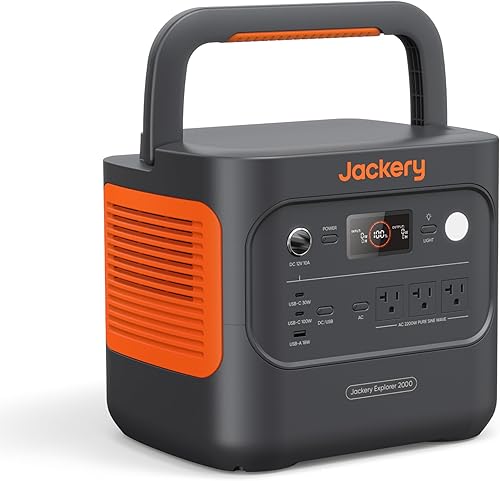
Jackery Explorer 2000 v2
Jackery Explorer 2000 v2
- Capacity
- 2,042 Wh
- AC output
- 2,200 W
- Surge
- 4,400 W
- Weight
- 39.5 lb
Who it's for: Households that want about 2 kWh one person can move, with no plans to expand.
Strengths
- About 2 kWh at 39.5 lb
- 4,400 W surge rating
- LFP battery
Weaknesses
- Heavier to move than 1 kWh models
- Not expandable
The runtime figures in this section use 85% of the listed capacity, assumed. From 85% of the listed 2,042 Wh, usable energy is 1,735.7 Wh. At 85%, a 100 W load runs for about 17.4 hours. 51.7 Wh per pound is what 2,042 Wh over 39.5 lb works out to.
Around 2 kWh fits in its 39.5 lb box. Surge reaches 4,400 W. No extra battery joins it. It runs on an LFP battery.
Read the Jackery Explorer 2000 v2 review.
Goal Zero Yeti 700
Goal Zero Yeti 700
- Capacity
- 677 Wh
- AC output
- 600 W
- Solar input
- 200 W
- Weight
- 20.3 lb
Who it's for: People who need more energy than a small station holds, but mostly run low-power devices.
Strengths
- Rated for use down to -4°F
- Fills the gap between small and 1 kWh stations
- Rated to keep 80% capacity after 4,000+ cycles
Weaknesses
- 600 W limits what you can run
- 200 W of solar input is low
Count the runtime figures in this section from an assumed 85% of the listed capacity. Usable energy comes from 677 Wh times 0.85. A 100 W draw lasts about 5.8 hours on that energy. 33.3 Wh per pound is what 677 Wh over 20.3 lb works out to.
A rating for use down to -4°F covers it. Its 600 W output limits the gear it runs. Solar input is 200 W. It is rated to keep 80% capacity after 4,000 cycles.
Read the Yeti 700 review.
How do they compare?
| Jackery 2000 v2 | Yeti 700 | |
|---|---|---|
| Capacity | 2,042 Wh | 677 Wh |
| AC output | 2,200 W | 600 W |
| Solar input | not listed | 200 W |
| Weight | 39.5 lb | 20.3 lb |
| UPS | not listed | not listed |
How to choose
Start with the output your home needs. Capacity sets how long the backup lasts before a refill. Panel power sets the refill speed. A lighter box suits a buyer who hauls it far. Expansion suits a home that grows.
FAQ
Which one leads on output?
The Jackery Explorer 2000 v2, with 2,200 W. The Goal Zero Yeti 700 gives 600 W.
Which one holds the most energy?
The Jackery Explorer 2000 v2, with 2,042 Wh. The Goal Zero Yeti 700 holds 677 Wh.
Which one accepts more solar input?
The Goal Zero Yeti 700, with 200 W. Solar input is not listed for the Jackery Explorer 2000 v2.
Which one weighs least?
The Goal Zero Yeti 700 weighs 20.3 lb. The Jackery Explorer 2000 v2 weighs 39.5 lb.