EcoFlow DELTA 3 Ultra Plus vs. BLUETTI Elite 300
As an Amazon Associate I earn from qualifying purchases. Read our affiliate disclosure.
Top picks at a glance
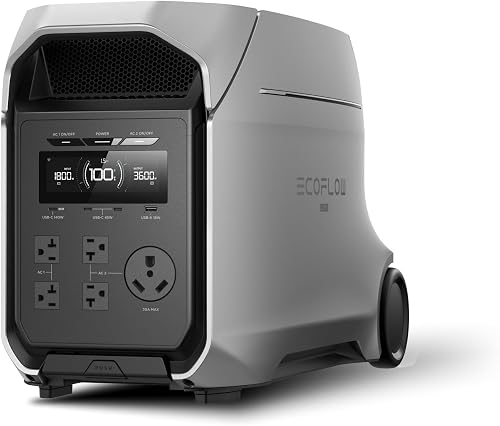 Best for more output and expansionEcoFlow DELTA 3 Ultra PlusCheck price on Amazon
 Best for RV TT-30 outletBLUETTI Elite 300Check price on Amazon
For most buyers choosing between the EcoFlow DELTA 3 Ultra Plus and the BLUETTI Elite 300, the DELTA 3 Ultra Plus is the better pick. The Elite 300 is the better pick only for a buyer who needs a TT-30 RV outlet built in and a lighter station.
The makers’ published specs, current in November 2026, are what this comparison is based on. PowerPicked Editorial did not test either station.
How do their specs compare?
| Spec | EcoFlow DELTA 3 Ultra Plus | BLUETTI Elite 300 |
|---|---|---|
| Capacity | 3,072 Wh | 3,014 Wh |
| AC output | 3,600 W | 2,400 W |
| Solar input | 1,600 W | 1,200 W |
| Weight | 74.3 lb | 58 lb |
Wh is short for watt-hour and counts stored energy. W stands for watt and counts power. AC output is the power plug-in devices draw. Solar input is the greatest power a station can draw from panels.
The DELTA 3 Ultra Plus holds 58 Wh more than the Elite 300. It gives 1,200 W more AC output than the Elite 300. It lists 400 W more solar input than the Elite 300. The Elite 300 is the lighter station, at 58 lb against 74.3 lb, a gap of 16.3 lb.
Which station suits you?
This station gives home backup buyers about 3 kWh and 3,600 W, with room to grow to 11 kWh. The Elite 300 fits RV owners and home backup buyers after about 3 kWh with a TT-30 outlet, with no plans to add batteries.
What does the DELTA 3 Ultra Plus give you?
Output is 3,600 W, with surge to 7,200 W. It lists 1,600 W of solar input. Noise stays at 25 dB or less under a 600 W load. Its weight of about 74.3 lb makes it heavy. App registration unlocks the full 5-year warranty.
EcoFlow DELTA 3 Ultra Plus
- Capacity
- 3,072 Wh
- AC output
- 3,600 W
- Solar input
- 1,600 W
- Weight
- 74.3 lb
Who it's for: Home backup buyers who want about 3 kWh and 3,600 W in one unit that can grow to 11 kWh.
Strengths
- 3,600 W output with a 7,200 W surge rating
- 1,600 W solar input
- Listed at 25 dB or less at 600 W
Weaknesses
- Heavy at about 74.3 lb
- Full 5-year warranty needs app registration
LFP, or LiFePO4, is the battery type, at 51.2 V and 60 Ah for 3,072 Wh. At 120 V, AC output totals 3,600 W, with surge to 7,200 W. With X-Boost, resistive appliances reach 4,600 W. It accepts up to 1,600 W of solar input. Solar plus generator dual charging fills it to 80% in about 48 minutes. Its UPS switchover is under 10 ms. Extra batteries grow it to 11 kWh from 3 kWh.
For the runtime numbers, take 85% of the listed capacity. That gives about 2,611.2 Wh, which is 3,072 Wh times 0.85. A 100 W load would run for about 26.1 hours on that energy. Each pound carries about 41.3 Wh, with 3,072 Wh over 74.3 lb.
For a full review of the DELTA 3 Ultra Plus on its own, see the EcoFlow DELTA 3 Ultra Plus review.
What does the BLUETTI Elite 300 give you?
It carries a TT-30 RV outlet built in, plus a 12 V, 30 A DC port. It lists 1,200 W of solar input. It is rated for 6,000 or more cycles. Expansion batteries cannot be added. Its weight of about 58 lb makes it heavy to carry.
BLUETTI Elite 300
- Capacity
- 3,014 Wh
- AC output
- 2,400 W
- Solar input
- 1,200 W
- Weight
- 58 lb
Who it's for: RV owners and home backup buyers who want about 3 kWh with a TT-30 outlet, without adding batteries.
Strengths
- Built-in TT-30 RV outlet and 12V/30 A DC port
- 1,200 W solar input
- Rated for 6,000+ cycles to 80%
Weaknesses
- Can't add expansion batteries
- Heavy to carry at about 58 lb
The battery uses LiFePO4, at 3,014.4 Wh and 314 Ah. Its cycle rating runs to 80% capacity after 6,000 or more cycles. It gives 2,400 W of AC output at 120 V. Power Lifting mode lifts resistive loads to 4,800 W. A full AC charge takes about 2 hours at 1,800 W. Solar charging tops out at 1,200 W and fills it in about 4.1 hours. With AC and solar at 2,400 W, it hits 80% in 78 minutes. UPS switchover is 10 ms or less. Pass-through charging works on it. Expansion is none, as BLUETTI says it can’t link with its expansion batteries.
For this section, take 85% of the listed capacity. That gives about 2,561.9 Wh, which is 3,014 Wh times 0.85. A 100 W load would run for about 25.6 hours on that energy. Each pound carries about 52.0 Wh, with 3,014 Wh over 58 lb.
For a full review of the Elite 300 on its own, see the BLUETTI Elite 300 review.
How to choose
First, weigh AC output: 3,600 W for the DELTA 3 Ultra Plus against 2,400 W for the Elite 300. Pick the DELTA 3 Ultra Plus when a device needs more than 2,400 W.
Second, weigh expansion. The DELTA 3 Ultra Plus takes extra batteries to grow from 3 to 11 kWh. The Elite 300 takes no extra batteries. Pick the DELTA 3 Ultra Plus when you plan to add batteries later.
Third, weigh the TT-30 outlet. A built-in TT-30 RV outlet is on the Elite 300. Pick the Elite 300 when an RV needs a TT-30 outlet.
FAQ
Which station has more AC output?
The EcoFlow DELTA 3 Ultra Plus has more AC output: 3,600 W, while the BLUETTI Elite 300 has 2,400 W. The gap is 1,200 W.
Which station lists the most solar input?
The EcoFlow DELTA 3 Ultra Plus lists the most solar input, at 1,600 W. The BLUETTI Elite 300 lists 1,200 W. The gap is 400 W.
Which station can add batteries?
The EcoFlow DELTA 3 Ultra Plus can add batteries, growing from 3 to 11 kWh. The BLUETTI Elite 300 cannot add batteries.
Which station is the lighter one?
The BLUETTI Elite 300 is the lighter one, at 58 lb. The EcoFlow DELTA 3 Ultra Plus is 74.3 lb. The gap is 16.3 lb.