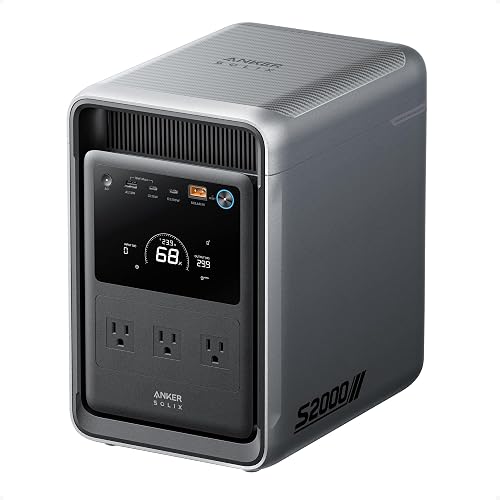
Best Anker SOLIX S2000 Alternatives
As an Amazon Associate I earn from qualifying purchases. Read our affiliate disclosure.
Top picks at a glance
 Best for high output and growthDJI Power 2000Check price on Amazon
 Best for RV TT-30 outletRenogy PowerStation 2000Check price on Amazon
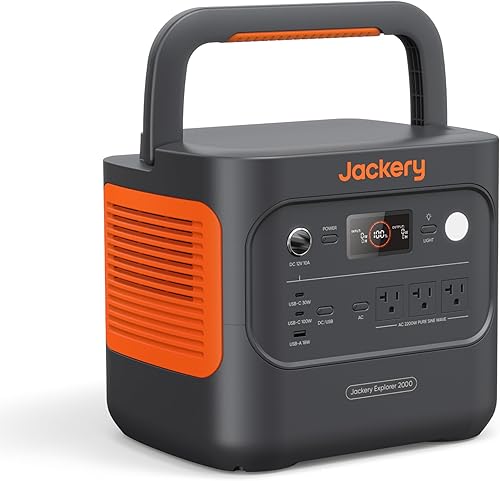 Best for light 2 kWh carryJackery Explorer 2000 v2Check price on Amazon
For most buyers looking for an Anker SOLIX S2000 alternative, the DJI Power 2000 is the best pick. It gives more AC output and grows with up to 10 expansion batteries.
The makers’ published specs, current in November 2026, underpin this guide. PowerPicked Editorial did not run tests on any station here.
How do the alternatives compare?
| Spec | DJI Power 2000 | Renogy PowerStation 2000 | Jackery Explorer 2000 v2 |
|---|---|---|---|
| Capacity | 2,048 Wh | 2,048 Wh | 2,042 Wh |
| AC output | 3,000 W | 2,400 W | 2,200 W |
| Weight | 48.5 lb | 51.81 lb | 39.5 lb |
A watt-hour counts stored energy. It is written Wh. A watt counts power. It is written W. AC output is the power plug-in devices need.
The DJI and the Renogy tie for the most capacity, at 2,048 Wh against 2,042 Wh. The DJI gives the most AC output, at 3,000 W against 2,400 W and 2,200 W. The Jackery is the lightest, at 39.5 lb against 48.5 lb and 51.81 lb.
Who should pick which alternative?
This station suits people after high output from a 2 kWh station, who may add batteries later. RV owners after about 2 kWh with a direct TT-30 connection will like the Renogy. Households after about 2 kWh one person can move, with no plans to expand, will like the Jackery.
What does the DJI Power 2000 offer?
Its output is 3,000 W. Up to 10 expansion batteries fit it. Its rating keeps over 80% capacity after 4,000 cycles. A separate DJI module or charger is needed for solar charging. Its weight is about 48.5 lb, so it is heavy to carry.
DJI Power 2000
- Capacity
- 2,048 Wh
- AC output
- 3,000 W
- Expansion
- Up to 22,528 Wh
- Weight
- About 48.5 lb
Who it's for: People who want high output from a 2 kWh station and may add batteries later.
Strengths
- 3,000 W output
- Takes up to 10 expansion batteries
- Rated to keep over 80% capacity after 4,000 cycles
Weaknesses
- Solar charging needs a separate DJI module or charger
- Heavy to carry at about 48.5 lb
It holds 2,048 Wh. It gives 3,000 W of AC output. Its weight is about 48.5 lb.
For the runtime numbers in this part, use 85% of the listed capacity. From 2,048 Wh times 0.85, usable energy is about 1,740.8 Wh. On that energy, a 100 W load runs for about 17.4 hours. Each pound carries about 42.2 Wh, with 2,048 Wh over 48.5 lb.
The DJI Power 2000 review on its own is at the DJI Power 2000 review.
What does the Renogy PowerStation 2000 offer?
A built-in TT-30 RV outlet is on board. It gives a 3,600 W surge rating. Under a 500 W load, noise is 25 dB. It is heavy to carry at 51.81 lb. The rating is 3,000 cycles, fewer than many models we compare.
Renogy PowerStation 2000
- Capacity
- 2,048 Wh
- AC output
- 2,400 W
- DC input
- 1,200 W
- Weight
- 51.81 lb
Who it's for: RV owners who want about 2 kWh with a direct TT-30 connection.
Strengths
- Built-in TT-30 RV outlet
- 3,600 W surge rating
- Listed at 25 dB under a 500 W load
Weaknesses
- Heavy to carry at 51.81 lb
- Rated for 3,000 cycles, fewer than many models we compare
Capacity is 2,048 Wh. Its AC output is 2,400 W. It lists 1,200 W of DC input. Weight is 51.81 lb.
Use 85% of the listed capacity for the runtime numbers in this part. Usable energy comes to about 1,740.8 Wh, which is 2,048 Wh times 0.85. That energy runs a 100 W load for about 17.4 hours. Per pound, it holds about 39.5 Wh, from 2,048 Wh over 51.81 lb.
The Renogy 2000 review on its own is at the Renogy PowerStation 2000 review.
What does the Jackery Explorer 2000 v2 give you?
It packs about 2 kWh at 39.5 lb. Its surge rating is 4,400 W. Its battery is LFP. It weighs more to move than 1 kWh models. It cannot expand.
Jackery Explorer 2000 v2
- Capacity
- 2,042 Wh
- AC output
- 2,200 W
- Surge
- 4,400 W
- Weight
- 39.5 lb
Who it's for: Households that want about 2 kWh one person can move, with no plans to expand.
Strengths
- About 2 kWh at 39.5 lb
- 4,400 W surge rating
- LFP battery
Weaknesses
- Heavier to move than 1 kWh models
- Not expandable
It holds 2,042 Wh. It gives 2,200 W of AC output. Its weight is 39.5 lb.
The runtime numbers here use 85% of the listed capacity. From 2,042 Wh times 0.85, usable energy is about 1,735.7 Wh. A 100 W load runs for about 17.4 hours on that energy. Per pound, it holds about 51.7 Wh, from 2,042 Wh over 39.5 lb.
The Explorer 2000 v2 review on its own is at the Jackery Explorer 2000 v2 review.
How to choose
First, weigh AC output. The DJI is 3,000 W, the Renogy is 2,400 W, and the Jackery is 2,200 W. Pick the DJI when a device needs more than 2,400 W.
Second, weigh expansion. The DJI takes up to 10 expansion batteries. Pick the DJI when you plan to add batteries later.
Third, weigh carry weight. The Jackery is 39.5 lb, the DJI is about 48.5 lb, and the Renogy is 51.81 lb. Pick the Jackery for hand carry.
FAQ
Which alternative’s AC output is highest?
The DJI Power 2000 leads on AC output. It gives 3,000 W, while the Renogy PowerStation 2000 gives 2,400 W and the Jackery Explorer 2000 v2 gives 2,200 W.
Which alternative takes expansion batteries?
The DJI Power 2000 takes expansion batteries. It fits up to 10 expansion batteries.
Which alternative weighs the most?
The Renogy PowerStation 2000 weighs the most. It weighs 51.81 lb, while the DJI Power 2000 weighs about 48.5 lb and the Jackery Explorer 2000 v2 weighs 39.5 lb.
Does any alternative have a TT-30 outlet?
Yes, the Renogy PowerStation 2000 has a TT-30 outlet. Its TT-30 RV outlet is built in.