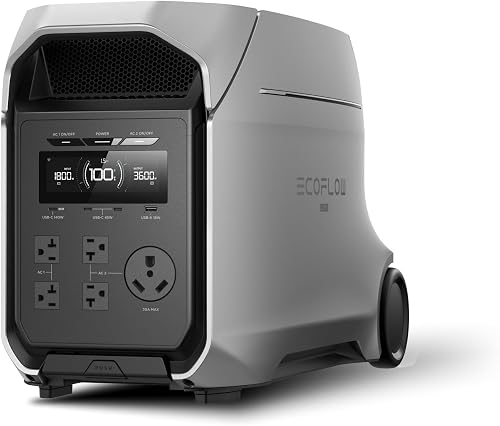
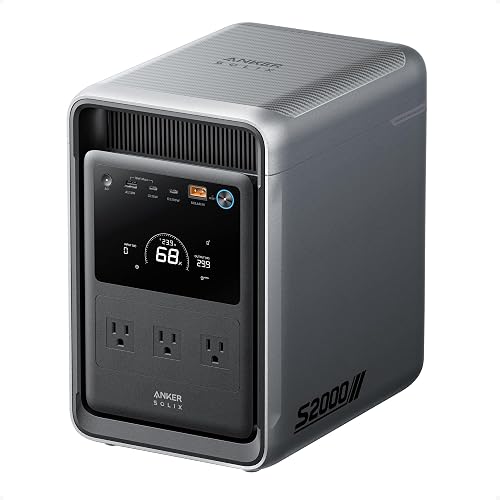
EcoFlow DELTA 2 Max vs. Anker SOLIX F3800 Plus
As an Amazon Associate I earn from qualifying purchases. Read our affiliate disclosure.
Top picks at a glance
 Best 2,048 Wh growable boxEcoFlow DELTA 2 MaxCheck price on Amazon
 Best 3,840 Wh home boxAnker SOLIX F3800 PlusCheck price on Amazon
For a home bank that grows, the EcoFlow DELTA 2 Max offers 2,048 Wh and 2,400 W. The Anker SOLIX F3800 Plus answers heavier loads, with 3,840 Wh and 6,000 W.
This guide weighs the DELTA 2 Max and the F3800 Plus on the makers’ published specs, current in November 2026. PowerPicked Editorial has not tested either of the two stations here.
A watt-hour is the unit for stored energy. It is written Wh. A watt measures power. It is written W. AC output is the plug-in power for the garage. Solar input is the panel power limit a station sets.
EcoFlow DELTA 2 Max
- Capacity
- 2,048 Wh
- AC output
- 2,400 W
- Solar input
- 1,000 W
- Weight
- 50 lb
Who it's for: Home backup and RV owners who want about 2 kWh now and room to grow to 6 kWh with extra batteries.
Strengths
- Expands to 6,144 Wh with two extra batteries
- 1,000 W solar input across two ports
- 2,400 W output, 3,400 W with X-Boost
Weaknesses
- Heavy at 50 lb
- UPS switchover time isn't listed
How long does the DELTA 2 Max run?
For the runtime numbers here, work from an assumed 85% of the listed capacity. At 85%, the listed 2,048 Wh leaves 1,740.8 Wh usable. A 100 W load draws for about 17.4 hours on that energy. 2,048 Wh over 50 lb works out to about 41.0 Wh per pound.
One unit holds 2,048 Wh. Extra batteries grow it to 6,144 Wh. Its warranty runs five years. At 50 lb, it is the lighter box here. Read the DELTA 2 Max review.
Anker SOLIX F3800 Plus
- Capacity
- 3,840 Wh
- AC output
- 6,000 W
- Solar input
- 3,200 W
- Weight
- 136.7 lb
Who it's for: RV owners and homeowners with heavy or 240V loads who can keep a large unit in one place.
The photo also shows the Home Power Panel, which Amazon sells with this model in some listings. Check what's included before you buy.
Strengths
- 120V and 240V output
- TT-30 RV port
- Supports up to six 3.84 kWh expansion batteries
Weaknesses
- Very heavy at 136.7 lb, though it has wheels
- AC charging input is 1,800 W
How long does the F3800 Plus run?
In this section, the runtime figures rest on an assumed 85% of the listed capacity. From 85% of the listed 3,840 Wh, usable energy is 3,264.0 Wh. That amount keeps a 100 W load going for about 32.6 hours. Each pound holds about 28.1 Wh: 3,840 Wh over 136.7 lb.
It puts out 6,000 W, the highest here. It sends both 120V and 240V power. A TT-30 RV port is built in. It takes up to six 3.84 kWh batteries. Wheels make moving it easier. AC input runs up to 1,800 W. The F3800 Plus review has the full spec read.
How do the two compare?
| DELTA 2 Max | F3800 Plus | |
|---|---|---|
| Capacity | 2,048 Wh | 3,840 Wh |
| AC output | 2,400 W | 6,000 W |
| Solar input | 1,000 W | 3,200 W |
| Weight | 50 lb | 136.7 lb |
| UPS | not listed | not listed |
How to choose
Start with the output your garage needs. Capacity sets how long the home run lasts before a refill. A bigger solar input gives a faster panel refill. A lighter box suits a buyer who wheels it often. Expansion suits a garage that grows its bank.
FAQ
Which one gives the highest output?
The F3800 Plus puts out 6,000 W. The EcoFlow DELTA 2 Max gives 2,400 W.
Which one holds more stored energy?
The F3800 Plus holds 3,840 Wh. The EcoFlow DELTA 2 Max holds 2,048 Wh.
Which one takes the bigger solar input?
The F3800 Plus takes 3,200 W of solar. The EcoFlow DELTA 2 Max takes 1,000 W.
Which one is lighter to shift?
The EcoFlow DELTA 2 Max, at 50 lb. The F3800 Plus weighs 136.7 lb.
Sources
- EcoFlow: DELTA 2 Max product page
- Anker: SOLIX F3800 Plus product page