Best Power Station with 140W USB-C Ports
As an Amazon Associate I earn from qualifying purchases. Read our affiliate disclosure.
Top picks at a glance
 Best for two 140W USB-C portsAnker SOLIX C300Check price on Amazon
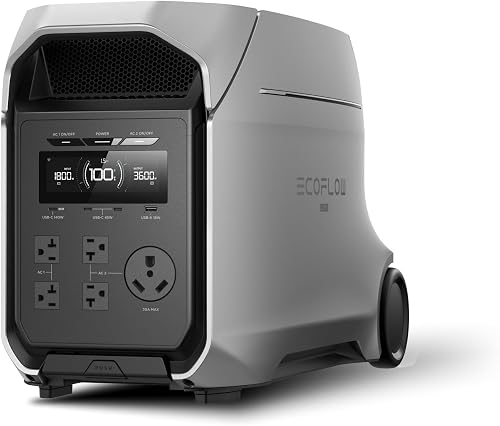 Best for 140W USB-C at 3 kWhEcoFlow DELTA 3 Ultra PlusCheck price on Amazon
 Best for 140W USB-C with TT-30BLUETTI Elite 300Check price on Amazon
The Anker SOLIX C300 is the best pick for a 140 W USB-C port in a small box, with two of them. The EcoFlow DELTA 3 Ultra Plus and the BLUETTI Elite 300 each offer one 140 W USB-C port in a 3 kWh box.
These picks are judged on the makers’ published specs, current in November 2026. PowerPicked Editorial did not test any station picked in this guide.
Wh is short for watt-hour. It counts the energy a battery can hold. Watts measure power. One watt is written W. AC output is the power for plug-in laptop gear. Solar input caps the power panels can push to a station.
How do the three stations compare?
| C300 | DELTA 3 Ultra Plus | Elite 300 | |
|---|---|---|---|
| 140 W USB-C ports | 2 | 1 | 1 |
| Capacity | 288 Wh | 3,072 Wh | 3,014 Wh |
| AC output | 300 W | 3,600 W | 2,400 W |
The C300 lists two 140 W USB-C ports. The DELTA 3 Ultra Plus has one 140 W USB-C port. The Elite 300 has one 140 W USB-C port.
Why does the Anker SOLIX C300 lead the USB-C picks?
Anker SOLIX C300
- Capacity
- 288 Wh
- AC output
- 300 W
- Solar input
- 100 W
- Weight
- 9.1 lb
Who it's for: Campers and commuters who mainly charge phones, laptops, and cameras and want a small 9 lb box.
Strengths
- Two 140 W USB-C ports
- Rated 3,000+ cycles to 80%
- 10 ms UPS switchover
Weaknesses
- 300 W AC output limits what it can run
- Solar input tops out at 100 W
The C300 fits a camper or commuter who mainly charges small gear and wants a 9 lb box. It gives 300 W of AC output, with a 600 W surge rating.
For this part, use 85% of the listed capacity for the runtime numbers. From 288 Wh times 0.85, usable energy is 244.8 Wh. That amount keeps a 100 W load going for about 2.4 hours. Dividing 288 Wh by 9.1 lb gives about 31.6 Wh per pound.
Its two 140 W USB-C ports are the most here. It is rated for 3,000 cycles or more to 80%. Its UPS switchover is 10 ms. Its 300 W of AC output caps what it can run. Its solar input is 100 W at most.
Find the C300 review at /guides/anker-solix-c300-review/.
Does the EcoFlow DELTA 3 Ultra Plus suit a 3 kWh box?
EcoFlow DELTA 3 Ultra Plus
- Capacity
- 3,072 Wh
- AC output
- 3,600 W
- Solar input
- 1,600 W
- Weight
- 74.3 lb
Who it's for: Home backup buyers who want about 3 kWh and 3,600 W in one unit that can grow to 11 kWh.
Strengths
- 3,600 W output with a 7,200 W surge rating
- 1,600 W solar input
- Listed at 25 dB or less at 600 W
Weaknesses
- Heavy at about 74.3 lb
- Full 5-year warranty needs app registration
The DELTA 3 Ultra Plus fits a home backup buyer who wants about 3 kWh, 3,600 W, and room to grow. Its AC output is 3,600 W, with a 7,200 W surge rating.
For this part, use an assumed 85% of the listed capacity for the runtime numbers. Usable energy is 2,611.2 Wh, from 3,072 Wh times 0.85. That energy gives a 100 W load about 26.1 hours. Dividing 3,072 Wh by 74.3 lb gives about 41.3 Wh per pound.
It has one 140 W USB-C port, plus two 45 W USB-C ports. Its solar input is 1,600 W. At 600 W, it is listed at 25 dB or less. Register in the app for the full 5-year warranty.
The DELTA 3 Ultra Plus review sits at /guides/ecoflow-delta-3-ultra-plus-review/.
Does the BLUETTI Elite 300 suit an RV or a home?
BLUETTI Elite 300
- Capacity
- 3,014 Wh
- AC output
- 2,400 W
- Solar input
- 1,200 W
- Weight
- 58 lb
Who it's for: RV owners and home backup buyers who want about 3 kWh with a TT-30 outlet, without adding batteries.
Strengths
- Built-in TT-30 RV outlet and 12V/30 A DC port
- 1,200 W solar input
- Rated for 6,000+ cycles to 80%
Weaknesses
- Can't add expansion batteries
- Heavy to carry at about 58 lb
The Elite 300 suits an RV owner or home backup buyer who wants about 3 kWh and a TT-30 outlet, with no extra batteries. It gives 2,400 W of AC output.
In this part, take 85% of the listed capacity for the runtime numbers. Times 0.85, the listed 3,014 Wh gives 2,561.9 Wh of usable energy. That amount gives a 100 W load about 25.6 hours. Dividing 3,014 Wh by 58 lb gives about 52.0 Wh per pound.
It has one 140 W USB-C port and one 100 W USB-C port. A TT-30 RV outlet and a 12V/30 A DC port are on it. Its solar input is 1,200 W. It cannot take extra batteries. Carrying it is hard work at 58 lb.
See the Elite 300 review at /guides/bluetti-elite-300-review/.
How to choose
Check the USB-C count your gear needs first. Capacity sets how long a run lasts before a recharge. Output sets what the station can run. Weight decides how easy the station is to shift around. Expansion lets the station take more batteries. Solar input sets how fast a panel refill goes.
FAQ
Which pick stores the most energy of all here?
The DELTA 3 Ultra Plus stores the most energy, at 3,072 Wh. The Elite 300 stores 3,014 Wh. The C300 stores 288 Wh.
Which pick offers the most AC output here?
The DELTA 3 Ultra Plus offers the most AC output, at 3,600 W. The Elite 300 offers 2,400 W. The C300 offers 300 W.
Which pick is the lightest here?
The C300 is the lightest, at 9.1 lb. The Elite 300 weighs 58 lb. The DELTA 3 Ultra Plus weighs 74.3 lb.
Which pick here has two 140 W USB-C ports?
Two 140 W USB-C ports sit on the C300. The DELTA 3 Ultra Plus has one, plus two 45 W USB-C ports. The Elite 300 has one, plus one 100 W USB-C port.