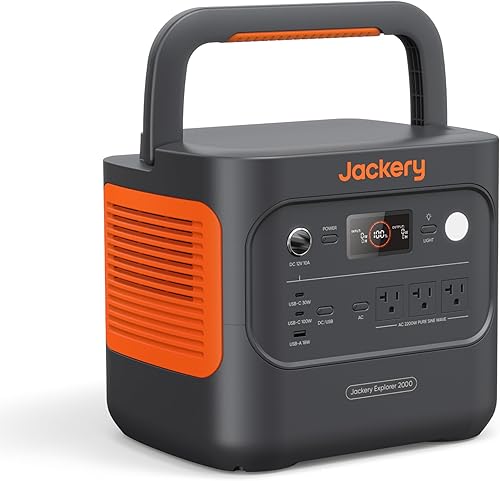
Best Power Station for a Hair Dryer
As an Amazon Associate I earn from qualifying purchases. Read our affiliate disclosure.
Top picks at a glance
 Best for hair dryersAnker SOLIX F3800 PlusCheck price on Amazon
 Best 4,000 W hair dryer boxEcoFlow DELTA Pro 3Check price on Amazon
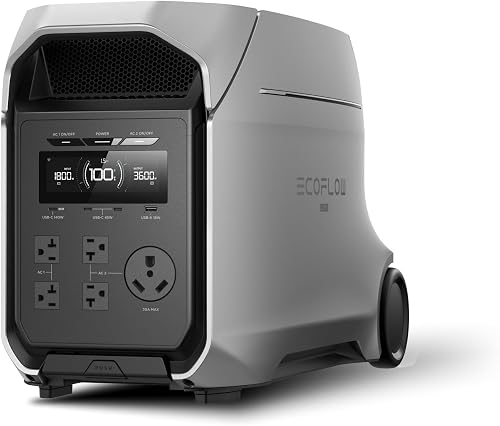 Best 3,600 W hair dryer boxEcoFlow DELTA 3 Ultra PlusCheck price on Amazon
High output decides the pick for a hair dryer, and the Anker SOLIX F3800 Plus leads with 6,000 W of output and 3,840 Wh of capacity. The EcoFlow DELTA Pro 3 and the EcoFlow DELTA 3 Ultra Plus cover lighter loads.
This guide weighs the hair dryer picks on the makers’ published specs, current in November 2026. PowerPicked Editorial did not test any hair dryer pick here.
A watt-hour counts stored energy, written Wh. Watts measure power. One watt is written W. The AC output number sets what a station can run at once. Solar input is the ceiling on power from a panel.
Anker SOLIX F3800 Plus
- Capacity
- 3,840 Wh
- AC output
- 6,000 W
- Solar input
- 3,200 W
- Weight
- 136.7 lb
Who it's for: RV owners and homeowners with heavy or 240V loads who can keep a large unit in one place.
The photo also shows the Home Power Panel, which Amazon sells with this model in some listings. Check what's included before you buy.
Strengths
- 120V and 240V output
- TT-30 RV port
- Supports up to six 3.84 kWh expansion batteries
Weaknesses
- Very heavy at 136.7 lb, though it has wheels
- AC charging input is 1,800 W
Why does the Anker SOLIX F3800 Plus lead for a hair dryer?
The F3800 Plus suits a buyer with heavy or 240V loads who keeps a large unit in one place. Output runs at 6,000 W, with 120V and 240V. It grows with up to six 3.84 kWh expansion batteries. Its TT-30 RV port fits an RV hookup. Panels can send it up to 3,200 W. AC charging input runs at 1,800 W. It weighs 136.7 lb, so shifting it is hard work, though it has wheels.
In this section, work out the runtime numbers from an assumed 85% of the listed capacity. Multiplying 3,840 Wh by 0.85 gives 3,264.0 Wh of usable energy. A 100 W load runs for about 32.6 hours from that energy. Per pound, it holds about 28.1 Wh. That is 3,840 Wh over 136.7 lb.
The F3800 Plus review can be found at /guides/anker-solix-f3800-plus-review/.
EcoFlow DELTA Pro 3
- Capacity
- 4 kWh
- AC output
- 4,000 W
- Voltage
- 120V and 240V
- Expansion
- Up to 12 kWh per unit
Who it's for: Homeowners who want 120V and 240V backup and may add batteries over time.
Strengths
- Expands to 12 kWh on one unit, more as a multi-unit system
- 120V and 240V output
- Rated to keep 80% capacity after 4,000 cycles
Weaknesses
- Lower continuous output than the F3800 Plus
- More capacity than small essential loads need
Is the EcoFlow DELTA Pro 3 a good hair dryer pick?
The DELTA Pro 3 fits a homeowner who wants 120V and 240V backup, with batteries that can join over time. It puts out 4,000 W of AC, with 120V and 240V. One unit reaches 12 kWh, and a multi-unit system reaches more. After 4,000 cycles, it keeps 80% of its capacity. The F3800 Plus gives more continuous output.
For this section, work out the runtime numbers from an assumed 85% of the listed capacity. Usable energy works out to 3,400 Wh at 85% of the listed 4 kWh. A 100 W load runs for about 34.0 hours from that amount. Weight is not listed for the DELTA Pro 3.
The DELTA Pro 3 review lives at /guides/ecoflow-delta-pro-3-review/.
EcoFlow DELTA 3 Ultra Plus
- Capacity
- 3,072 Wh
- AC output
- 3,600 W
- Solar input
- 1,600 W
- Weight
- 74.3 lb
Who it's for: Home backup buyers who want about 3 kWh and 3,600 W in one unit that can grow to 11 kWh.
Strengths
- 3,600 W output with a 7,200 W surge rating
- 1,600 W solar input
- Listed at 25 dB or less at 600 W
Weaknesses
- Heavy at about 74.3 lb
- Full 5-year warranty needs app registration
Does the EcoFlow DELTA 3 Ultra Plus suit a hair dryer?
The DELTA 3 Ultra Plus is made for a home backup buyer who wants about 3 kWh, 3,600 W, and room to grow to 11 kWh. AC output runs at 3,600 W, with a 7,200 W surge. X-Boost runs resistive loads up to 4,600 W. Panels can send it up to 1,600 W. For noise, the listing gives 25 dB or less at 600 W. UPS switchover is under 10 ms. Extra batteries take it from 3 kWh to 11 kWh. A 140 W USB-C port and two 45 W USB-C ports are on it. Registering in the app stretches the warranty to the full 5 years. At 74.3 lb, it is heavy to carry.
Count on an assumed 85% of the listed capacity for the runtime numbers in this section. Times 0.85, the listed 3,072 Wh gives 2,611.2 Wh of usable energy. From that energy, a 100 W load gets about 26.1 hours. It holds 41.3 Wh for each pound: 3,072 Wh over 74.3 lb.
The DELTA 3 Ultra Plus review link is /guides/ecoflow-delta-3-ultra-plus-review/.
How to choose
Start with the output your hair dryer needs. Capacity sets how long the dryer runs before a recharge. A higher surge rating suits a dryer that starts up hard. Weight decides how easy the station is to carry to the campsite. Extra batteries let the station grow. Solar input sets how fast panels refill the dryer box.
FAQ
Which pick puts out the most AC?
At 6,000 W, the F3800 Plus gives the highest AC output of the three. The DELTA Pro 3 puts out 4,000 W, and the DELTA 3 Ultra Plus puts out 3,600 W.
Which pick stores the most energy of all?
The DELTA Pro 3 stores the most energy of all, at 4 kWh. The F3800 Plus holds 3,840 Wh, and the DELTA 3 Ultra Plus holds 3,072 Wh.
Which pick is the lightest of all?
The DELTA 3 Ultra Plus is the lightest, at 74.3 lb. The F3800 Plus weighs 136.7 lb, and the DELTA Pro 3 lists no weight.
Which pick has X-Boost?
The DELTA 3 Ultra Plus has X-Boost for resistive loads, up to 4,600 W.