BLUETTI Apex 300 Review: Big Output, Read From the Specs
As an Amazon Associate I earn from qualifying purchases. Read our affiliate disclosure.
At a glance
 Best for 240V home backupBLUETTI Apex 300Check price on Amazon
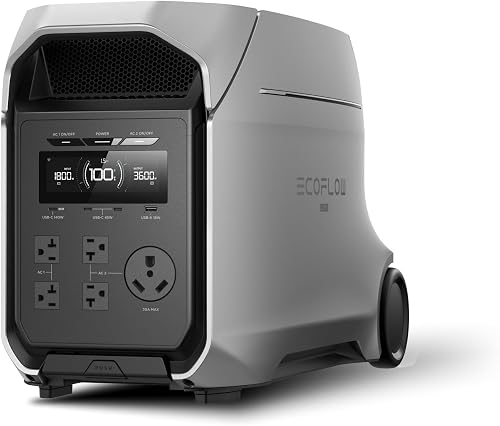
The BLUETTI Apex 300 is a 2,764.8 Wh station with 3,840 W of AC output, a TT-30 RV outlet, and a NEMA 14-50R outlet for 120/240V power. It suits home backup and RV owners who run heavy loads and want room to add batteries later.
This review draws on the makers’ published spec sheets for November 2026. PowerPicked Editorial did not test the Apex 300, so every claim below traces to those specs.
BLUETTI Apex 300
- Capacity
- 2,764.8 Wh
- AC output
- 3,840 W
- Solar input
- 2,400 W
- Weight
- 83.78 lb
Who it's for: Home backup and RV owners who want 240V output, a 50 A RV outlet, and room to add batteries.
Strengths
- 120/240V output through a NEMA 14-50R outlet
- Expands with up to 6 B300K batteries
- Two solar inputs, 2,400 W in total
Weaknesses
- USB and DC ports need the separate Hub D1
- Heavy at 83.78 lb
Who is the Apex 300 for?
The Apex 300 fits a household or RV that needs real 240V power from a portable box. Its NEMA 14-50R outlet delivers 120/240V at 50 A, and the TT-30R outlet covers a 30 A RV hookup. With 3,840 W of AC output, it can run several large appliances at once, where a 1 kWh or 2 kWh station would fall short.
It also fits buyers who plan to grow. The Apex 300 takes up to six B300K, B300S, or B300 batteries per unit, so capacity can rise well past the built-in 2,764.8 Wh. That makes it a starting point for a larger backup system rather than a fixed-size box.
The trade-off is size. At 83.78 lb, this is not a station you carry to a picnic table. It belongs in a garage, a utility room, or an RV bay, moved only when it has to move.
What does the Apex 300 do well?
Output is the headline. The 3,840 W rated output beats every 3 kWh rival in this guide, and BLUETTI lists lifting power of 7,680 W. Four 20 A outlets, a TT-30R, and a 14-50R give you six AC outlets in total, so heavy loads and ordinary plugs can share the same box.
Solar charging is strong too. Two solar inputs take in 2,400 W together, which is double the 1,200 W of the Elite 300. On a sunny day, that shortens the refill time for a big battery in a way a single 500 W input never could.
Charging from the wall is fast when Turbo Charging runs. BLUETTI lists 80% in about 45 minutes at 3,840 W of maximum input. With one to six B300K batteries attached, maximum input rises to 6,240 W.
The battery itself is built to last. It is LiFePO4, rated for 6,000 or more cycles to 80% of its original capacity. A five-year warranty covers the unit.
Two smaller details help. The Amazon listing says the Apex 300 can restart from solar or other sources with no power at all, which matters after a long outage drains it flat. The same listing describes silent operation at 22 dB, though it does not state the load.
What are its weak points?
The USB and DC ports are the weak spot. The two 100 W USB-C ports, the two 15 W USB-A ports, the car port, the DC5521 ports, and the Anderson port all need the Hub D1, which is rated at 700 W. Without that hub, you charge phones and laptops from the AC outlets instead, which wastes energy on small loads.
Weight is the second drawback. At 83.78 lb, the Apex 300 is the heaviest station in this review set by a wide margin. It has no handle or wheels listed in the reference files, so plan where it will live before it arrives.
Wall charging alone is slower than the Turbo figure suggests. The AC input tops out at 1,800 W, so the 45-minute figure depends on Turbo Charging at its full 3,840 W input, not on a wall outlet by itself.
How long does it run?
For the runtime math in this section, assume 85% of the listed capacity reaches your devices. That gives 2,350.08 Wh of usable energy from the listed 2,764.8 Wh. A 100 W load runs for about 23.5 hours on that energy.
Weight efficiency is modest for a station this size. Dividing 2,764.8 Wh by 83.78 lb gives about 33.0 Wh per pound. The Elite 300 packs more energy per pound, so the Apex 300 trades portability for output and expansion room.
How does the Apex 300 compare?
The two closest stations by capacity are the BLUETTI Elite 300 and the Jackery HomePower 3000. The rows for usable energy and runtime below count on 85% of the listed capacity.
| BLUETTI Apex 300 | BLUETTI Elite 300 | Jackery HomePower 3000 | |
|---|---|---|---|
| Capacity | 2,764.8 Wh | 3,014 Wh | 3,072 Wh |
| AC output | 3,840 W | 2,400 W | 3,600 W |
| Solar input | 2,400 W | 1,200 W | 1,000 W |
| Weight | 83.78 lb | 58 lb | 59.52 lb |
| Usable energy at 85% | 2,350.08 Wh | 2,561.9 Wh | 2,611.2 Wh |
| Runtime at 100 W | about 23.5 hours | about 25.6 hours | about 26.1 hours |
| Wh per pound | about 33.0 | about 52.0 | about 51.6 |
| Expansion | Up to 6 batteries | None | None |
The Apex 300 holds the least capacity of the three, but it puts out the most power and takes in the most solar. The Elite 300 is lighter and carries a TT-30 outlet plus a 12V/30 A DC port, and it needs no hub for its USB ports. Read the Elite 300 review for its full spec breakdown.
The HomePower 3000 sits between them on output at 3,600 W, with a 7,200 W surge rating and a 30 A outlet. Read the HomePower 3000 review to compare its limits. Neither rival takes extra batteries, so the Apex 300 is the only one of the three that grows.
How to choose
Pick the Apex 300 when you need 240V output, a 50 A RV outlet, or a system that can grow with extra batteries. Its 3,840 W output and 2,400 W of solar input suit heavy home backup loads.
Pick the Elite 300 when you want a lighter 3 kWh box with built-in USB and DC ports and no hub to buy. Pick the HomePower 3000 when you want 3,600 W of output with a 7,200 W surge rating in a simpler unit that takes no extra batteries.
Check the nameplate of each appliance you plan to run, and compare its rated and surge draw with the station’s output before you buy.
FAQ
Can the Apex 300 run a 240V appliance?
Yes. Its NEMA 14-50R outlet supplies 120/240V at 50 A, and total AC output is 3,840 W. Check the appliance nameplate first, since a 240V load above that output will not run.
Can I add batteries to the Apex 300?
Yes. It takes up to six B300K, B300S, or B300 batteries per unit. Maximum input rises to 6,240 W with one to six B300K batteries attached.
How fast does the Apex 300 charge?
Turbo Charging reaches 80% in about 45 minutes at up to 3,840 W of input. Wall charging alone tops out at 1,800 W, and the two solar inputs take in up to 2,400 W together.
Does the Apex 300 have USB ports built in?
No. Its USB-C, USB-A, car, DC5521, and Anderson ports all need the Hub D1, rated at 700 W. Without the hub, small devices charge from the AC outlets instead.