Best Power Station for Security Cameras
As an Amazon Associate I earn from qualifying purchases. Read our affiliate disclosure.
Top picks at a glance
 Best for cameras and a hubBLUETTI Elite 100 V2Check price on Amazon
 Best tiny camera backupAnker SOLIX C300Check price on Amazon
 Best for a fast rechargeEcoFlow DELTA 3 ClassicCheck price on Amazon
Security cameras and their hub must keep recording when the power drops, and the BLUETTI Elite 100 V2 switches to battery in 10 ms or less with 1,024 Wh behind it. The other two picks below are smaller or faster to recharge, so the right one depends on how many cameras you run and how long the outage lasts.
This guide is built on the makers’ published spec sheets for November 2026. PowerPicked Editorial did not test any station in it; each claim below comes from those sheets.
BLUETTI Elite 100 V2
- Capacity
- 1,024 Wh
- AC output
- 1,800 W
- Solar input
- 1,000 W
- Weight
- 25 lb
Who it's for: Campers and small-space buyers who want about 1 kWh and 1,800 W at around 25 lb.
Strengths
- 1,000 W solar input, full in about 70 minutes
- 80% AC charge in about 45 minutes
- Listed at 30 dB under 600 W
Weaknesses
- AC charging tops out at 1,200 W
- Holds less than BLUETTI's own AC180
What do security cameras need?
Switchover time matters first. A station with UPS mode sits between the wall outlet and the cameras, and when the wall power drops it must switch to battery fast enough that the cameras and their hub never reboot. A slow switch can leave a gap in the recording.
Capacity decides how long the cameras keep running. A bigger battery covers a longer outage, and solar input stretches the runtime when the sun is out. Temperature limits matter for an outdoor camera setup, so check the range in the spec sheet before you buy.
Read the nameplate on each camera and on the hub, and compare the rated draw with the station’s output before you buy.
BLUETTI Elite 100 V2
The Elite 100 V2 is the main pick for cameras and a hub. With 1,024 Wh inside and 1,800 W of output, it switches to battery in 10 ms or less. Noise is listed at 30 dB when the load stays under 600 W, so it suits a desk beside the hub.
Panels feed it at up to 1,000 W and fill it in about 70 minutes. A wall outlet fills it to 80% in about 45 minutes. The app runs over Wi-Fi and Bluetooth. At about 25 lb, it sits on a shelf beside the hub.
Its weak points are wall charging and capacity. A wall outlet feeds it at most 1,200 W, and it holds less than the AC180, its bigger BLUETTI sibling. For cameras and a hub alone, though, 1,024 Wh covers a long outage.
Anker SOLIX C300
- Capacity
- 288 Wh
- AC output
- 300 W
- Solar input
- 100 W
- Weight
- 9.1 lb
Who it's for: Campers and commuters who mainly charge phones, laptops, and cameras and want a small 9 lb box.
Strengths
- Two 140 W USB-C ports
- Rated 3,000+ cycles to 80%
- 10 ms UPS switchover
Weaknesses
- 300 W AC output limits what it can run
- Solar input tops out at 100 W
Anker SOLIX C300
The C300 is the tiny pick for one or two cameras. It holds 288 Wh at 9.1 lb, and it puts out 300 W with a 600 W surge. Its UPS switchover runs at 10 ms, and it has two USB-C ports at 140 W each. Its warranty runs five years.
It fits in a hand and hides on a shelf, which suits a small camera setup in a flat or a shed. Its 120 W car outlet covers 12V gear, and its app runs over Wi-Fi and Bluetooth.
Its weak points are capacity, output, and solar. At 288 Wh, it runs a 100 W load for only about 2.4 hours at 85% usable energy, and its 300 W output caps what it can run. Solar input is capped at 100 W, and no expansion is listed for it, so 288 Wh is the full capacity.
EcoFlow DELTA 3 Classic
- Capacity
- 1,024 Wh
- AC output
- 1,800 W
- Solar input
- 500 W
- Weight
- 26.7 lb
Who it's for: Buyers who want a 1 kWh home or camping unit that refills from the wall in about an hour.
Strengths
- 0-80% in 45 minutes on AC
- 10 ms UPS switchover
- LiFePO4 battery
Weaknesses
- Solar input tops out at 500 W
- Full 5-year warranty needs app registration
- Only one 18 W USB-A port
EcoFlow DELTA 3 Classic
The DELTA 3 Classic is the pick for a fast recharge. Inside it are 1,024 Wh, and output runs at 1,800 W, with X-Boost reaching 2,600 W. Switchover runs at 10 ms. AC power fills it to 80% in 45 minutes, with a full charge in 60 minutes, so it is ready again soon after a short outage.
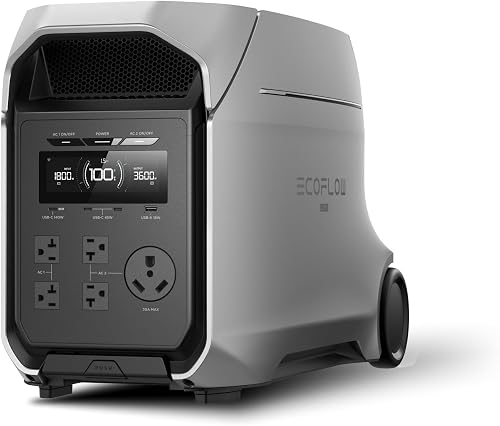
Listing photos show three AC outlets, enough for cameras, a hub, and a router. USB-C ports run at 100 W and 30 W, and a single USB-A port runs at 18 W. Warranty cover runs five years: three standard years and two more after app registration.
Its weak points are solar input and ports. Panels feed it at most 500 W, and a full charge from panels takes about 2.5 hours. The single USB-A port runs at 18 W.
How long will they run?
For the runtime math in this section, assume your devices can use 85% of the listed capacity. That works out to 870.4 Wh of usable energy from the listed 1,024 Wh of the Elite 100 V2. A 200 W load runs for about 4.4 hours on that energy.
| Elite 100 V2 | C300 | DELTA 3 Classic | |
|---|---|---|---|
| Capacity | 1,024 Wh | 288 Wh | 1,024 Wh |
| Usable energy at 85% | 870.4 Wh | 244.8 Wh | 870.4 Wh |
| Runtime at 100 W | about 8.7 hours | about 2.4 hours | about 8.7 hours |
| Wh per pound | about 41.0 | about 31.6 | about 38.4 |
| UPS switchover | 10 ms or less | 10 ms | 10 ms |
| Solar input | 1,000 W | 100 W | 500 W |
Cameras and a hub draw little, so the hours above understate how long the recording lasts. The two 1,024 Wh picks run a 100 W load for about 8.7 hours each, while the C300 runs it for about 2.4 hours.
How to choose
Go with the Elite 100 V2 for the strongest solar input and a 10 ms switchover for cameras and a hub. Pick the C300 when the setup is small and the station must hide on a shelf.
Go with the DELTA 3 Classic for the fastest wall recharge and three AC outlets. Whichever one you pick, leave it plugged in between the wall and the hub so the UPS switchover stays ready.
FAQ
Will my cameras keep recording through an outage?
Yes, when the station has UPS mode and enough capacity. All three picks here switch in 10 ms or less, so a brief cut does not reboot the cameras or the hub. Capacity decides how long the recording lasts.
How long will the cameras run on battery?
That depends on the draw of the cameras and the hub. At a 100 W load, the two 1,024 Wh picks run for about 8.7 hours at 85% usable energy, and the C300 runs for about 2.4 hours. Read the nameplate on each camera and on the hub to work out the hours for your setup.
Can solar keep the cameras going?
Yes, when the sun is out. The Elite 100 V2 takes up to 1,000 W of solar, the DELTA 3 Classic takes up to 500 W, and the C300 takes up to 100 W. Panels add runtime while the wall power stays down.
Do I need a big station for security cameras?
Not always. Cameras and a hub draw little, so a 1,024 Wh station covers a long outage. The C300 suits one or two cameras, while the Elite 100 V2 and the DELTA 3 Classic suit a full setup with a hub and a router.