Best Power Station for Overlanding
As an Amazon Associate I earn from qualifying purchases. Read our affiliate disclosure.
Top picks at a glance
 Best for overlandingAnker SOLIX C2000 Gen 2Check price on Amazon
 Best fast-charge overland boxEcoFlow DELTA 3 PlusCheck price on Amazon
 Best 2 kWh overland boxBLUETTI Elite 200 V2Check price on Amazon
An overland rig charges from the car and the sun, and the Anker SOLIX C2000 Gen 2 leads with a car input, an alternator input, and 2,048 Wh of capacity. The EcoFlow DELTA 3 Plus covers faster car charging, and the BLUETTI Elite 200 V2 covers stronger solar input.
This guide weighs the overlanding picks on the makers’ published specs, current in November 2026. PowerPicked Editorial did not test any overlanding pick here.
Wh is short for watt-hour, a unit of stored energy. Power is measured in watts. A watt is written W. AC output is the power for plug-in overland gear. Solar input sets the ceiling for panel power.
Anker SOLIX C2000 Gen 2
- Capacity
- 2,048 Wh
- AC output
- 2,400 W
- Solar input
- 800 W
- Weight
- 41.7 lb
Who it's for: Home backup and RV buyers who want 2 kWh and a TT-30 outlet in a box lighter than most 2 kWh stations.
Strengths
- 2,400 W rated, 4,000 W peak
- TT-30 RV outlet
- 10 ms UPS switchover
Weaknesses
- Solar input tops out at 800 W
- Expands to only 4,096 Wh with one battery
Why does the Anker SOLIX C2000 Gen 2 lead for overlanding?
The C2000 Gen 2 suits a home backup or RV buyer who wants 2 kWh and a TT-30 outlet in a box lighter than most 2 kWh stations. It gives 2,400 W rated, with a 4,000 W peak. A TT-30 RV outlet is on it. Its UPS switches over in 10 ms. Panels can send it up to 800 W. It grows to 4,096 Wh with one BP2000 battery. It lists two 140 W USB-C ports, a 15 W USB-C port, and a 12 W USB-A port. It also has a car socket at 12V/10 A. From AC, it fills in 88 minutes at 1,800 W. From solar, it fills in 3 hours at up to 800 W. AC and solar together fill it in 58 minutes. It takes a 100 W car input. An alternator charger can send up to 800 W. It is listed at 30 dB for noise. An app controls it over Wi-Fi and Bluetooth. Five years is the warranty listed. At 41.7 lb, it is heavy to carry.
Work from an assumed 85% of the listed capacity for the runtime numbers in this section. Usable energy is 1,740.8 Wh at 85% of the listed 2,048 Wh. It keeps a 100 W load going for about 17.4 hours. It holds 49.1 Wh for each pound: 2,048 Wh over 41.7 lb.
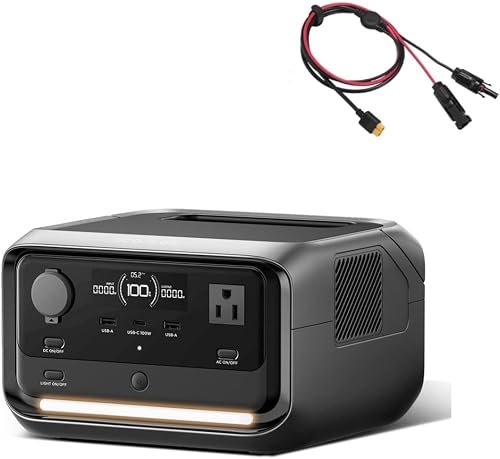
EcoFlow DELTA 3 Plus
- Capacity
- 1,024 Wh
- AC output
- 1,800 W
- Solar input
- 1,000 W
- Weight
- 27.6 lb
Who it's for: Campers and van owners who want fast recharging, strong solar input, and the option to add batteries later.
Strengths
- Expandable to 5 kWh
- 1,000 W of solar input
- Full charge in about 1.3 hours from an 800 W car source
Weaknesses
- Fast car charging needs a separate Alternator Charger
- 1 kWh base capacity is modest for full-time use
Is the EcoFlow DELTA 3 Plus a good overlanding pick?
It fills in about 1.3 hours, from an 800 W car source. Car charging fills it in about 1.3 hours from an 800 W source. Solar input runs to 1,000 W at most. Extra batteries grow it to 5 kWh. AC output is 1,800 W. It weighs 27.6 lb. Fast car charging needs the separate Alternator Charger. Its 1 kWh base is modest for full-time use.
Base the runtime numbers in this section on 85% of the listed capacity, assumed. Usable energy is 870.4 Wh at 85% of the listed 1,024 Wh. It gives a 100 W load about 8.7 hours. It holds 37.1 Wh for each pound: 1,024 Wh over 27.6 lb.
Look up the DELTA 3 Plus review at /guides/ecoflow-delta-3-plus-review/.
BLUETTI Elite 200 V2
- Capacity
- 2,073.6 Wh
- AC output
- 2,600 W
- Solar input
- 1,000 W
- Weight
- 53.4 lb
Who it's for: People who stay parked, run on solar, and don't need to carry their station far.
Strengths
- About 2 kWh in one unit
- 1,000 W of solar input
- LiFePO4 battery
Weaknesses
- Heavy to carry at 53.4 lb
- Car input is only 96 W on 12V or 192 W on 24V
Does the BLUETTI Elite 200 V2 suit overlanding?
It fits a person who stays parked, runs on solar, and does not need to carry the station far. Panels can send it up to 1,000 W. It puts out 2,600 W of AC. It holds 2,073.6 Wh. It weighs 53.4 lb. Car input runs at 96 W on 12V or 192 W on 24V. It uses a LiFePO4 battery.
In this section, take 85% of the listed capacity for the runtime numbers. Multiplying 2,073.6 Wh by 0.85 gives 1,762.6 Wh of usable energy. A 100 W load runs for about 17.6 hours from that energy. It holds 38.8 Wh for each pound: 2,073.6 Wh over 53.4 lb.
The Elite 200 V2 review can be read at /guides/bluetti-elite-200-v2-review/.
How to choose
Start with the car input your rig needs. Capacity sets how long the rig runs before a recharge. Solar input sets how fast panels refill the rig box. Weight decides how easy the station is to carry to the rig. A TT-30 outlet suits an RV that takes that plug.
FAQ
Which pick has a car input?
The C2000 Gen 2 and the Elite 200 V2 have car inputs. The DELTA 3 Plus fills from a car source with a separate Alternator Charger.
Which of the three stores the most energy?
The Elite 200 V2 leads on energy, at 2,073.6 Wh. The C2000 Gen 2 holds 2,048 Wh, and the DELTA 3 Plus holds 1,024 Wh.
Which of the picks is the lightest?
The DELTA 3 Plus is the lightest, at 27.6 lb. The C2000 Gen 2 weighs 41.7 lb, and the Elite 200 V2 weighs 53.4 lb.
Which pick takes the highest solar input?
The DELTA 3 Plus and the Elite 200 V2 each take the most solar input, at 1,000 W. The C2000 Gen 2 takes 800 W.