Best Power Station for a Microwave
As an Amazon Associate I earn from qualifying purchases. Read our affiliate disclosure.
Top picks at a glance
 Best for high-output cookingDJI Power 2000Check price on Amazon
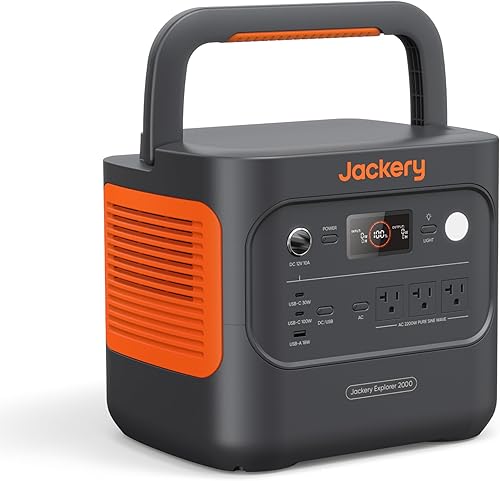 Best for a spare kitchen stationJackery Explorer 2000 v2Check price on Amazon
 Best for most microwavesAnker SOLIX C1000 Gen 2Check price on Amazon
The DJI Power 2000 is the best power station for a microwave. Its 3,000 W AC output is the highest of the three picks here, and its 2,048 Wh capacity gives a high-power kitchen device room to run. The Jackery Explorer 2000 v2 and the Anker SOLIX C1000 Gen 2 are the other picks, for buyers who want a lighter box or a smaller one.
This guide is built on the makers’ published specs, current in November 2026. PowerPicked Editorial did not test any of the stations in this guide.
A watt-hour, written Wh, counts stored energy. A watt, written W, counts power. AC output is the power for plug-in kitchen gear. Solar input is the top power a station can pull from panels.
Which station runs a microwave best?
| Spec | DJI Power 2000 | Jackery Explorer 2000 v2 | Anker SOLIX C1000 Gen 2 |
|---|---|---|---|
| Capacity | 2,048 Wh | 2,042 Wh | 1,024 Wh |
| AC output | 3,000 W | 2,200 W | 2,000 W |
| Weight | 48.5 lb | 39.5 lb | 24.9 lb |
The DJI leads on output and capacity, so it is the pick for a microwave that runs often. The Jackery is close on capacity with a little less output, and it is lighter at 39.5 lb. The C1000 Gen 2 is the smallest pick, with 1,024 Wh and 2,000 W, and it suits a buyer who runs a microwave briefly and values a 24.9 lb box.
DJI Power 2000
DJI Power 2000
- Capacity
- 2,048 Wh
- AC output
- 3,000 W
- Expansion
- Up to 22,528 Wh
- Weight
- About 48.5 lb
Who it's for: People who want high output from a 2 kWh station and may add batteries later.
Strengths
- 3,000 W output
- Takes up to 10 expansion batteries
- Rated to keep over 80% capacity after 4,000 cycles
Weaknesses
- Solar charging needs a separate DJI module or charger
- Heavy to carry at about 48.5 lb
The DJI suits buyers who want strong output from a 2 kWh station and may add batteries later. Its 3,000 W output is the highest here, and it takes up to 10 expansion batteries, growing to 22,528 Wh in total. Its cycle rating keeps over 80% capacity after 4,000 cycles.
The runtime numbers in this section assume 85% of the listed capacity. Usable energy comes to 1,740.8 Wh, from 2,048 Wh times 0.85. A 100 W load gets about 17.4 hours from that energy. Per pound, it holds about 42.2 Wh. That is 2,048 Wh over 48.5 lb.
The weak points are weight and solar. At about 48.5 lb, it is not light to carry. You need a separate DJI part to charge from panels. You can read the DJI Power 2000 review on its own at /guides/dji-power-2000-review/.
Jackery Explorer 2000 v2
Jackery Explorer 2000 v2
- Capacity
- 2,042 Wh
- AC output
- 2,200 W
- Surge
- 4,400 W
- Weight
- 39.5 lb
Who it's for: Households that want about 2 kWh one person can move, with no plans to expand.
Strengths
- About 2 kWh at 39.5 lb
- 4,400 W surge rating
- LFP battery
Weaknesses
- Heavier to move than 1 kWh models
- Not expandable
The Jackery suits a household that wants about 2 kWh one person can move. Its 2,200 W output is enough for a microwave, and its 4,400 W surge rating covers the short power spike when a device starts. Its battery is LFP.
Assume 85% of the listed capacity for the runtime numbers in this section. Usable energy is 1,735.7 Wh, from 2,042 Wh times 0.85. That amount gives a 100 W load about 17.4 hours. Each pound holds about 51.7 Wh, with 2,042 Wh over 39.5 lb.
The trade-offs are weight and growth. Moving it takes more effort than moving a 1 kWh model, and it takes no extra batteries.
Anker SOLIX C1000 Gen 2
Anker SOLIX C1000 Gen 2
- Capacity
- 1,024 Wh
- AC output
- 2,000 W
- Solar input
- 600 W
- Weight
- 24.9 lb
Who it's for: People who want about 1 kWh and 2,000 W in a portable box, and don't need to add batteries.
Strengths
- 49-minute full AC charge
- 2,000 W output, 3,000 W peak
- Rated to keep 80% capacity after 4,000 cycles
Weaknesses
- Not expandable
- Lower solar input than the DELTA 3 Plus
The C1000 Gen 2 suits buyers who want about 1 kWh and 2,000 W in a box they can carry, with no plans to add batteries. Its full AC charge takes 49 minutes, which is the fastest here. Its output is 2,000 W with a 3,000 W peak, and its cycle rating keeps 80% capacity after 4,000 cycles. Solar input is 600 W.
This part’s runtime numbers assume 85% of the listed capacity. Usable energy is about 870.4 Wh here, from 1,024 Wh times 0.85. That energy keeps a 100 W load going for about 8.7 hours. Per pound it carries about 41.1 Wh, from 1,024 Wh over 24.9 lb.
The limits are capacity and growth. At 1,024 Wh it holds about half the energy of the two larger picks, so it suits brief microwave use rather than long cooking sessions. It takes no extra batteries, and its solar input is lower than the DELTA 3 Plus.
How to choose
Start with AC output, since a microwave is a high-power device. All three picks here clear 2,000 W, with the DJI at 3,000 W. Next, check capacity. A 100 W load runs for about 17.4 hours on either 2 kWh pick and about 8.7 hours on the C1000 Gen 2, so a buyer who cooks often should pick the larger box. Then think about weight. The C1000 Gen 2 at 24.9 lb is the easiest to move, while the DJI at 48.5 lb suits a fixed spot in the kitchen. Finally, think about growth. Only the DJI takes extra batteries, so a buyer who may need more energy later should pick it.
FAQ
Can the C1000 Gen 2 run a microwave on its own?
Yes. Its AC output is 2,000 W with a 3,000 W peak, which covers a microwave. Its 1,024 Wh capacity suits brief use, and its full AC charge takes 49 minutes, so a refill is quick.
Which of the three runs a 100 W load the longest?
The DJI Power 2000 runs it the longest, at about 17.4 hours, from 2,048 Wh times 0.85. The Jackery Explorer 2000 v2 is close at about 17.4 hours from 2,042 Wh, while the C1000 Gen 2 gives about 8.7 hours.
Can I add batteries to the DJI Power 2000 later?
Yes. It takes up to 10 expansion batteries, growing to 22,528 Wh in total. That is the most growth of the three picks here, since the Jackery and the C1000 Gen 2 take no extra batteries.
Is the Jackery Explorer 2000 v2 light enough to move by hand?
Yes, one person can move it. It weighs 39.5 lb, which is lighter than the DJI at 48.5 lb, though it takes more effort to move than a 1 kWh model.


