Best Power Station for a Food Truck
As an Amazon Associate I earn from qualifying purchases. Read our affiliate disclosure.
Top picks at a glance
 Best for a food truckAnker SOLIX F3800 PlusCheck price on Amazon
 Best for 4 kWh capacityEcoFlow DELTA Pro 3Check price on Amazon
 Best for a smaller big boxBLUETTI Elite 300Check price on Amazon
A food truck needs a station with high output, a large capacity, and an outlet that fits a heavy load. The Anker SOLIX F3800 Plus is the best power station for a food truck.
This guide follows the makers’ published specs, current in November 2026. PowerPicked Editorial did not test any station named in this guide at all.
A watt-hour measures stored energy. It is written Wh. A watt is a measure of power. It is written W. AC output is the power for plug-in truck gear. Solar input limits the power panels can send a station.
How do the three picks compare?
| F3800 Plus | DELTA Pro 3 | Elite 300 | |
|---|---|---|---|
| Capacity | 3,840 Wh | 4 kWh | 3,014 Wh |
| AC output | 6,000 W | 4,000 W | 2,400 W |
The F3800 Plus has the highest AC output of the three. The DELTA Pro 3 has the largest capacity of the three. The Elite 300 has the lowest AC output of the three.
Why is the Anker SOLIX F3800 Plus the main pick?
Anker SOLIX F3800 Plus
- Capacity
- 3,840 Wh
- AC output
- 6,000 W
- Solar input
- 3,200 W
- Weight
- 136.7 lb
Who it's for: RV owners and homeowners with heavy or 240V loads who can keep a large unit in one place.
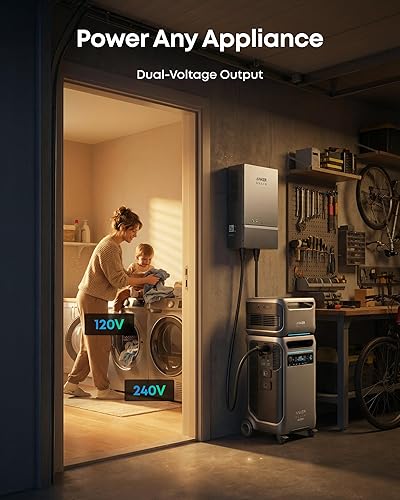
The photo also shows the Home Power Panel, which Amazon sells with this model in some listings. Check what's included before you buy.
Strengths
- 120V and 240V output
- TT-30 RV port
- Supports up to six 3.84 kWh expansion batteries
Weaknesses
- Very heavy at 136.7 lb, though it has wheels
- AC charging input is 1,800 W
The F3800 Plus is a large unit for an RV owner or homeowner with heavy or 240V loads, kept in one place. It gives 120V and 240V output, and it has a TT-30 RV port.
Assume 85% of the listed capacity for the runtime numbers here. 3,264.0 Wh is the usable energy, from 3,840 Wh times 0.85. A 100 W load gets about 32.6 hours of runtime from that energy. Weight works out to about 28.1 Wh per pound, from 3,840 Wh over 136.7 lb.
It takes up to six extra 3.84 kWh battery packs. Its AC charging input is 1,800 W. It is very heavy at 136.7 lb, though wheels help move it.
Find the F3800 Plus review at /guides/anker-solix-f3800-plus-review/.
Does the EcoFlow DELTA Pro 3 offer more capacity?
EcoFlow DELTA Pro 3
- Capacity
- 4 kWh
- AC output
- 4,000 W
- Voltage
- 120V and 240V
- Expansion
- Up to 12 kWh per unit
Who it's for: Homeowners who want 120V and 240V backup and may add batteries over time.
Strengths
- Expands to 12 kWh on one unit, more as a multi-unit system
- 120V and 240V output
- Rated to keep 80% capacity after 4,000 cycles
Weaknesses
- Lower continuous output than the F3800 Plus
- More capacity than small essential loads need
The DELTA Pro 3 suits a homeowner who wants 120V and 240V backup, with room to add batteries over time. It holds 4 kWh, and it can grow to 12 kWh as a single unit, and more with extra units.
In this part, the runtime math assumes 85% of the listed capacity. 3,400 Wh is the usable energy, from 4 kWh times 0.85. On that energy, a 100 W load runs about 34.0 hours.
Its AC output is 4,000 W, lower than the F3800 Plus. The listing says it keeps 80% of its capacity after 4,000 cycles. Its capacity is more than small essential loads need, and small essential loads need less capacity than it holds.
The DELTA Pro 3 review sits at /guides/ecoflow-delta-pro-3-review/.
Does the BLUETTI Elite 300 suit a smaller big box?
BLUETTI Elite 300
- Capacity
- 3,014 Wh
- AC output
- 2,400 W
- Solar input
- 1,200 W
- Weight
- 58 lb
Who it's for: RV owners and home backup buyers who want about 3 kWh with a TT-30 outlet, without adding batteries.
Strengths
- Built-in TT-30 RV outlet and 12V/30 A DC port
- 1,200 W solar input
- Rated for 6,000+ cycles to 80%
Weaknesses
- Can't add expansion batteries
- Heavy to carry at about 58 lb
The Elite 300 suits an RV owner or home backup buyer who wants about 3 kWh, a TT-30 outlet, and no extra batteries to add. It has a built-in TT-30 RV outlet and a 12V/30 A DC port.
In this part, the runtime figures assume 85% of the listed capacity. From 3,014 Wh times 0.85, usable energy is 2,561.9 Wh. A 100 W load gets about 25.6 hours from that amount. Weight works out to about 52.0 Wh per pound, from 3,014 Wh over 58 lb.
Its USB-C ports are 100 W and 140 W. It is rated for 6,000+ cycles to 80%. AC charging is 1,800 W, full in about 2 hours. Solar input is up to 1,200 W, full in about 4.1 hours. UPS switchover is 10 ms or less. It cannot link extra batteries. At about 58 lb, carrying it is hard work.
Find the Elite 300 review at /guides/bluetti-elite-300-review/.
How to choose
Pick the station with the output your truck gear needs. A 240V load needs a station that lists 240V output. A TT-30 outlet fits an RV-style plug. Capacity sets how long the station can run before it needs a charge. A heavier station stays in one place, while a lighter one is easier to move. Expansion lets a station grow with more batteries.
FAQ
Which pick stores the most energy here?
The DELTA Pro 3 stores the most energy, at 4 kWh. The F3800 Plus stores 3,840 Wh. The Elite 300 stores 3,014 Wh.
Which pick here offers the highest AC output?
The F3800 Plus offers the highest AC output, at 6,000 W. The DELTA Pro 3 offers 4,000 W. The Elite 300 offers 2,400 W.
Can the F3800 Plus grow with extra batteries?
Yes. It accepts up to six extra 3.84 kWh battery packs. The DELTA Pro 3 can grow to 12 kWh as a single unit. The Elite 300 cannot link extra batteries.
Which pick here weighs the least?
The Elite 300 weighs the least, at about 58 lb. The F3800 Plus weighs 136.7 lb. The DELTA Pro 3 does not list a weight.