Best Power Station for a Dehumidifier
As an Amazon Associate I earn from qualifying purchases. Read our affiliate disclosure.
Top picks at a glance
 Best for a big basementAnker SOLIX F3800 PlusCheck price on Amazon
 Best for whole-home coverEcoFlow DELTA Pro 3Check price on Amazon
 Best quiet basement pickEcoFlow DELTA 3 MaxCheck price on Amazon
A dehumidifier in a damp basement after a storm needs steady output, enough capacity to run for hours, and UPS cover when the power blips, and the Anker SOLIX F3800 Plus brings 6,000 W of output with 3,840 Wh behind it. The other two picks below trade size for output or for quiet running, so the right one depends on the basement and the size of the unit.
The makers’ published spec sheets for November 2026 form the ground for this guide. PowerPicked Editorial did not run any station in this guide, so each claim below comes from those sheets.
Anker SOLIX F3800 Plus
- Capacity
- 3,840 Wh
- AC output
- 6,000 W
- Solar input
- 3,200 W
- Weight
- 136.7 lb
Who it's for: RV owners and homeowners with heavy or 240V loads who can keep a large unit in one place.
The photo also shows the Home Power Panel, which Amazon sells with this model in some listings. Check what's included before you buy.
Strengths
- 120V and 240V output
- TT-30 RV port
- Supports up to six 3.84 kWh expansion batteries
Weaknesses
- Very heavy at 136.7 lb, though it has wheels
- AC charging input is 1,800 W
What does a dehumidifier need?
A dehumidifier runs for hours at a steady draw, so capacity decides how long it keeps a basement dry. Rated output must cover the unit at every point, including startup. UPS mode matters after a storm, when the power can blip and the dehumidifier must keep running without a restart. Expansion matters when one battery is not enough for a long, damp spell.
Read the nameplate on your dehumidifier and compare its rated and surge draw with each station’s rated and surge output before you buy.
Anker SOLIX F3800 Plus
The F3800 Plus is the main pick for a big basement. It holds 3,840 Wh and puts out 6,000 W, the highest output of the three picks. Its 120V and 240V output covers large appliances, and its TT-30 RV port suits a 30 A hookup. Up to six extra batteries of 3.84 kWh each fit it, so capacity can grow far past the built-in 3,840 Wh.
Its solar input runs at 3,200 W, the highest of the three picks, so panels refill it fast on a sunny day. It has wheels, which help at 136.7 lb, though it still belongs in one place.
Its weak points are weight and AC charging. At 136.7 lb, it is the heaviest pick here by a wide margin. Its AC charging input is 1,800 W, which is slow for a battery this size.
EcoFlow DELTA Pro 3
- Capacity
- 4 kWh
- AC output
- 4,000 W
- Voltage
- 120V and 240V
- Expansion
- Up to 12 kWh per unit
Who it's for: Homeowners who want 120V and 240V backup and may add batteries over time.
Strengths
- Expands to 12 kWh on one unit, more as a multi-unit system
- 120V and 240V output
- Rated to keep 80% capacity after 4,000 cycles
Weaknesses
- Lower continuous output than the F3800 Plus
- More capacity than small essential loads need
EcoFlow DELTA Pro 3
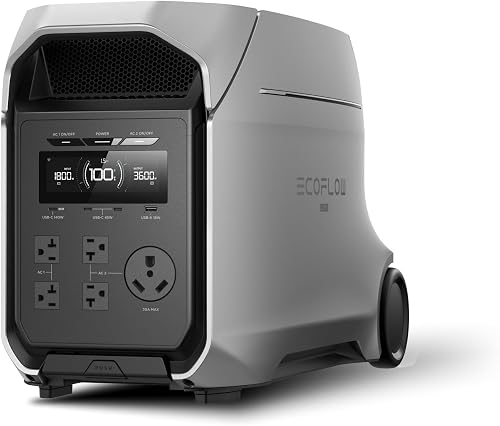
The DELTA Pro 3 is the pick for whole-home cover. It holds 4 kWh, the most of the three picks, and puts out 4,000 W with 120V and 240V output. One unit grows to 12 kWh, and more as a multi-unit system. After 4,000 cycles it still keeps 80% of its capacity, by the rating.
Its 4,000 W output covers a dehumidifier with room to spare, and its 12 kWh expansion covers a long, damp spell without a wall outlet.
Its weak point is capacity. It holds more than small essential loads need, so buyers with a single dehumidifier may not need all 4 kWh.
EcoFlow DELTA 3 Max
- Capacity
- 2,048 Wh
- AC output
- 2,400 W
- Solar input
- 500 W
- Weight
- 44.7 lb
Who it's for: Home backup buyers who want 2 kWh with 20 A outlets in a quiet box.
Strengths
- 2,048 Wh with 2,400 W output
- 25 dB at 600 W (maker's test)
- Under 10 ms UPS switchover
Weaknesses
- Solar input only 500 W for a 2 kWh battery
- 0-80% takes 68 minutes on AC
- Heavy at 44.7 lb
EcoFlow DELTA 3 Max
The DELTA 3 Max is the pick for a quiet basement. It carries 2,048 Wh and 2,400 W of output, with X-Boost to 3,400 W. Switchover runs in under 10 ms. The maker’s test puts it at 25 dB or less at 600 W.
Four 120V outlets run at 20 A at most each. USB-C ports charge at 100 W and 30 W, and one USB-A port charges at 18 W. It carries a five-year warranty, with three years standard and two more after app registration.
Its weak points are solar input, charging time, and expansion. Its solar input stays at 500 W despite the 2 kWh battery. It needs 68 minutes on AC power to reach 80%. No expansion battery is listed for it.
How long will they run?
For the runtime math in this section, assume 85% of the listed capacity powers your devices. That gives 3,400 Wh of usable energy from the listed 4 kWh of the DELTA Pro 3. A 50 W load runs for about 68.0 hours on that energy.
| F3800 Plus | DELTA Pro 3 | DELTA 3 Max | |
|---|---|---|---|
| Capacity | 3,840 Wh | 4 kWh | 2,048 Wh |
| Usable energy at 85% | 3,264 Wh | 3,400 Wh | 1,740.8 Wh |
| Runtime at 100 W | about 32.6 hours | about 34.0 hours | about 17.4 hours |
| Wh per pound | about 28.1 | not listed | about 45.8 |
| AC output | 6,000 W | 4,000 W | 2,400 W |
| Solar input | 3,200 W | not listed | 500 W |
The DELTA Pro 3 runs a 100 W load the longest of the three, at about 34.0 hours. The F3800 Plus runs it for about 32.6 hours, and the DELTA 3 Max runs it for about 17.4 hours. A dehumidifier draws more while it runs, so the hours above overstate how long it keeps a basement dry.
How to choose
Pick the F3800 Plus when you want the highest output, the strongest solar input, and room to add up to six batteries. Pick the DELTA Pro 3 when you want the most capacity with 240V output and expansion to 12 kWh.
Pick the DELTA 3 Max when you want a lighter, quieter box with the fastest UPS switchover. Read the nameplate on your dehumidifier first, then match its rated and surge draw against the station’s output.
FAQ
Can a power station run a dehumidifier?
Yes, within its output limit. The F3800 Plus puts out 6,000 W, the DELTA Pro 3 puts out 4,000 W, and the DELTA 3 Max puts out 2,400 W. Add up the rated draw of the dehumidifier and keep it under the station’s output.
How long will a dehumidifier run on battery?
That depends on the dehumidifier’s draw. At a 100 W load, the DELTA Pro 3 runs for about 34.0 hours at 85% usable energy, the F3800 Plus runs for about 32.6 hours, and the DELTA 3 Max runs for about 17.4 hours. Read the nameplate on your dehumidifier to work out the hours for your unit.
Does UPS mode matter for a dehumidifier?
Yes, after a storm. A station with UPS mode switches to battery in milliseconds when the wall power drops, so the dehumidifier keeps running without a restart. The DELTA 3 Max switches in under 10 ms.
Which station here takes extra batteries?
The F3800 Plus takes up to six extra batteries. The DELTA Pro 3 grows to 12 kWh on one unit.