Anker SOLIX PS400 Review: Reading the Spec Sheet
As an Amazon Associate I earn from qualifying purchases. Read our affiliate disclosure.
At a glance
 Best 400 W single panelAnker SOLIX PS400Check price on Amazon
The Anker SOLIX PS400 suits a vehicle-based user who wants 400 W from one panel and has a station with enough voltage headroom. It gives 400 W from a single panel, so one panel does the work of two.
This review works from the makers’ published specs, current in November 2026. PowerPicked Editorial did not test the PS400.
A watt counts power, written W. Rated power is the highest figure a panel lists in its spec table. Open-circuit voltage is the voltage a panel shows with no load. IP67 means dustproof, and safe from short dips in water.
Anker SOLIX PS400
- Rated power
- 400 W
- Open-circuit voltage
- 57.6 V
- Water rating
- IP67
- Weight
- 35.3 lb
Who it's for: Vehicle-based users who want 400 W from one panel and have a station with enough voltage headroom.
Strengths
- 400 W from a single panel
- Less setup than linking two panels
Weaknesses
- Heavy at 35.3 lb
- 57.6 V is close to a 60 V input limit
What does the Anker SOLIX PS400 give you?
Maximum output is 400 W, all from one panel. Open-circuit voltage is 57.6 V, with an operating voltage of 48 V and an operating current of 8.33 A. The cells are monocrystalline, with up to 23% conversion efficiency.
It weighs 35.3 lb. Folded, it measures 39 by 26.6 by 2 in. Unfolded, it stretches 100 by 39 by 1.2 in. The stand tilts to 30, 40, 50, or 80 degrees.
Water rating is IP67. Anker says to cover the MC4 ports with the rubber plug before rain or water. It works with stations that accept up to 60 V and have an MC4 input.
At 57.6 V, its open-circuit voltage sits close to a 60 V input limit.
How does the Anker SOLIX PS400 compare?
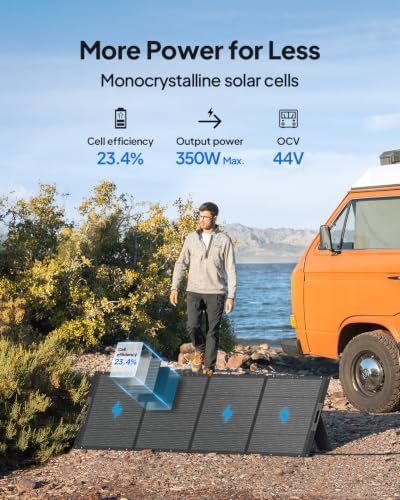
The two closest panels by rated power are the BLUETTI PV350 and the EcoFlow 220W Bifacial, at 350 W and 220 W.
| Anker SOLIX PS400 | BLUETTI PV350 | EcoFlow 220W Bifacial | |
|---|---|---|---|
| Rated power | 400 W | 350 W | 220 W front, 175 W rear |
| Open-circuit voltage | 57.6 V | 44 V | 21.5 V |
| Water rating | IP67 | IP65 or IP67 | IP68 |
| Weight | 35.3 lb | 32.4 lb | about 15.4 lb |
| Efficiency | up to 23% | up to 23.4% | 25% |
The PS400 gives the most power of the three, at 400 W, and it is also the heaviest, at 35.3 lb. The PV350 is close on power, at 350 W, and close on weight, at 32.4 lb. The EcoFlow panel is the lightest, at about 15.4 lb, and the most efficient, at 25%.
How to choose
Check the rated power against what your station takes. Check the open-circuit voltage against your station’s input limit. Weight decides how easy the panel is to move to a sunny spot. A water rating suits a panel that stays outside. A stand with more angles suits uneven ground. A single panel suits a user who wants less setup.
FAQ
Does the PS400 work with any station?
Only stations that accept up to 60 V and have an MC4 input.
Is it heavy to carry?
It weighs 35.3 lb, and it folds to 39 by 26.6 by 2 in.
What angles does the stand give?
30, 40, 50, or 80 degrees.
Can it get wet?
It is rated IP67, and Anker says to cover the MC4 ports with the rubber plug before rain or water.