Anker SOLIX F3800 Plus vs. Jackery HomePower 3000
As an Amazon Associate I earn from qualifying purchases. Read our affiliate disclosure.
Top picks at a glance
 Best for 240V and whole-home plansAnker SOLIX F3800 PlusCheck price on Amazon
 Best for 3 kWh you can still moveJackery HomePower 3000Check price on Amazon
These two answer different home-backup questions. The Anker SOLIX F3800 Plus is the pick if you need 240V for a well pump or a dryer circuit, or want to build up to many kilowatt-hours of storage over time. The Jackery HomePower 3000 is the pick if 3 kWh at 120V covers your outage plan and you want a station that weighs well under half as much.
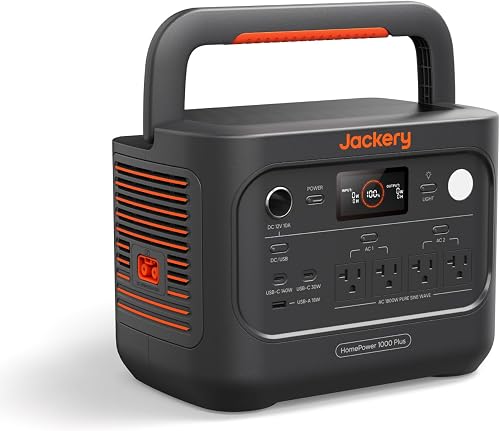
Our sources are Anker’s and Jackery’s US spec pages, our earlier F3800 Plus review, and one Jackery listing photo, all checked in November 2026. We have not set up either station, so treat this as a reading of published numbers.
Anker SOLIX F3800 Plus: the system builder
Anker SOLIX F3800 Plus
- Capacity
- 3,840 Wh
- AC output
- 6,000 W
- Solar input
- 3,200 W
- Weight
- 136.7 lb
Who it's for: RV owners and homeowners with heavy or 240V loads who can keep a large unit in one place.
The photo also shows the Home Power Panel, which Amazon sells with this model in some listings. Check what's included before you buy.
Strengths
- 120V and 240V output
- TT-30 RV port
- Supports up to six 3.84 kWh expansion batteries
Weaknesses
- Very heavy at 136.7 lb, though it has wheels
- AC charging input is 1,800 W
The F3800 Plus is close to a home battery on wheels. It holds 3,840 Wh of LFP rated for 3,000+ cycles, and Anker lists room for as many as six 3.84 kWh add-on batteries. It delivers 6,000 W at both 120V and 240V, and adds a NEMA TT-30 RV port rated for 3,000 W.
Solar input is its other strength: 3,200 W across two ports, more than three times the Jackery’s limit. That is well above its 1,800 W AC input, so a large array can refill it faster than a wall outlet. Anker lists a 5-year warranty.
The weak points are size and grid charging. It weighs 136.7 lb and measures 27.6 × 15.3 × 15.6 in with its wheels, so it needs a permanent spot. AC charging input tops out at 1,800 W, and its UPS switchover is listed at 20 ms on a 120V wall outlet. Some Amazon listings bundle a Home Power Panel, so check what’s included.
Jackery HomePower 3000: the compact 3 kWh
Jackery HomePower 3000
- Capacity
- 3,072 Wh
- AC output
- 3,600 W
- Solar input
- 1,000 W
- Weight
- 59.52 lb
Who it's for: Home backup buyers who want 3 kWh and a 30 A outlet without adding battery packs.
Strengths
- 3,072 Wh at 59.52 lb
- 3,600 W output, 7,200 W surge
- 30 A outlet rated 3,600 W
Weaknesses
- Can't add expansion batteries
- AC charging takes 2.2 hours
- Bypass mode limited to 1,440 W
The HomePower 3000 fits 3,072 Wh of LiFePO4 into 59.52 lb and a 16.4 x 12.8 x 12 in box. It puts out 3,600 W in total with a 7,200 W surge peak. You get four 120 V 20 A outlets and one 120 V 30 A outlet rated 3,600 W, which Jackery’s listing photo shows as a TT-30 RV port. Two 100 W USB-C ports and two USB-A ports handle small devices.
It discharges down to 5°F and switches to battery within 20 ms. Its two 8 mm inputs accept 1,000 W of solar combined. The warranty is 3+2 years, or 5 years when bought from Jackery.com.
Its limits are firm. Jackery says it can’t connect extra batteries, so 3,072 Wh is the ceiling. It has no 240V output, AC charging takes 2.2 hours, and bypass mode is limited to 1,440 W. Its cycle rating is 4,000 cycles to 70%+ capacity.
How do the specs compare?
| SOLIX F3800 Plus | HomePower 3000 | |
|---|---|---|
| Capacity | 3,840 Wh | 3,072 Wh |
| Expansion | Up to six 3.84 kWh batteries | None |
| Battery | LFP, 3,000+ cycles | LiFePO4, 4,000 cycles to 70%+ |
| AC output | 6,000 W | 3,600 W, 7,200 W surge |
| Voltage | 120V and 240V | 120 V |
| RV port | NEMA TT-30, 3,000 W max | TT-30, 3,600 W |
| Solar input | 3,200 W | 1,000 W |
| AC charging | 1,800 W max input | Full in 2.2 hours |
| UPS switchover | 20 ms | Within 20 ms |
| Weight | 136.7 lb | 59.52 lb |
| Warranty | 5 years | 3+2 years |
What does each one deliver for its weight?
With 85% of capacity assumed to reach your appliances, the F3800 Plus gives about 3,264 Wh and the HomePower 3000 about 2,611.2 Wh. A steady 500 W load would run about 6.5 hours against about 5.2 hours. Add up the watts on your own appliance labels to see where you land.
The weight story is lopsided. The HomePower 3000 stores about 51.6 Wh per lb, and the F3800 Plus about 28.1 Wh per lb. The Anker is 77.18 lb heavier, and much of that goes to 240V output, wheels, and higher power limits.
How to choose
- 240V appliances: only the F3800 Plus has 240V output.
- Several days of backup in the future: the F3800 Plus expands; the HomePower 3000 can’t.
- Big solar array: the F3800 Plus takes 3,200 W, the HomePower 3000 takes 1,000 W.
- You need to lift it into a vehicle or up stairs: the HomePower 3000 weighs 59.52 lb.
- RV hookup: both have a TT-30 port; the Jackery’s is rated higher, at 3,600 W against 3,000 W.
FAQ
Does the Jackery HomePower 3000 have 240V output?
No. The Jackery HomePower 3000 lists 120 V outlets only, including one 30 A outlet rated 3,600 W. The Anker SOLIX F3800 Plus offers both 120V and 240V output.
Can I add batteries to the Jackery HomePower 3000?
No. Jackery says the HomePower 3000 can’t connect extra batteries, so it stays at 3,072 Wh. The Anker SOLIX F3800 Plus can take as many as six 3.84 kWh add-on batteries.
How much heavier is the Anker SOLIX F3800 Plus?
The Anker SOLIX F3800 Plus weighs 136.7 lb and the Jackery HomePower 3000 weighs about 59.52 lb, a gap of 77.18 lb. The Anker has wheels to help move it.
Which one has a better RV port?
Both have a TT-30 port. Jackery rates the HomePower 3000’s 30 A outlet at 3,600 W, and Anker lists the F3800 Plus’s TT-30 port at 3,000 W max.